Study Findings: Lunar Surface and Subsurface Water Revealed by Chang’e-6

Image (Credit): Artist’s rendering of the Chang’e-6 probe. (China Daily)

Nature Astronomy abstract of the study findings:

The processes driving the formation and distribution of lunar water (OH/H2O), particularly in the subsurface, remain poorly understood. An opportunity to study subsurface water comes from lander plumes, which can displace and expose millimetre- to centimetre-sized regolith during the descent of the lander. Here we analyse data from the Chang’e-6 landing site and find that plume-disturbed areas exhibit distinct temperature and water-content patterns, which are driven by the redistribution of fine regolith. The average water content of the exposed fine regolith of the shallow subsurface is ~76 ppm, which is lower than the surface abundance of ~105 ppm measured at the surface. The Chang’e-6 landing site also contains on average approximately twice the water content than the Chang’e-5 one. Temporal variations of water content are observed at identical locations but different local times, exhibiting a minimum at local noon. We suggest that the differences in water content are correlated with the regolith glass abundance, particle sizes, depths and local times, reinforcing the hypothesis that solar wind implantation and impact gardening govern lunar water formation and distribution.

Citation: Liu, B., Zeng, X., Xu, R. et al. Lunar surface and subsurface water revealed by Chang’e-6. Nat Astron (2025).

https://doi.org/10.1038/s41550-025-02668-7

Study-related story:

Chinese Academy of Sciences – “Chang’e-6 Probe Data Reveal Water Distribution on Moon”
NASA Moves Away from an ISS Cargo Contractor

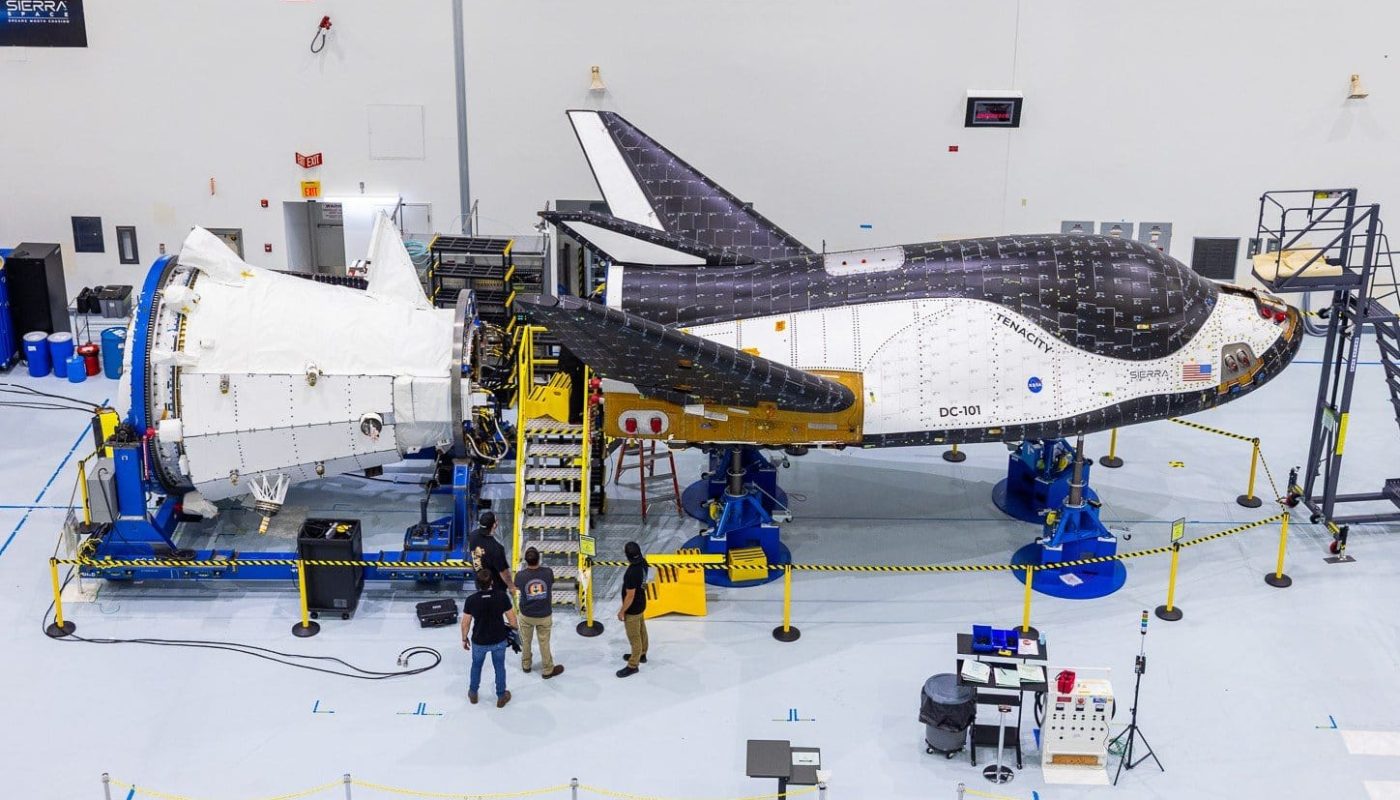
Image (Credit): The Dream Chaser and Shooting Star Cargo Module. (Sierra Space)

Back in 2016 NASA was looking for more commercial cargo haulers for its International Space Station (ISS), and Sierra Space’s reusable Dream Chaser spaceplane was one of those options. NASA contracted for multiple resupply missions to the ISS. However, all of that is now over.

NASA has announced that the contract has been modified so that Sierra Space is only to provide a “free flight demonstration” in 2026. What that means is that NASA will give the company a chance to prove its technology, but it will stop financing these efforts. And NASA will not commit to any future resupply missions, but may choose to do so at a later point.

It sounds like quite a gut-punch to another commercial option for the ISS at the same time that Boeing’s Starliner is still limping along. That leaves SpaceX and Northrop Grumman as the only players on the field as the station heads towards it decommissioning in 2030.

Sierra Space can certainly pursue other commercial space opportunities, which is expected to include commercial space stations at some point in the future. Even so, it appears NASA has lost confidence in the company’s ability to deliver on earlier promises related to the ISS.

In a recent press release, the company has put the most positive spin it can on this new arrangement:

Sierra Space is prioritizing first-flight readiness with Dream Chaser, targeting a launch in late 2026 to align with expected launch vehicle availability. Sierra Space and NASA worked together to reach this mutually beneficial agreement that provides greater mission flexibility for Dream Chaser’s first flight. This flight aims to demonstrate critical capabilities for NASA’s ISS resupply and future Commercial LEO Destinations (CLD) missions and position Dream Chaser as a national asset available for future national security and defense demonstrations.

Sierra Space has many other ongoing projects under a variety of government and private sector contracts, including NASA. For instance, it signed a contract with NASA earlier this year to study the use of the company’s expandable space station technology on the Moon.

So the company will be staying busy even after this latest setback. That said, getting the Dream Chaser into orbit on schedule has to remain a key priority for a company that want’s to be a big player in the space race ahead.

A Day in Astronomy: Luna 16 Lunar Sample Return

Image (Credit): USSR postage stamp commemorating the Luna 16 mission. (USSR Post)

On this day in 1970, the USSR’s Luna 16 spacecraft returned to Earth with a lunar sample. The Luna 16 spacecraft landed on the Moon on September 20 to collect a 3.5 ounce sample before returning to Earth.

While the Apollo 11 and 12 missions had already returned with more than 120 pounds of lunar material, it was still an important milestone for the USSR’s space program. Two more Luna missions would bring back additional lunar samples in the 1970s.

The Russian’s last attempt to send a spacecraft to study the Moon’s surface was in 2023 with Luna 25, which ended in failure.

Space Stories: Artemis II to Launch February 2026, 10 New Astronauts Selected, and Plans to Destroy an Incoming Asteroid

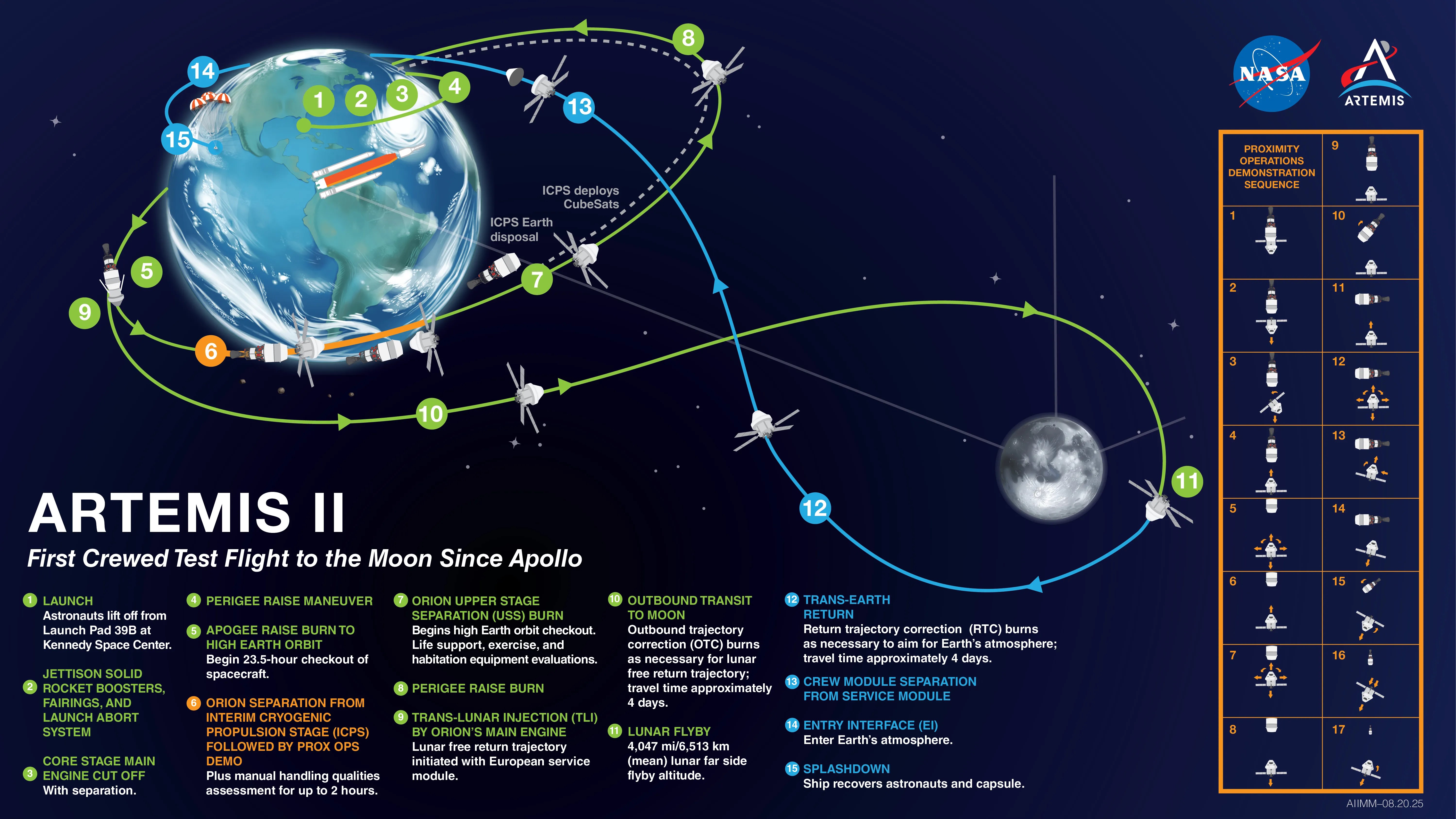
Image (Credit): Artemis II mission map. (NASA)

Here are some recent space-related stories of interest.

BBC News: Nasa Plans First Crewed Moon Mission in 50 years for February 2026

Nasa has said it hopes to send astronauts on a ten-day trip around the Moon as soon as February. The US space agency had previously committed to launching no later than the end of April but said it aims to bring the mission forward…Artemis Launch Director, Charlie Blackwell-Thompson explained that the powerful rocket system built to take the astronauts to the Moon, the Space Launch System (SLS) was “pretty much stacked and ready to go”. All that remained was to complete the crew capsule, called Orion, connected to SLS and to complete ground tests.

CNN: NASA Selects 10 New Astronauts as it Chases Bold Plans for the Moon and Mars

NASA on Monday introduced the 10 people — selected from a pool of 8,000 applicants — who will join the agency’s astronaut corps as it races to return to the moon before attempting an unprecedented crewed mission to Mars. The group includes six women and four men, whom acting NASA Administrator Sean Duffy called “America’s best and brightest.”…This astronaut class marks the first in which there are more women than men, according to NASA.

IFLScience: “Forget Saving Earth, NASA Wants Us To Save The Moon From Asteroid 2024 YR4

A large asteroid strike on the Moon could have negative consequences for the artificial satellites we now depend on. That being the case, a NASA-led team has looked into the options for preventing Asteroid 2024 YR4 from making such an impact in 2032. Contrary to the usual conclusions that asteroids should be diverted, not destroyed, they think this is a time for a Hollywood-approved demolition event.

Space Quote: SpaceX Delays May Sink Efforts to Beat China to the Moon

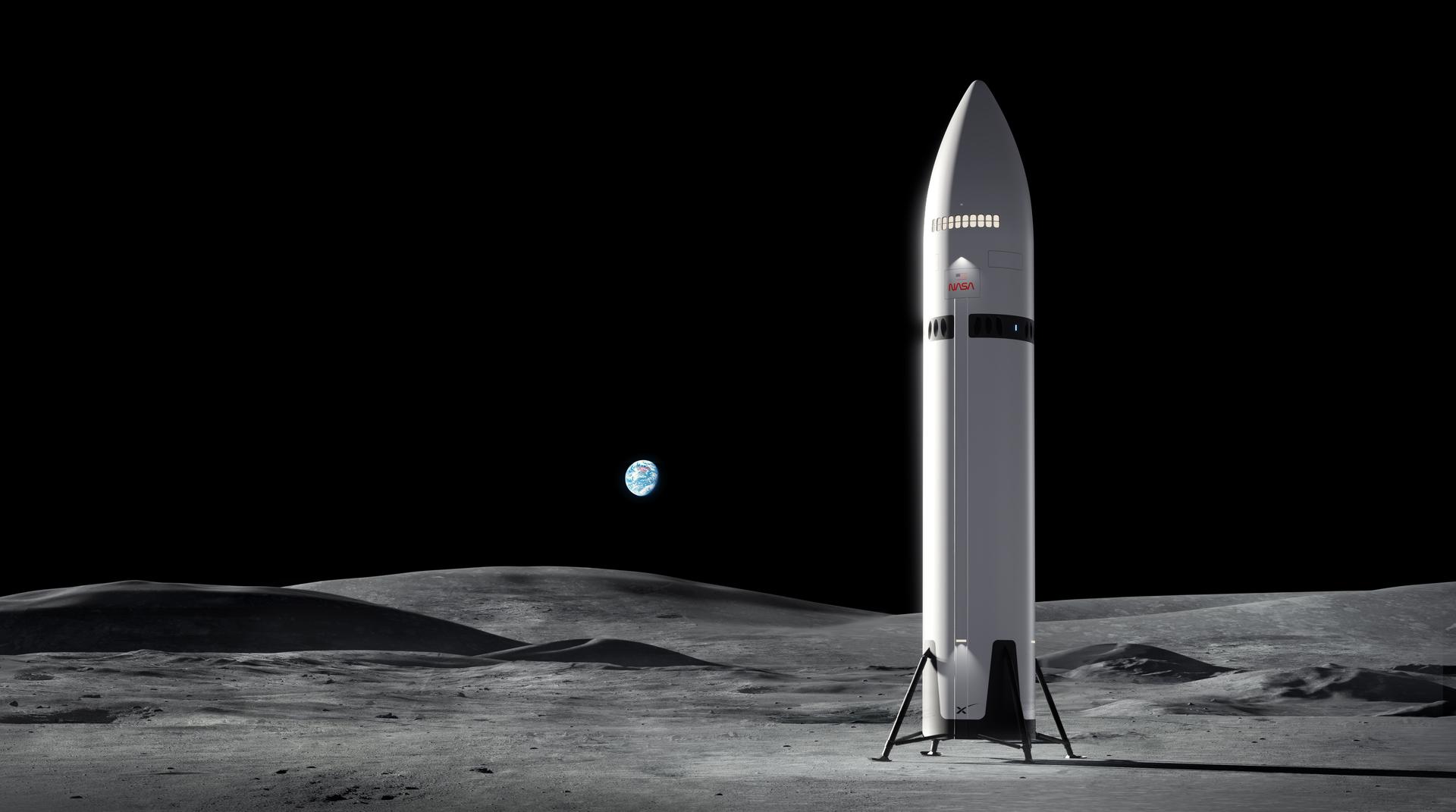
Image (Credit): Artist’s rendering of SpaceX’s Starship HLS on the Moon. (SpaceX)

“The HLS schedule is significantly challenged and, in our estimation, could be years late for a 2027 Artemis 3 moon landing.”

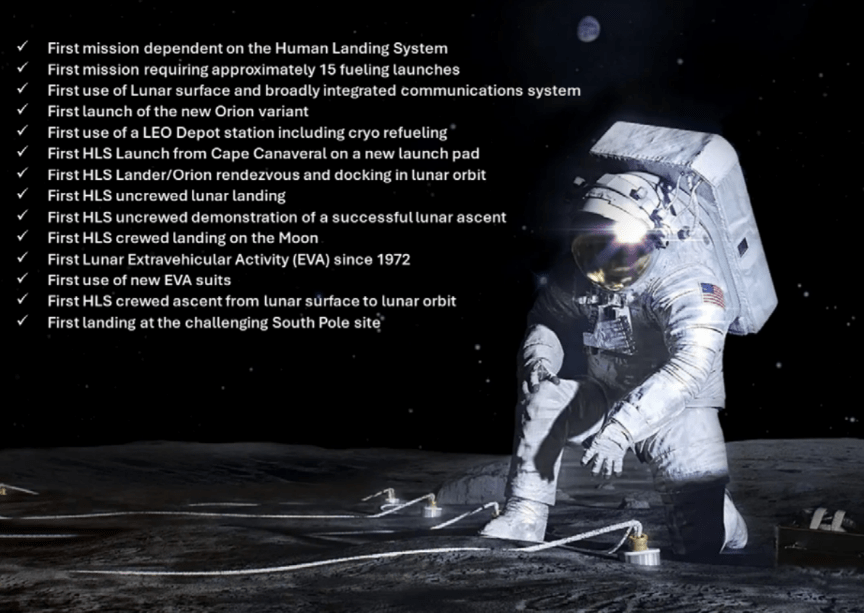
-Statement by Aerospace Safety Advisory Panel (ASAP) member Paul Sean Hill, as quoted by Space News. NASA contracted with SpaceX to develop the Human Landing System (HLS) for the astronauts landing on the Moon as part of Artemis III and later missions. While Blue Origin has also been tapped by NASA to assist with later missions, SpaceX was expected to provide the initial HLS. Maybe NASA should have picked two companies to provide the initial HLS, with the second in place still assisting with later landings. The ASAP’s 2024 Annual Report highlighted the many risks related to Artemis III, including several related to the HLS (shown below). Everyone knew this was going to be difficult, and no one wants to be asked to answer “Who Lost the Moon?” Also, it is good we still have a few advisory panels left after the recent purge.

Image (Credit): Figure 1, “First-time milestones for the Artemis III mission,” contained in the ASAP’s 2024 Annual Report. (ASAP)