Space Stories: Distant Spacecraft Updates, Lucy Gets Ready for a Flyby, and Lunar Near-Earth Asteroids

Image (Credit): Voyager II spacecraft instruments. (NASA)

Here are some recent stories of interest.

Space.com: “NASA’s interstellar Voyager Probes Get Software Updates Beamed from 12 Billion Miles Away

About 46 years after NASA’s Voyager 1 and Voyager 2 launched on an epic journey to explore space, the probes’ antique hardware continues to receive tweaks from afar. One update, a software fix, ought to tend to the corrupted data that Voyager 1 began transmitting last year, and another set aims to prevent gunk from building up in both spacecraft’s thrusters. Together, these updates intend to keep the spacecraft in contact with Earth for as long as possible.

NASA: “NASA’s Lucy Spacecraft Preparing for its First Asteroid Flyby

NASA’s Lucy spacecraft is preparing for its first close-up look at an asteroid. On Nov. 1, it will fly by asteroid Dinkinesh and test its instruments in preparation for visits in the next decade to multiple Trojan asteroids that circle the Sun in the same orbit as Jupiter. Dinkinesh, less than half a mile, or 1 kilometer, wide, circles the Sun in the main belt of asteroids located between the orbits of Mars and Jupiter. Lucy has been visually tracking Dinkinesh since Sept. 3; it will be the first of 10 asteroids Lucy will visit on its 12-year voyage. To observe so many, Lucy will not stop or orbit the asteroids, instead it will collect data as it speeds past them in what is called a “flyby.”

UC San Diego: “How Could a Piece of the Moon Become a Near-Earth Asteroid? Researchers Have an Answer

A team of astronomers has found a new clue that a recently discovered near-Earth asteroid, Kamooalewa, might be a chunk of the moon. They hypothesized that the asteroid was ejected from the lunar surface during a meteorite strike–and they found that a rare pathway could have allowed Kamooalewa to get into orbit around the sun while remaining close to the orbits of the Earth and the Moon. The research team details their findings in the Oct. 23 issue of the journal Nature Communications Earth & Environment. Kamo`oalewa has been the object of several astronomy studies in recent years. As a result, a Chinese mission launching in 2025 is set to land on the asteroid and return samples to Earth.

Speaking of Soil Samples…

Image (Credit): Apollo 17 commander Eugene Cernan approaching the Lunar Roving Vehicle. (NASA)

In addition to the asteroid Bennu sample, a lunar sample from 1972 is also grabbing headlines. It appears that the lunar sample collected by the Apollo 17 crew indicates the Moon may be about 40 million years older than previously believed.

In a study published in the journal Geochemical Perspectives Letters, titled “4.46 Ga Zircons Anchor Chronology of Lunar Magma Ocean,” states (in part):

The atomic spatial resolution analysis of individual mineral grains demonstrates the absence of nanoscale clustering of lead, which supports a 4.46 Ga ancient formation age for lunar zircon in sample 72255. This age pushes back the age of the first preserved lunar crust by ∼40 Myr and provides a minimum formation age for the Moon within 110 Myr after the formation of the solar system.

If you can forgive the title of the piece, it basically resets the understanding of the Moon’s formation and, thereby, the formation of the early Earth.

In a Reuters story, Cosmochemist Philipp Heck, senior director of research at the Field Museum in Chicago and senior author of the study, noted:

The giant impact that formed the moon was a cataclysmic event for Earth and changed Earth’s rotational speed. After that, the moon had an effect on stabilizing Earth’s rotational axis and slowing down Earth’s rotational speed…The formation date of the moon is important as only after that Earth became a habitable planet.

What will we still be learning about asteroid Bennu in 50 years (assuming we can get all of that soil out of the canister)?

Can Someone Give NASA a Hand with its Asteroid Canister?

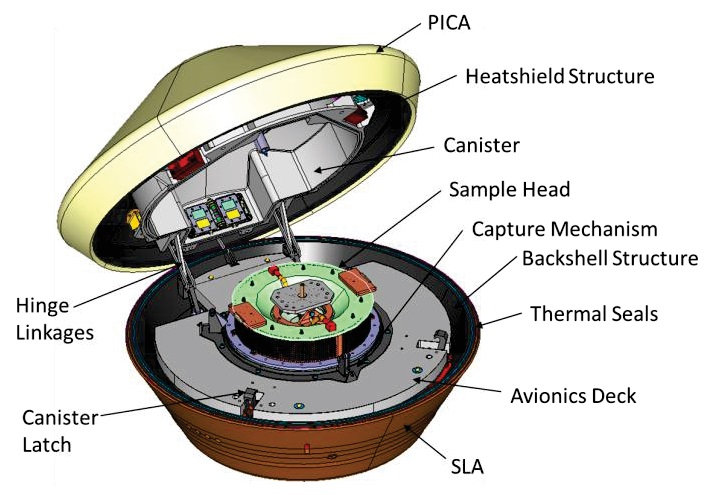
Image (Credit): OSIRIS-REx Sample Return Capsule. (NASA/Lockheed Martin)

Remember when you had to run the pickle jar under the faucet before you could take off the lid? Well, this can even happen to scientists. In fact, it has happened with NASA’s Origins, Spectral Interpretation, Resource Identification, and Security–Regolith Explorer (OSIRIS-REx) sample canister.

NASA has reported that it is still trying to get the lid off of the canister, though it has been able to collect material from outside the container. On Friday, NASA stated:

In the last week, the team at NASA’s Johnson Space Center in Houston changed its approach to opening the TAGSAM head, which contained the bulk of the rocks and dust collected by the spacecraft in 2020. After multiple attempts at removal, the team discovered two of the 35 fasteners on the TAGSAM head could not be removed with the current tools approved for use in the OSIRIS-REx glovebox. The team has been working to develop and implement new approaches to extract the material inside the head, while continuing to keep the sample safe and pristine.

NASA stated it may take a few more weeks to resolve since the scientists need to be careful with the tools they use in the confined space.

The good news is that, even without the additional material, the team has already recovered about 70 grams of material from asteroid Bennu sample, which surpasses the agency’s goal of bringing at least 60 grams to Earth.

It is a pretty odd ending after the sample has gone through a multi-year journey before landing in the Utah desert. At least the sample canister is in a safe place while the scientists play with it.

Pic of the Week: Annular Solar Eclipse Over the U.S.

Image (Credit): Lunar shadow captured on October 14, 2023. (NASA)

This image of last week’s annular solar eclipse was captured by NASA’s Earth Polychromatic Imaging Camera (EPIC) imager carried aboard the Deep Space Climate Observatory (DSCVR), which is a joint venture between NASA, NOAA, and the U.S. Air Force.

NASA made this statement regarding the image:

An annular eclipse occurs when the Moon passes in front of the Sun but is too far from Earth to completely obscure it. The Moon is at or near its farthest distance from Earth—known as its apogee—during an annular eclipse, making it look smaller in the sky. This leaves the Sun’s edges exposed in a red-orange ring, dubbed the “ring of fire.” A satellite caught an earthly view of the event, as the Moon’s shadow crossed North America.

NASA also provided a map showing those areas in the United States most impacted by the eclipse (shown below).

Image (Credit): Map showing the dark path of the annularity stretching across the lower 48 states from Oregon to Texas. (NASA)

Space Stories: Roving Students, Preparing for Roman Times, and a New Space Center

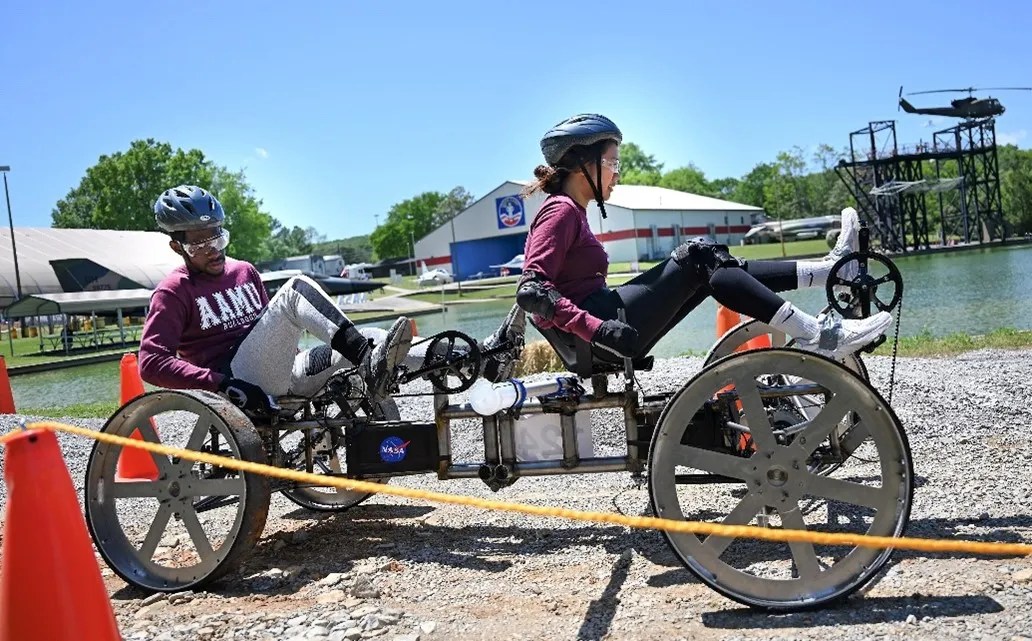
Image (Credit): Students at this year’s obstacle course at the U.S. Space & Rocket Center during NASA’s Human Exploration Rover Challenge event. (NASA)

Here are some recent stories of interest.

NASA: “Dozens of Student Teams Worldwide to Compete in NASA Rover Challenge

NASA has selected 72 student teams to begin an engineering design challenge to build human-powered rovers that will compete next April at the U.S. Space & Rocket Center in Huntsville, Alabama, near the agency’s Marshall Space Flight Center. Celebrating its 30th anniversary in 2024, the Human Exploration Rover Challenge tasks high school, college, and university students to design, build, and test lightweight, human-powered rovers on an obstacle course simulating lunar and Martian terrain, all while completing mission-focused science tasks.

Space.com: “NASA’s Roman Space Telescope will Launch in 2027. Here’s How Scientists are Getting Ready

NASA is mobilizing the scientific community to ensure the agency’s next big space telescope will be ready to deliver a “big picture” view of the universe almost immediately after launching. The Nancy Grace Roman Telescope — also known as the Roman Space Telescope, or just Roman — is set to launch in 2027 and will view the cosmos with a staggeringly wide field of view. Its big-picture observations of distant and early galaxies could help scientists solve the mysteries of dark matter and dark energy. Collectively, this so-called dark universe accounts for 95% of the energy and matter in the cosmos, yet the true nature of dark matter and dark energy eludes scientists.

SF YIMBY: “UC Berkeley Announces $2 Billion Space Center At NASA Ames Research Center

New plans have been revealed for a $2 billion research center run by UC Berkeley at the NASA Ames Center in Mountain View, Santa Clara County. The Berkeley Space Center, as it will be called, will reshape 36 acres on the sprawling Ames Research Center, providing a hub for future companies to collaborate with the school and NASA scientists & engineers to improve technology for aviation, space exploration, and how people live and work in space.