Image (Credit): Members of the Soyuz MS-25 crew – commander Oleg Novitskiy (bottom), NASA astronaut Tracy Dyson (middle), and Belarus guest cosmonaut Marina Vasilevskaya (top). (NASA/Bill Ingalls)
Earlier today, a Russian Soyuz rocket launched into space to bring three new crew members to the International Space Station (ISS).
The passengers on today’s delayed flight are cosmonauts Oleg Novitskiy and Marina Vasilevskaya as well as NASA astronaut Tracy Dyson. They are expected to board the ISS on Monday.
Astronaut Dyson, who plans to stay on the station for six months, will assist her fellow astronauts on the ISS with a variety of experiments, including “…[s]tudies of neurological organoids, plant growth, and shifts in body fluids,”
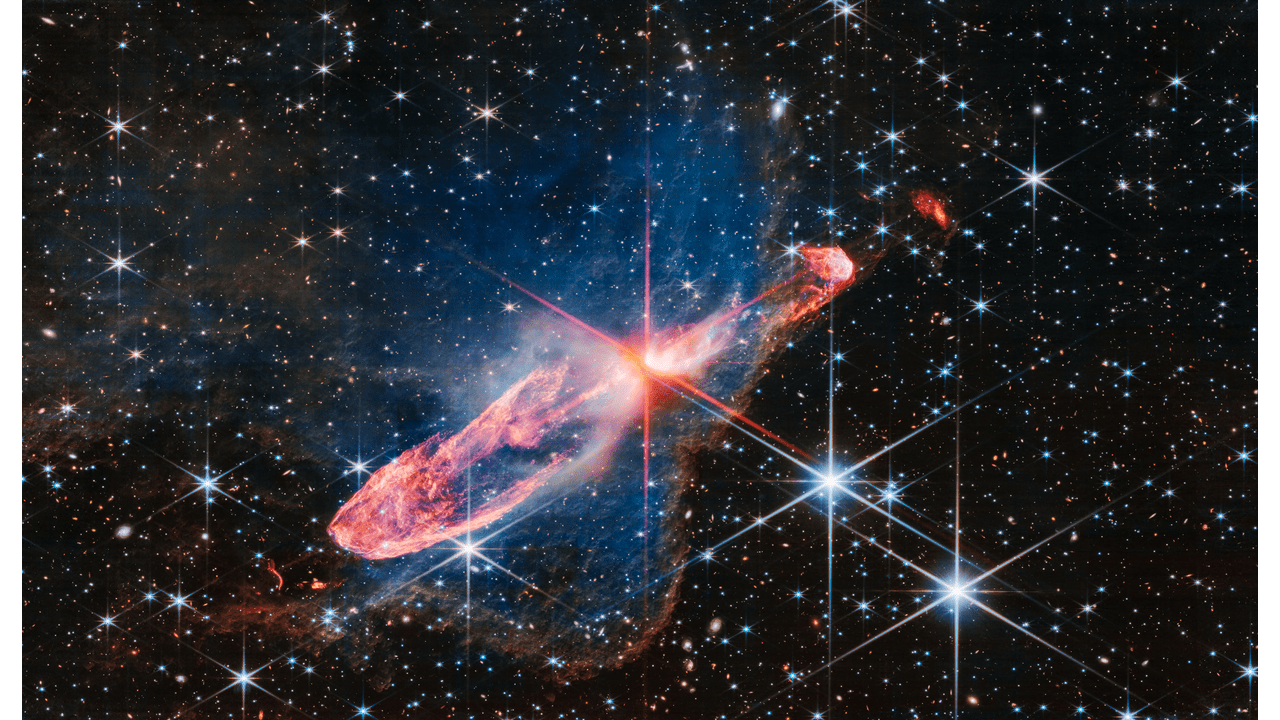
NASA’s James Webb Space Telescope has captured a tightly bound pair of actively forming stars, known as Herbig-Haro 46/47, in high-resolution near-infrared light. Look for them at the center of the red diffraction spikes. The stars are buried deeply, appearing as an orange-white splotch. They are surrounded by a disk of gas and dust that continues to add to their mass.
Herbig-Haro 46/47 is an important object to study because it is relatively young – only a few thousand years old. Stars take millions of years to fully form. Targets like this also give researchers insight into how stars gather mass over time, potentially allowing them to model how our own Sun, a low-mass star, formed.
The two-sided orange lobes were created by earlier ejections from these stars. The stars’ more recent ejections appear in a thread-like blue, running along the angled diffraction spike that covers the orange lobes.
Actively forming stars ingest the gas and dust that immediately surrounds them in a disk (imagine an edge-on circle encasing them). When the stars “eat” too much material in too short a time, they respond by sending out two-sided jets along the opposite axis, settling down the star’s spin, and removing mass from the area. Over millennia, these ejections regulate how much mass the stars retain.
Don’t miss the delicate, semi-transparent blue cloud. This is a region of dense dust and gas, known as a nebula. Webb’s crisp near-infrared image lets us see through its gauzy layers, showing off a lot more of Herbig-Haro 46/47, while also revealing a deep range of stars and galaxies that lie far beyond it. The nebula’s edges transform into a soft orange outline, like a backward L along the right and bottom.
The blue nebula influences the shapes of the orange jets shot out by the central stars. As ejected material rams into the nebula on the lower left, it takes on wider shapes, because there is more opportunity for the jets to interact with molecules within the nebula. Its material also causes the stars’ ejections to light up.
Over millions of years, the stars in Herbig-Haro 46/47 will fully form – clearing the scene.
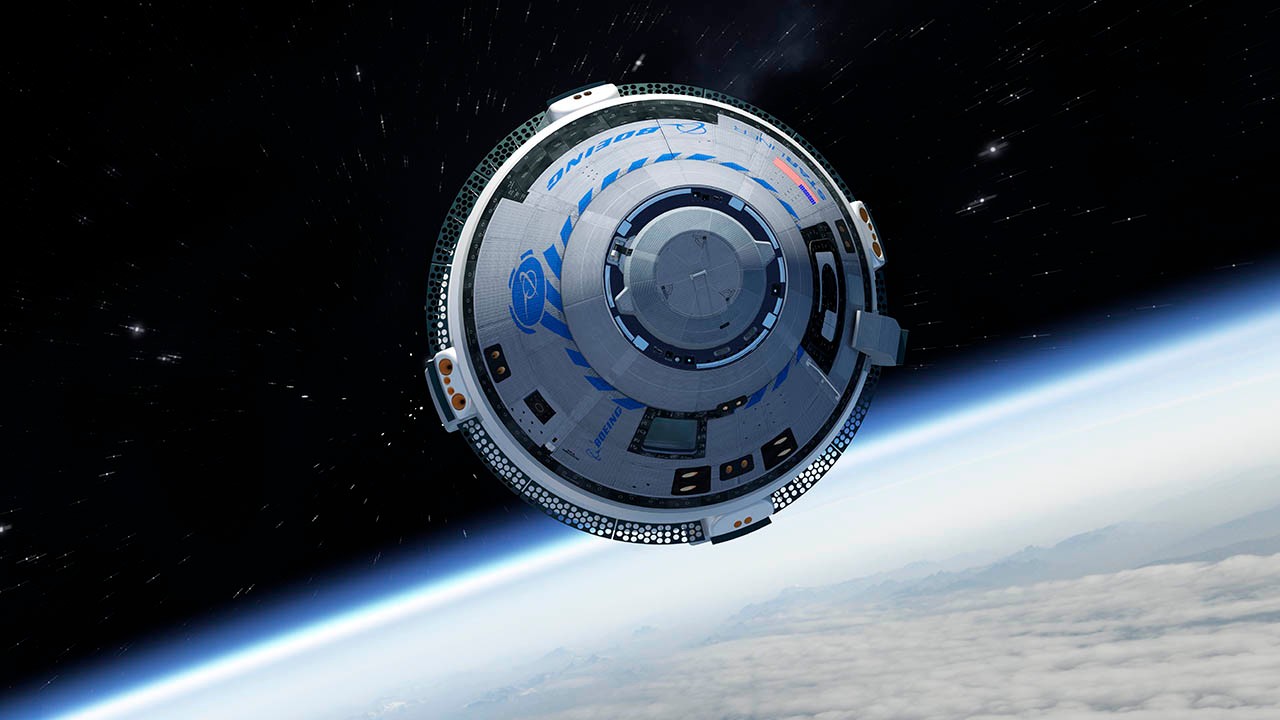
A new spacecraft will at last launch its first crew in May, and a fresh group of NASA astronauts say they’re excited to support it. NASA’s newest astronaut group graduated from basic training on March 5, just in time for the first Boeing Starliner test launch with astronauts, which is now expected in May…When it’s up and running, Starliner will regularly carry astronauts to and from the ISS alongside SpaceX’s Crew Dragon vehicle, which began its own astronaut flights in 2020. The newest astronaut cohort can’t wait to climb on board the Boeing craft.
It’s not every day that a giant volcano is discovered hiding in plain sight. By reviewing satellite imagery from many missions, scientists have spotted the remains of a colossal volcano on Mars. The volcano, provisionally named “Noctis Mons,” had been imaged repeatedly since the early 1970s, but extensive erosion had concealed it from view. Researchers have also spotted hints at an adjacent glacier buried underneath the volcanic slopes. Noctis Mons is located near the Martian equator, in the eastern part of the Tharsis volcanic province, sandwiched between the vast canyons of Valles Marineris and the fractured maze-like terrain of Noctis Labyrinthus.
The current theoretical model for the composition of the universe is that it’s made of ‘normal matter,’ ‘dark energy’ and ‘dark matter.’…A University of Ottawa study published today challenges the current model of the universe by showing that, in fact, it has no room for dark matter...This discovery challenges the prevailing understanding of the universe, which suggests that roughly 27% of it is composed of dark matter and less than 5% of ordinary matter, remaining being the dark energy.
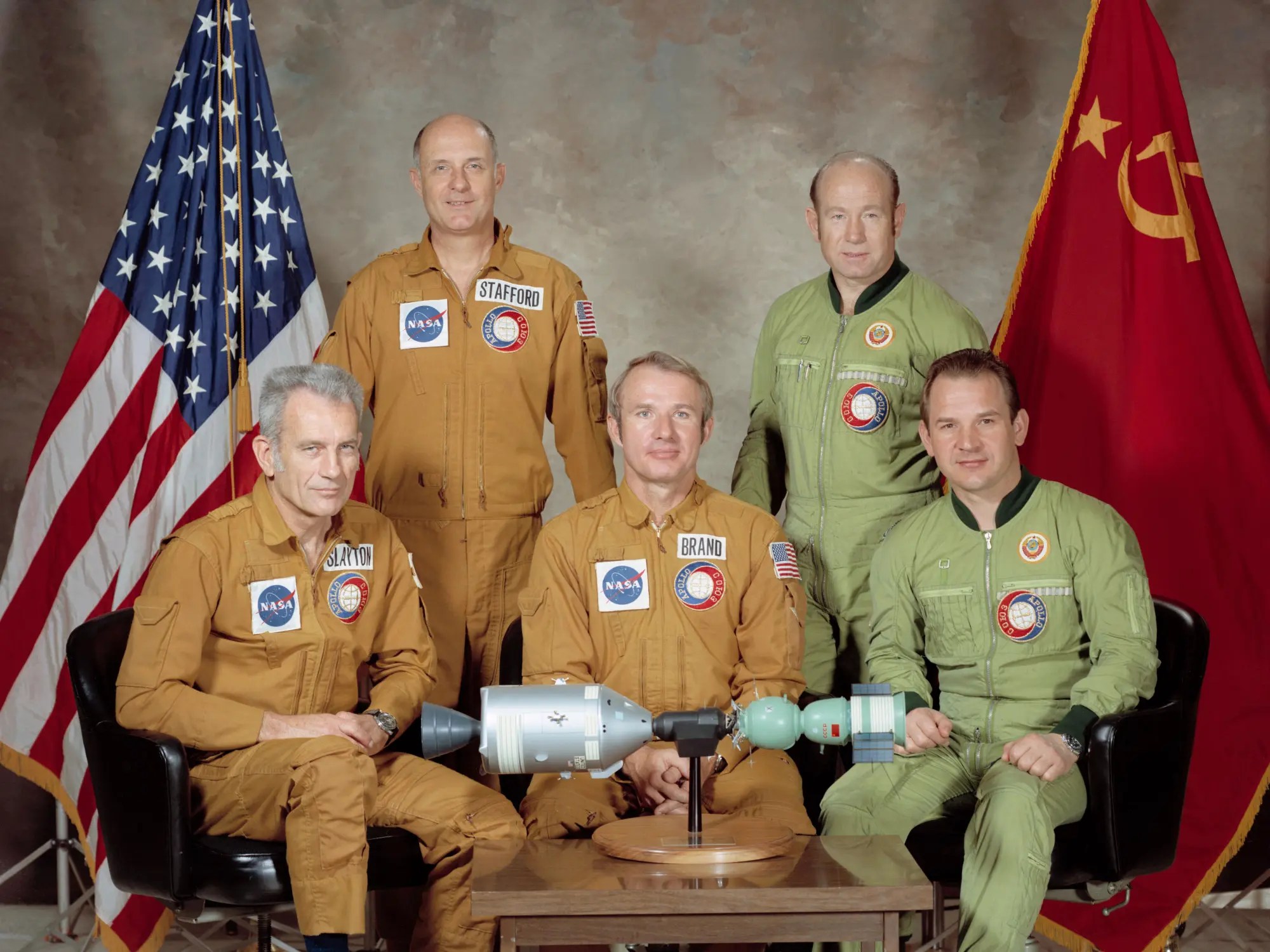
Image (Credit): The joint U.S.-USSR crew for the Apollo Soyuz Test Project. Astronaut Thomas P. Stafford (standing on left), commander of the American crew; Cosmonaut Aleksey A. Leonov (standing on right), commander of the Soviet crew; Astronaut Donald K. Slayton (seated on left), docking module pilot of the American crew; Astronaut Vance D. Brand (seated in center), command module pilot of the American crew; and Cosmonaut Valeriy N. Kubasov (seated on right), engineer on the Soviet crew. (NASA)
As we plan our return to the Moon, we cannot forget the Apollo astronauts who showed us the way last century. One of those astronauts, Thomas Stafford, died today at the age of 93.
Among his many achievements, including his Apollo 10 mission that prepared the way for the first Moon landing by Apollo 11, he may be most remembered for his 1975 space encounter with the U.S.S.R. cosmonauts.
The Apollo-Soyuz Test Project was the first international mission in space. It involved an Apollo spacecraft (crew of three) connecting with a Soyuz spacecraft (crew of two) in Earth orbit. The two days of joint activities created a precedent that was later followed by the International Space Station (ISS).
We were in the middle of the Cold War in 1975, so any cooperation with the U.S.S.R. was pretty amazing. It is just as surprising to witness SpaceX bringing cosmonauts to the ISS while the U.S. maintains severe sanctions on Russia.
Thomas Stafford died knowing that his early efforts to blaze a path to the Moon and cooperate with the Russians were still going strong today. That must have provided him with a little bit of peace in his final days.
You can watch a NASA video on Mr. Stafford’s accomplishments here.
You can also read more on Mr. Stafford’s life and career at these sites: