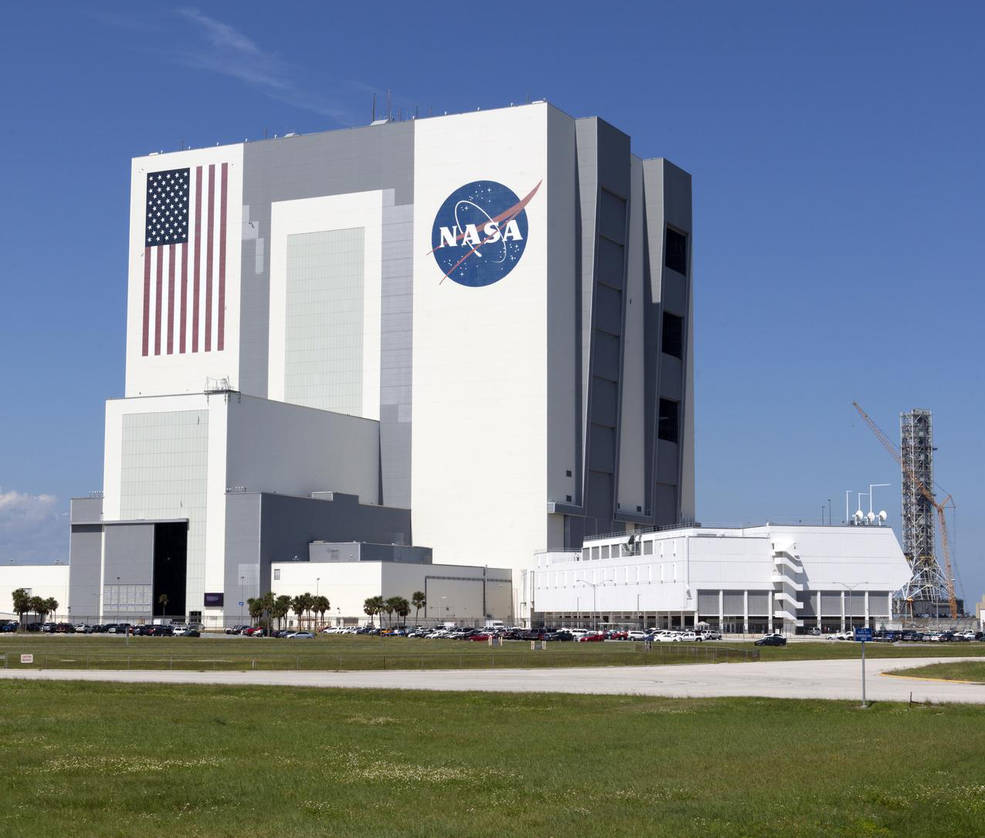
Image (Credit): The Vehicle Assembly Building at NASA’s Kennedy Space Center in Florida. (NASA/Kim Shiflett)
“On average we have a $250 to $260 million dollar annual maintenance gap…Unplanned failures can have mission impacts, and the last thing we want to do is affect Artemis or some other significant mission.”
-Statement by NASA Facilities and Real Estate Division Director Eric Weiser regarding the maintenance of NASA’s infrastructure, as reported in The Register. He went on to say, “What that means is, on average, we’re renewing our infrastructure around every 200 years… A better number would be 60 to 80 years, and to do that we simply need more funding.” I know maintenance expenditures are boring, but this is no different than defense or highways. You get what you pay for, and also what you maintain.
“We really are trying to get in the details of that schedule because when we come up with a date, December of 2025, or whatever that date might be, we want to have confidence for our teams, that we all have a realistic path to get there.”
-Statement by Jim Free, NASA associate administrator of Exploration Systems Development, regarding the launch date of the Artemis III mission, as reported in Florida Today. The story highlights the potential delays related to SpaceX’s Starship and Axiom’s space suits.
Image (Credit): Galaxy NGC 6684 captured by the NASA/ESA Hubble Space Telescope. (ESA/Hubble & NASA, R. Tully)
This week’s image is from NASA/European Space Agency’s (ESA) Hubble Space Telescope. It shows the glowing galaxy NGC 6684, which is around 44 million light-years from Earth.
This oddly shaped galaxy is explained on the ESA’s website:
Lenticular galaxies like NGC 6684 (lenticular means lens-shaped) possess a large disc but lack the prominent spiral arms of galaxies like the Andromeda Galaxy. This leaves them somewhere between elliptical galaxies and spiral galaxies, and lends these galaxies a diffuse, ghostly experience. NGC 6684 also lacks the dark dust lanes that thread through other galaxies, adding to its spectral, insubstantial appearance.
The length of Mars’ day is shortening by three-quarters of a millisecond each year as the planet’s rotation spins up, according to new results from NASA’s InSight lander…Planetary scientists are not entirely sure why this is happening, but it is likely related to the redistribution of Mars’ mass, which can have an effect on the planet’s rotation like an ice skater pulling in their arms to spin faster. This redistribution might be caused by the accumulation of ice on Mars’ polar caps, experts believe, or by the surface itself slowly rebounding from residing under the weight of immense glaciers that existed at equatorial latitudes during the world’s most recent ice ages, which ended about 400,000 years ago.
NASA has left the door open for changing the scope of Artemis 3, currently set to be the first crewed lunar landing of the program, if key elements suffer major delays. Speaking at an Aug. 8 briefing at the Kennedy Space Center, Jim Free, NASA associate administrator for exploration systems development, said the Artemis 3 mission still has a formal launch date of December 2025 but that he was monitoring potential delays in hardware needed for the mission. “We may end up flying a different mission if that’s the case,” he said. “If we have these big slips out, we’ve looked at if can we do other missions.” Artemis 3 could also change based on the outcome of Artemis 2, he added.
One of the oldest known objects in the universe is wandering around the Milky Way. Star cluster M92, a densely packed ball of stars roughly 27,000 light-years from Earth, is about 13.8 billion years old, researchers report in a paper submitted June 3 to arXiv.org. The newly refined age estimate makes this clump of stars nearly the same age as the universe. Refining the ages of clusters like M92 can help put limits on the age of the universe itself. It can also help solve cosmic conundrums about how the universe evolved.
“While NASA’s programs are very popular and highly visible, we really don’t spend much on our space agency. In 2022, the U.S. treasury took in revenues of $4.9 trillion and then charged up another $1.4 trillion so it could spend a whopping $6.3 trillion. Of that largesse NASA received an historically generous appropriation of $24 billion. Still, that was just 0.35% of federal spending.”



 Our Awesome Universe