Space Quote: NASA Cannot Do Everything in this Budget Environment


“The current budget environment has significant implications for mission and safety risk. NASA has a very full mission plate. To the extent that their budget request is not fully funded, the leadership will need to acknowledge and make critical decisions with respect to program content or schedules, which will need to be adjusted to meet fiscal realities. Attempting to do all planned efforts on expected timelines will introduce unacceptable and unmanaged risk. The Agency will need to rely on its developed strategic vision, objectives, and architecture to establish well-defined priorities to ground its endeavors in reality – taking fully into account the risk-benefit tradeoffs.”

-Statement in the Aerospace Safety Advisory Panel’s 2023 Annual Report regarding NASA’s operating environment. One particular area of risk relates to Artemis III, which entails a crewed landing on the Moon. The report states:

In addition, prior to the Artemis III mission, NASA will need to address whatever issues arise from the Artemis II mission, including the possibilities of hardware (HW) and software (SW) changes to both the Space Launch System (SLS) and Orion. Orion flight time on Artemis III will exceed previous durations. Given that it is a new rocket, a new human capsule, and a new human spaceflight environment for this generation of NASA workers, it is not unreasonable to think that NASA will still have a great deal of discovery to do with every Artemis mission for the foreseeable future, and that both schedules and workloads will need to expand accordingly.

Commercial Benefits from the Space Program


You may have been told that the earlier space program gave us Tang and Velcro. Well, that is not really true.

For instance, Tang was already at your local supermarket back in 1959. It was not until 1962 when Tang was taken into space with John Glenn on Friendship 7 and only then did it become a “space age drink” used by the Gemini through Apollo programs.

In the case of Velcro, it was invented by a Swiss engineer who based it on burrs that clung to the fur of his dog. Later on, NASA found it to be very useful for astronauts.

So what did NASA introduce to the world? Fortunately, NASA’s 2024 Spinoff report can provide you with plenty of answers. In an article on the report, NASA highlighted the following commercial applications of space technology:

  • Spherical “squishy” robots capable of dropping into dangerous situations before first responders enter;
  • “Digital winglets” aircraft-routing technology that’s enabling increased fuel efficiency and smoother flights;
  • Lighter, more durable disc brake designs that produce less dust than traditional disc brakes;
  • Computer software to help businesses and communities cope with and recover from natural disasters like wildfires; and
  • New 3D printing methods to additively manufacture rocket engines and other large aluminum parts.

If you go to the full report, you can find other commercial applications that are more readily relatable to your everyday, including:

  • NASA-funded molecular research enables better disease detection;
  • Radiation-resistant microbe studied in space leads to fewer wrinkles, less sun damage on Earth;
  • Technology pioneered for space plant-growth chambers cleans indoor air; and
  • Materials for coating spaceplanes maintain comfort in outerwear, sports uniforms, jeans.

Take a look at the report yourself for more examples. It is full of good stories about how the space program can assist us here on Earth.

I am sure we can find similar reports related to the defense industry, but I would prefer our goal be better products generated from a space race rather than an arms race.

Pic of the Week: Space Shuttle Finds a New Home

Image (Credit): Ongoing construction work assembling the Space Shuttle Endeavor and related stack elements at the planned Samuel Oschin Air and Space Center. (California Science Center)

This week’s image comes from California and shows the construction of a new giant exhibit at the future Samuel Oschin Air and Space Center. What you are seeing is a covered Space Shuttle Endeavour, which flew its final mission back in May 2011.

You can view more images and videos related to the creation of this new exhibit by visiting the California Science Center site. The site notes:

This will be the only complete stack of authentic space shuttle flight hardware in existence, making the Endeavour exhibit even more significant than before. In addition to allowing the public unprecedented, unique vantage points, this configuration retains a complete flight stack for engineers and historians to examine in the future. NASA and aerospace companies frequently visit museums to look at hardware from previous programs in order to design for the future projects.

Northrop Grumman Cargo Ship Heads to ISS

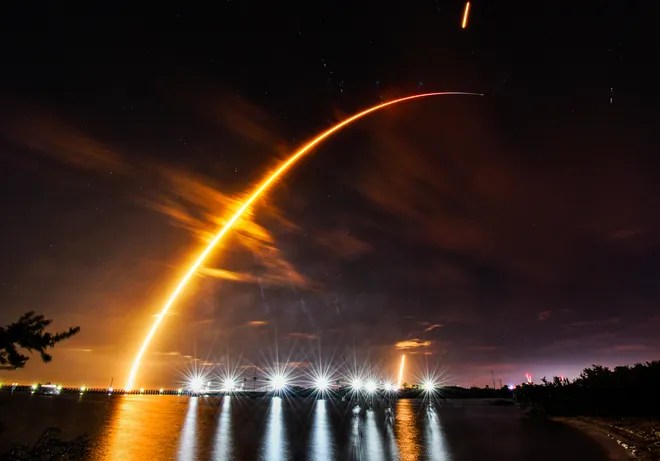
Image (Credit): Launch of the Cygnus spacecraft earlier today on its way to the ISS. (NASA)

Earlier today, Northrop Grumman launched a resupply spacecraft via a SpaceX Falcon 9 rocket to the International Space Station (ISS). The Cygnus spacecraft is conducting its 20th mission to the station, making it reliable workhorse as NASA awaits even more commercial partners to come online.

According to NASA, the resupply spacecraft contains numerous experiments, including:

  • the first surgical robot on the space station;
  • an orbit re-entry platform that collects thermal protection systems data;
  • a 3D cartilage cell culture that maintains healthy cartilage in a lower gravity; and
  • a metal 3D printer, an autonomous semiconductor manufacturing platform.

A surgical robot you ask? You can read more about this Miniaturized In-vivo Robotic Assistant (MIRA) by visiting this Gizmodo site.

Space Stories: The ISS Succession Plan, Privately-built Moon Landers, and Working with Moonquakes

Image (Credit): View of the International Space Station. (NASA)

Here are some recent stories of interest.

—Aviation Week Network: “Safety Panel Raises Commercial Space Station Transition Concerns“

Concerns over a “very tight” timeline for NASA to transition human low-Earth-orbit operations from the International Space Station (ISS) to commercial successors tops a list of seven concerns raised by an agency safety panel. The latest annual report by NASA’s Aerospace Safety Advisory Panel’s (ASAP) was released Jan. 25. The 56-page report expresses concerns over sufficient evidence of a viable business case to make NASA one of multiple tenants of at least one ISS successor. The effort is currently supported by NASA and the European, Japanese, Russian and Canadian space agencies.

—Astronomy.com: “Vertex Moon Mission Getting Closer to Launch“

 A new era in lunar research is coming, and Lunar Vertex is getting ready to lead the way. Lunar Vertex is NASA’s first so-called PRISM mission (Payloads and Research Investigations on the Surface of the Moon). PRISM taps into the Commercial Lunar Payload Services program that uses privately built landers to deliver NASA science and other payloads to the lunar surface. PRISM missions are meant to be lower-cost, faster-to-flight programs. There is a mass limit of just over 100 pounds (45 kilograms) — so the science instruments have to be small — and the budget for the first PRISM suite is just $30 million (excluding the lander and the launch vehicle). Lunar Vertex is first in line, and recently has hit a number of major milestones on its way to a June 2024 launch.

—NASA: “Shrinking Moon Causing Moonquakes and Faults Near Lunar South Pole“

As NASA continues to make progress toward sending astronauts to the lunar South Pole region with its Artemis campaign, data from a NASA-funded study is helping scientists better understand this strategic part of the Moon. The study presents evidence that moonquakes and faults generated as the Moon’s interior gradually cools and shrinks are also found near and within some of the areas the agency identified as candidate landing regions for Artemis III, the first Artemis mission planned to have a crewed lunar landing.