Space Stories: James Webb’s Partner, the Big Bang Black Holes, and Green Energy on the Red Planet

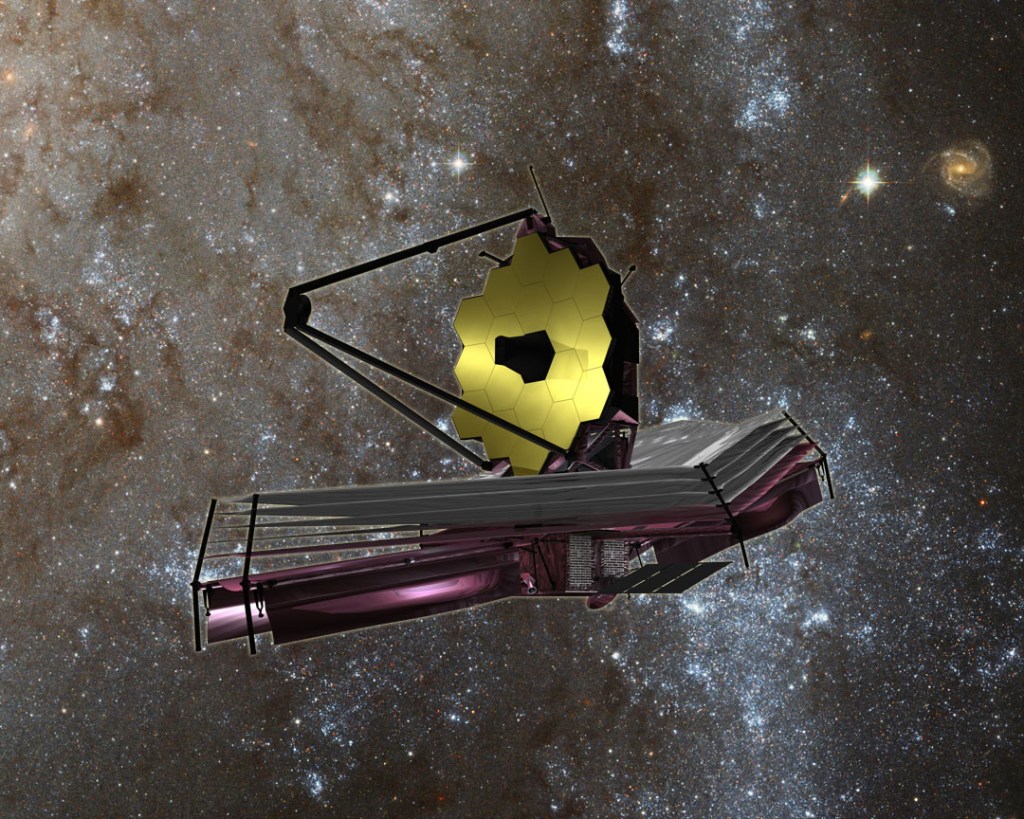
Image (Credit): James Webb Space Telescope. (NASA)

Here are some recent stories of interest.

Futurism: “NASA Sending Adorable Little Buddy to Hang Out Next to the James Webb

The space agency recently selected a toaster-sized cubesat that will become the much bigger telescope’s tiny, adorable “sidekick,” according to a statement. NASA chose the $8.5 million space mission, called the “Monitoring Activity from Nearby sTars with uv Imaging and Spectroscopy” (MANTIS), which will be designed and built by researchers at the University of Colorado Boulder. The diminutive but mighty spacecraft, scheduled to launch sometime in 2026, will make observations of the night sky in the full range of ultraviolet light, including extreme UV (EUV) light, a more energetic form.

Universe Today: “Why Didn’t the Big Bang Collapse in a Giant Black Hole?

Despite the enormous densities, the early universe didn’t collapse into a black hole because, simply put, there was nothing to collapse into…Even though the early universe was incredibly dense, it was also incredibly uniform. The average density throughout the universe was the same from place to place. There weren’t enough differences to trigger the formation of black holes.

University of Warwick: “Using Photosynthesis for Martian Occupation—While Making Space Travel More Sustainable

In a study published in Nature Communications, scientists assess a new technique which could convert renewable, green energy from outside the Earth’s atmosphere. They are taking advantage of photosynthesis—the chemical process plants undergo every day to create energy—to help the space industry become more sustainable. The research led by the University of Warwick evaluates the use of a special device known as semiconductor to absorb sunlight on moon and Mars. It is hoped that the devices could promote Martian life support systems.

Do We Need to Fear Lunar Organisms?

Image (Credit): A Tardigrade, or water bear, which may have landed on the Moon thanks to an Israeli mission. (NASA)

If we had a real chance of being harmed by life on the lunar surface, Covid 19 would be child’s play. The New York Times has an article, “Cosmic Luck: NASA’s Apollo 11 Moon Quarantine Broke Down,” indicates we were not really ready for any potential contamination during the Apollo program. The newspaper cites a recent study on the quarantine process, which noted:

As NASA prepared to land astronauts on the Moon in the 1960s, scientists and federal officials came to fear that they could bring lunar microorganisms back to Earth, with potentially grave consequences for human, plant, and animal life. To prevent this“back contamination,”representatives from NASA and a network of federal departments and services developed a protocol to quarantine astronauts, equipment, samples, and spacecraft exposed to lunar dust. Yet although NASA assured policy makers and an anxious public that it had implemented impermeable safeguards against the escape of lunar microorganisms, it had in fact prioritized likely risks to astronauts over unlikely risks to American society. To a degree previously unknown, the Apollo quarantine protocol suffered from numerous containment breaches that would likely have exposed the terrestrial biosphere to contamination—had lunar microorganisms actually existed.

Of course, now that we have landed on the moon and sent up multiple missions, the risk today is that we have contaminated the lunar surface, as noted in this second story from Futurism, “NASA Says There May Be Life on the Moon After All.” For instance, an earlier Israeli mission that crashed on the lunar surface was carrying thousands of microscopic Tardigrades. The story also cites meteors as a possible source of life that could have found refuge on the Moon.

I think I will put my money on the Tardigrades.

Pic of the Week: The Ongoing Perseverance Rover Mission

Image (Credit): NASA’s Perseverance Mars rover captured this mosaic of a hill nicknamed “Pinestand.”
(NASA/JPL-Caltech/ASU/MSSS)

This week’s image comes from NASA’s Mars rover Perseverance as it explores the to Jezero Crater. The photo was posted last month. It has been a little while since we directly our attention at the Red Planet.

The image shows what may be the result of a fast-moving river some time in the past. In the NASA write-up accompanying the photo above, we read:

“Pinestand” is an isolated hill bearing sedimentary layers that curve skyward, some as high as 66 feet (20 meters). Scientists think these tall layers may also have been formed by a powerful river, although they’re exploring other explanations, as well.

“These layers are anomalously tall for rivers on Earth,” [postdoctoral researcher at NASA’s Jet Propulsion Laboratory in Southern California Libby] Ives said. “But at the same time, the most common way to create these kinds of landforms would be a river.”

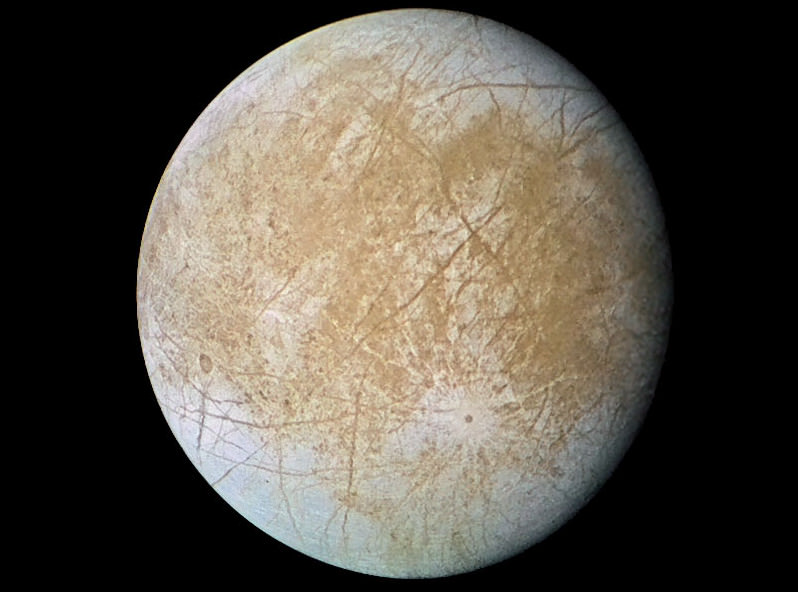
A Poem for Europa

Image (Credit): The icy moon Europa. (NASA)

U.S. Poet Laureate Ada Limon was asked by NASA to write a poem for the upcoming Europa Clipper mission. Her new poem, “In Praise of Mystery: a Poem for Europa,” premiered late last week in Washington, DC.

Here is the poem from the Library of Congress (and you can also hear it in the poet’s voice):

Arching under the night sky inky
with black expansiveness, we point
to the planets we know, we

pin quick wishes on stars. From earth,
we read the sky as if it is an unerring book
of the universe, expert and evident.

Still, there are mysteries below our sky:
the whale song, the songbird singing
its call in the bough of a wind-shaken tree.

We are creatures of constant awe,
curious at beauty, at leaf and blossom,
at grief and pleasure, sun and shadow.

And it is not darkness that unites us,
not the cold distance of space, but
the offering of water, each drop of rain,

each rivulet, each pulse, each vein.
O second moon, we, too, are made
of water, of vast and beckoning seas.

We, too, are made of wonders, of great
and ordinary loves, of small invisible worlds,
of a need to call out through the dark.

Amazingly, this poem will be engraved on the exterior of the spacecraft.

NASA has done a great job stimulating scientists, but this is a great stimulus for budding poets as well.

NASA TV: Stay Tuned In

If you cannot find anything worthwhile on regular television, don’t forget that NASA continues to broadcast key events on its own television station, including this week’s meeting on UFOs, now called “unidentified anomalous phenomena,” or UAPs.

Here is the latest schedule for NASA TV:

Tuesday, May 30
9 a.m. – Coverage of hatch closure for the Axiom Mission 2 crew aboard the International Space Station. Hatch closure scheduled for approx. 9:10 a.m. 
10:45 a.m. – Coverage of the the Axiom Mission 2 crew undocking from the International Space Station. Undocking scheduled for 11:05 a.m.
12:30 p.m. – ISS Expedition 69 in-flight educational event with the New Mexico Museum of Space History in Alamogordo, NM, and NASA flight engineers Frank Rubio and Steve Bowen
2 p.m. — Media teleconference on the science bound for the International Space Station aboard SpaceX’s 28th commercial resupply services mission

Wednesday, May 31
10:30 a.m. – Coverage of the public meeting of the independent study team on categorizing and evaluating data of unidentified anomalous phenomena (UAP)
3 p.m. – Unidentified anomalous phenomena (UAP) post-meeting media teleconference

Thursday, June 1
12 p.m. – News conference for upcoming spacewalks to install new International Space Station Roll-Out Solar Arrays (IROSAs)
7 p.m. — NASA and U.S. Poet Laureate Ada Limón unveil her poem for Europa