Image (Credit): The Progress 86 resupply ship approaches the ISS. (NASA)
This week’s image shows the Roscosmos Progress 86 cargo craft approaching the International Space Station (ISS) last Sunday with three tons of needed supplies. The space craft almost appears to be performing ballet. I expect everyone one on board the station was happy to see it arriving, hopefully loaded with some holiday treats.
The Russian cargo craft needed to be guided in manually by cosmonauts after the auto system failed. Backup systems are great, but fully functioning space systems are better. I guess the Russians got some practice that day.
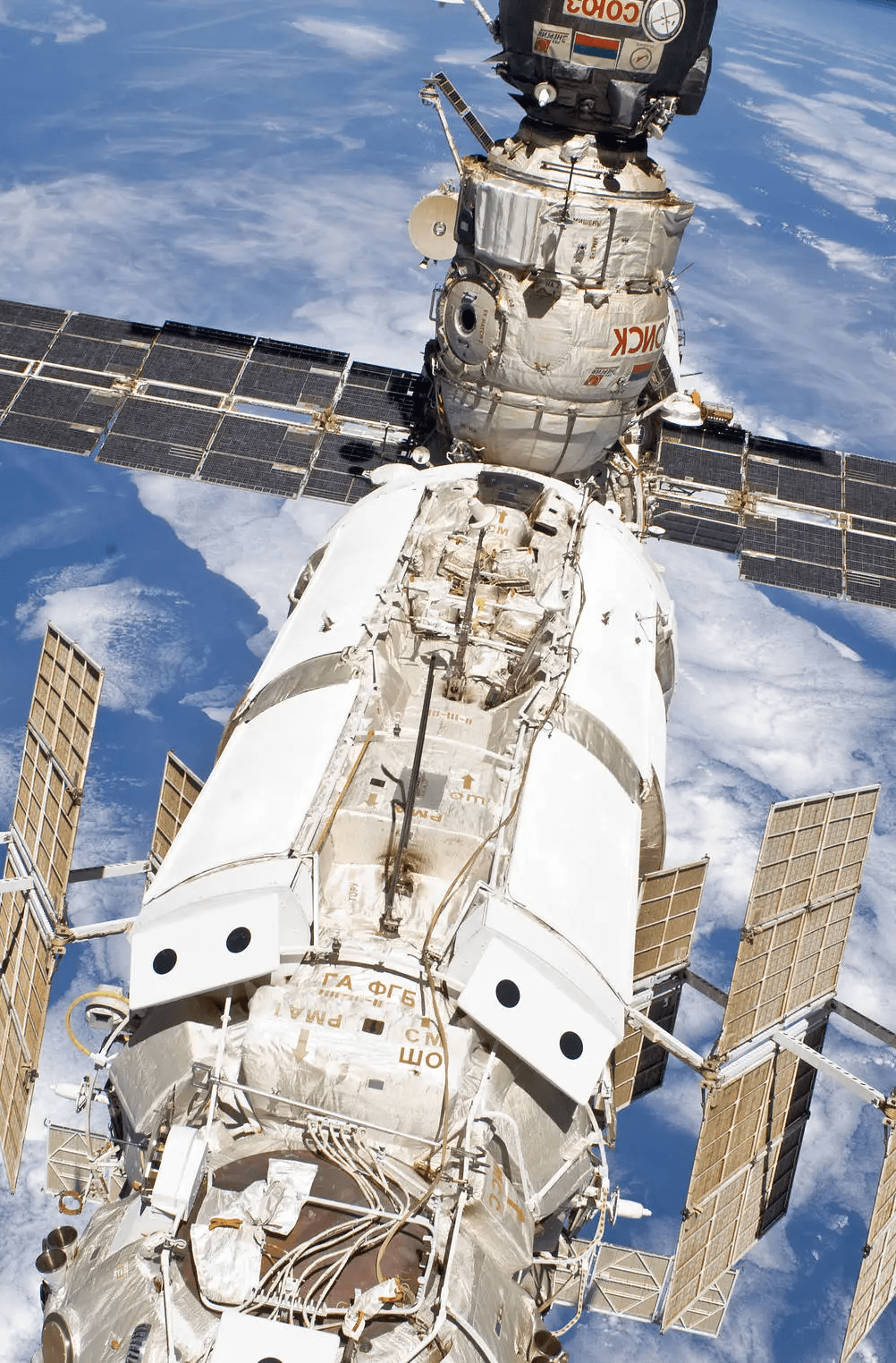
Image (Credit): The ISS’s Zarya module (in the image bottom to center). (NASA)
On this day in 1998, two modules, the Russian Zarya and American Unity, were joined in Earth orbit to create the International Space Station (ISS).
The ISS was built by five space agencies involving 15 nations. NASA notes that 273 people from 21 countries have visited the ISS over the years to assist with more than 3,300 research and educational investigations. The station has been busy, and pretty expensive at more than $150 billion to design and build.
Back in 2012, Astrophysicist Neil DeGrasse Tyson stated:
If the United States commits to the goal of reaching Mars, it will almost certainly do so in reaction to the progress of other nations – as was the case with NASA, the Apollo program, and the project that became the International Space Station.
Eleven years later, the ISS continues to orbit the Earth while plans are still being made to return to the Moon and visit Mars. Maybe Dr. Tyson was right given our current race with China to the Moon. We sometimes need that extra push to move towards the stars (as least in terms of crewed flights).
The legislative branch’s audit arm, the Government Accountability Office (GAO), has some bad news regarding the Artemis mission to the moon – the landing on the Moon may need to wait until 2027.
As of September 2023, the Human Landing System program had delayed eight of 13 key events by at least 6 months. Two of these events have been delayed to 2025—the year the lander is planned to launch. The delays were caused in part by the Orbital Flight Test, which was intended to demonstrate certain features of the launch vehicle and lander configuration in flight. The test was delayed by 7 months to April 2023. It was then terminated early when the vehicle deviated from its expected trajectory and began to tumble. Subsequent tests rely on successful completion of a second Orbital Flight Test.
The Human Landing System was awarded to SpaceX, which has been having a few issues getting everything to work on schedule. Of course, this is just one of many issues that contribute to potential delays (such as the space suit), but I expect SpaceX does not want to be labeled as the drag on the program when we are trying to beat the Chinese to the Moon.
The audit report is comprehensive and serves as a warning that things are slipping and may continue to slip without sufficient attention.
Artemis represent an international effort to bring together the best parties from the government and private sector for something amazing. The Apollo missions to the Moon were run by one country as a central government program. This is a chance for everyone to shine using a whole new approach. We just need to keep up the momentum.
Are you looking for that perfect book for a space enthusiast? You may want to take a look at some of the books authored by NASA astronauts in the last few years. Be it inspiration or adventure you are seeking, you can find it with these authors. Below are three books to consider as gift ideas.
Mike Massimino achieved his dream of exploring space. Now he distills stories and insights from NASA into an actionable guide to accomplish your biggest goals. Mike reveals how to make possible the seemingly impossible—on Earth. Written with characteristic wit and a big heart, Mike identifies ten hard-earned lessons of spaceflight and his other life experiences, including:
One in a Million Is Not Zero: The odds are against you. Do it anyway.
The Thirty-Second Rule: You’re going to make mistakes. Learn how to deal with them.
Be Amazed: The universe is an incredible place. Stop what you’re doing and look around.
Know When to Pivot: Change is inevitable. Accept and embrace it.
We all have our own personal “moon shots” we’d like to take in life, but as mission control will tell you, doing one big thing really means getting a thousand little things right along the way. Moonshot is the book that will show you how to do just that, and help set you on the right path to achieve your own personal and professional dreams.
Stott imparts essential lessons in problem-solving, survival, and crisis response that each of us can practice to make change. She knows we can overcome differences to address global issues, because she saw this every day on the International Space Station. Stott shares stories from her spaceflight and insights from scientists, activists, and changemakers working to solve our greatest environmental challenges. She learns about the complexities of Earth’s biodiversity from NASA engineers working to enable life in space and from scientists protecting life on Earth for future generations. Ultimately, Stott reveals how we each have the power to respect our planetary home and one another by living our lives like crewmates, not passengers, on an inspiring shared mission.
NASA is about to launch Apollo 18. While the mission has been billed as a scientific one, flight controller Kazimieras “Kaz” Zemeckis knows there is a darker objective. Intelligence has discovered a secret Soviet space station spying on America, and Apollo 18 may be the only chance to stop it.
But even as Kaz races to keep the NASA crew one step ahead of their Russian rivals, a deadly accident reveals that not everyone involved is quite who they were thought to be. With political stakes stretched to the breaking point, the White House and the Kremlin can only watch as their astronauts collide on the lunar surface, far beyond the reach of law or rescue.
Image (Credit): Martian horizon courtesy of NASA’s Mars Odyssey orbiter. (NASA/JPL-Caltech/ASU)
The image this week is what the International Space Station might see if it were traveling over Mars. Instead, this is the view of NASA’s Mars Odyssey orbiter.
You can learn more about this image by watching this video with Laura Kerber, deputy project scientist for NASA’s Mars Odyssey orbiter. You can also read more about the orbiter’s mission and the video of Phobos by visiting this NASA site.