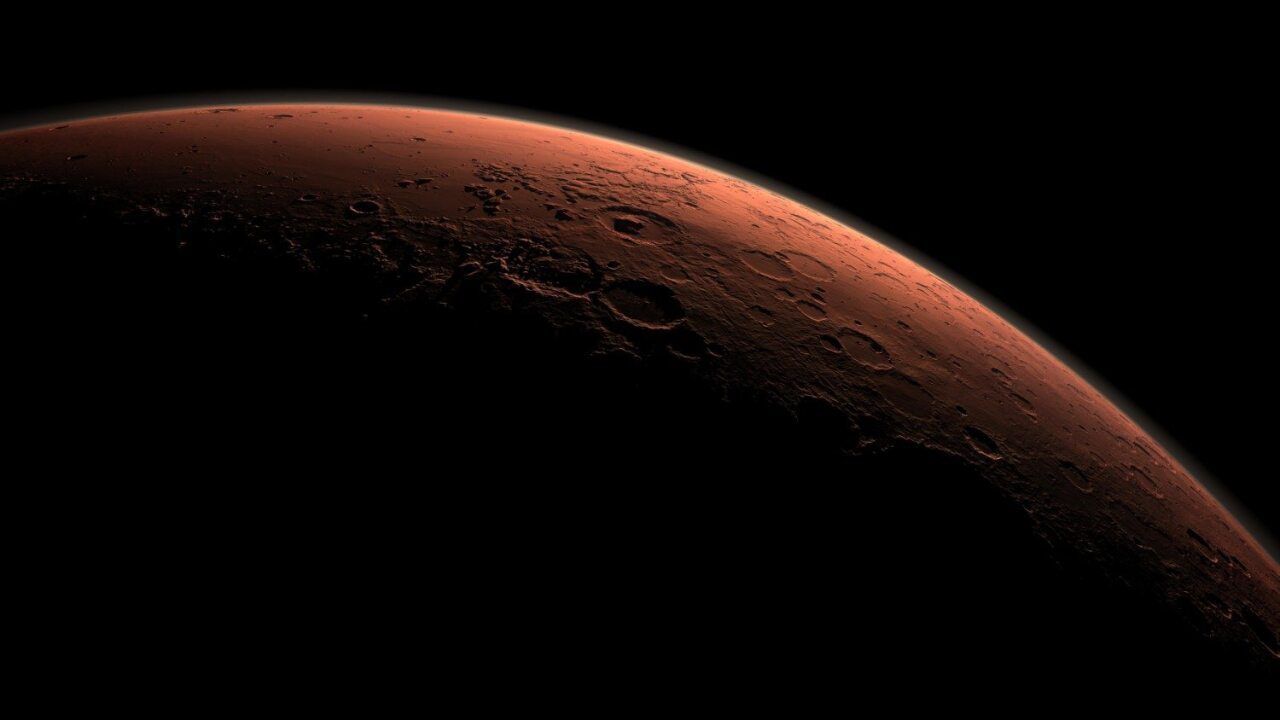
Image (Credit): Martian horizon courtesy of NASA’s Mars Odyssey orbiter. (NASA/JPL-Caltech/ASU)
The image this week is what the International Space Station might see if it were traveling over Mars. Instead, this is the view of NASA’s Mars Odyssey orbiter.
You can learn more about this image by watching this video with Laura Kerber, deputy project scientist for NASA’s Mars Odyssey orbiter. You can also read more about the orbiter’s mission and the video of Phobos by visiting this NASA site.
The Japanese government has said it will establish a $6.6 billion (¥1 trillion) fund to develop the country’s space industry as programs in the U.S., Russia, China and India rush to put men on the moon, build lunar sites and plan for the future of the International Space Station in a renewed race for celestial supremacy...Nikkei, a Japanese newspaper, reported that funding will be given to companies developing technologies that could be used to support national security or those that could rival Elon Musk’s SpaceX by developing rockets and “satellite constellations”—groups of satellites that operate as one system.
With just two Starship integrated test flights under its belt, SpaceX announced last week it is already working on a major overhaul of its second-stage Starship vehicle. The design changes will be significant enough to speciate the ship, giving it the title of Version 2. SpaceX plans to finish and launch four or five additional Starship V1 prototypes before transitioning to its V2 product line, Elon Musk said on X. Insights gained from the upcoming flights will be integrated into the next-gen rocket.
When the US imposed sanctions to degrade Russia’s aerospace industry, including embargoes on semiconductors, lasers, sensors, and navigation equipment, Dmitry Rogozin, then chief of Russia’s space program, warned it might cause the International Space Station to fall on the US or Europe. These comments and others from a supposedly serious scientific organization did cause a crash — the decades-old US-Russia space partnership was effectively ended after decades of joint work, including the Soviet era, that had benefited science, détente, and humanity. The events of 2022-2023 have made it more likely Russia would step away from exploration and, with China, focus on military applications in space.
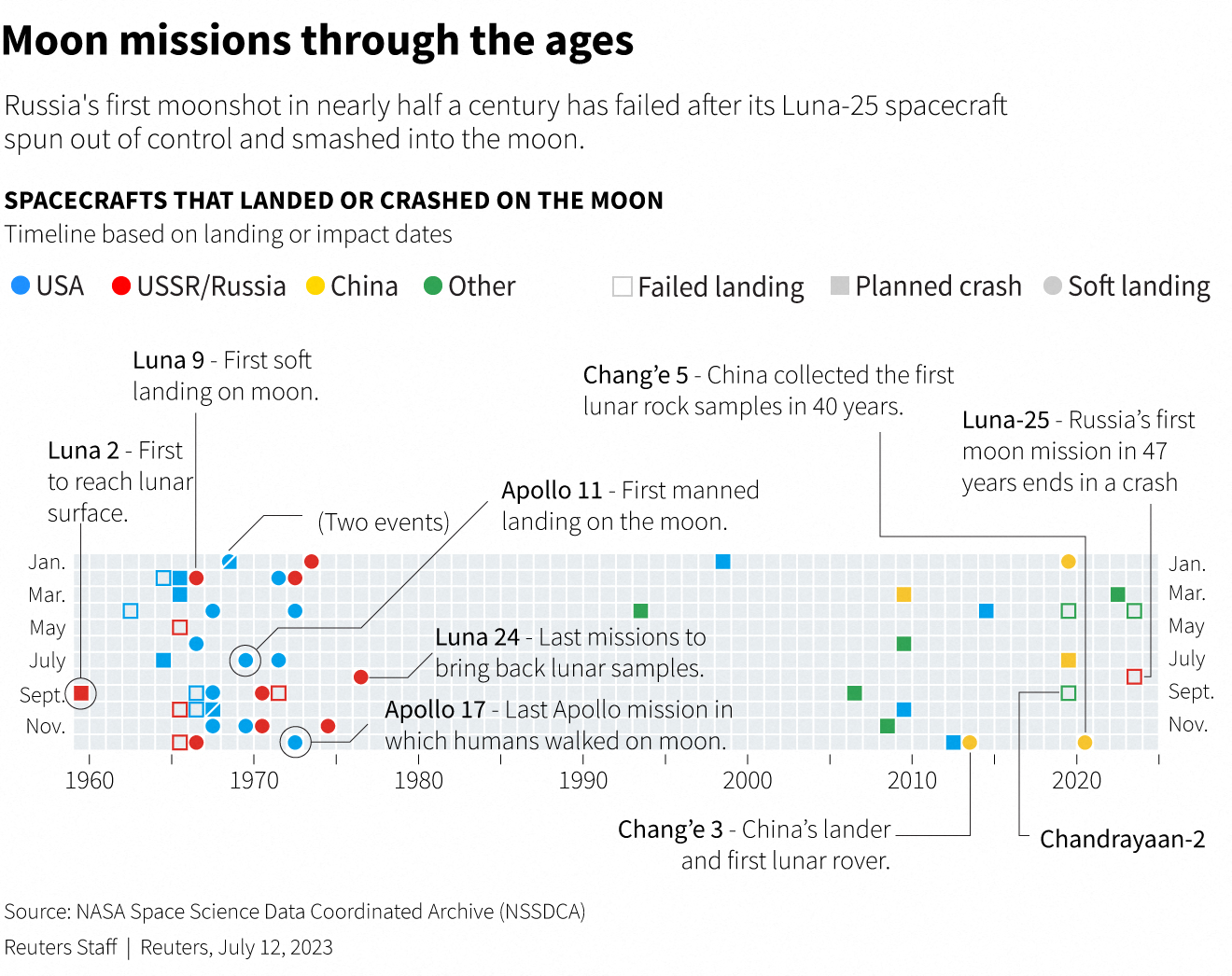
Note: The helpful graphic below is used in the Center for European Policy Analysis story.
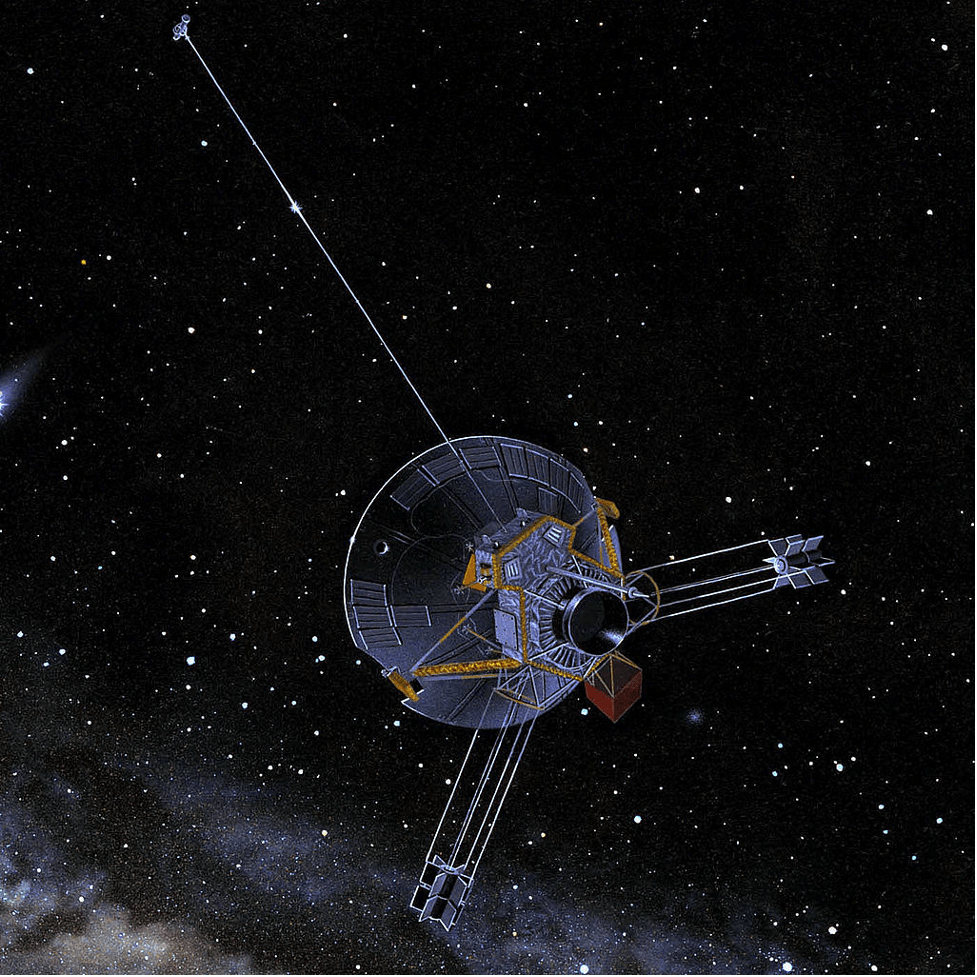
Image (Credit): Artist’s rendering of the Pioneer 10 spacecraft. (Don Davis for NASA)
We may have missed the date of the story in this piece (the anniversary was November 6), but this is an opportunity to share another site that brings astronomical history to life. The American Astronomical Society, which brings together professional astronomers, astronomy educators, and amateur astronomers, has its own blog on astronomical anniversaries that I wanted to highlight. It is called This Month in Astronomical History.
The November article is about the 50th anniversary of NASA’s Pioneer 10 mission as it came in contact with Jupiter. The article notes that the spacecraft first started imaging Jupiter on November 6, 1973 when it was still 16 million miles away from the planet. Overall, it sent back about 500 images of Jupiter and its moons.
You can read the article itself for information on the success of the mission. The author also noted the fate of the spacecraft:
Originally slated for 21 months of operation — sufficient to complete the Jupiter observations — its official science mission was ended on 31 March 1997. Its last signal was sent on 23 January 2003; from a distance of about 12.2 billion km (7.6 billion miles) from home, Pioneer’s swansong took over 11 hours to reach us.
The spacecraft was still communicating with us about 50 years after its Jupiter mission. That is impressive.
Image (Credit): Astronaut Thomas Kenneth Mattingly II. (NASA)
Last month we lost another astronaut who almost flew on the Apollo 13 mission and later flew on the Apollo 16 mission. Thomas Kenneth Mattingly II died on late last month at the age of 87 in Arlington, Virginia.
In addition to his work on the Apollo missions, he also flew on two space shuttle missions.
Mr. Mattingly is best remembered for his efforts to bring the Apollo 13 mission safely back to Earth after his lost his seat in that very mission when he was exposed to rubella. All of this was well documented in the 1995 Ron Howard film Apollo 13.
Okay, the plan is for Blue Origin to launch NASA satellites towards Mars, so don’t worry about Jeff Bezos and Elon Musk fighting it out on the Martian surface.
NASA has tapped Blue Origin to take two satellites worth about $79 into space, which will be the first use of the company’s New Glenn rocket. The launch is planned for next year, giving Blue Origin time to test the rocket and prepare for the mission.
The NASA mission, called the Escape and Plasma Acceleration and Dynamics Explorers (EscaPADE), involves two identical probes that were originally scheduled to fly with the Psyche mission.
The goals of the EscaPADE mission are to:
understand the processes controlling the structure of Mars’ hybrid magnetosphere and how it guides ion flows;
understand how energy and momentum are transported from the solar wind through Mars’ magnetosphere; and
understand the processes controlling the flow of energy and matter into and out of the collisional atmosphere.
Can Blue Origin be ready by next year when the window to Mars opens up? That is the big question given the continued delays with the New Glenn rocket.
It is good to see NASA spreading its launches into more hands. Now we just need the industry to meet the challenge.