“A comet could stay in one place if it was basically on a ‘collision course’ with Earth,…That’s exactly what you would expect of an object that’s going to pass very, very close to the Earth.”
-Statement by Mark Matney, a planetary scientist at NASA, as quoted in Scientific American. He has proposed in his paper that the Star of Bethlehem cited in the Bible may have been a “broom star,” or comet, spotted by Chinese astronomers in 5 B.C.E. In his paper, he concludes “…it is no longer justifiable to claim that ‘no astronomical event’ could possibly have behaved in the manner described by Matthew.”
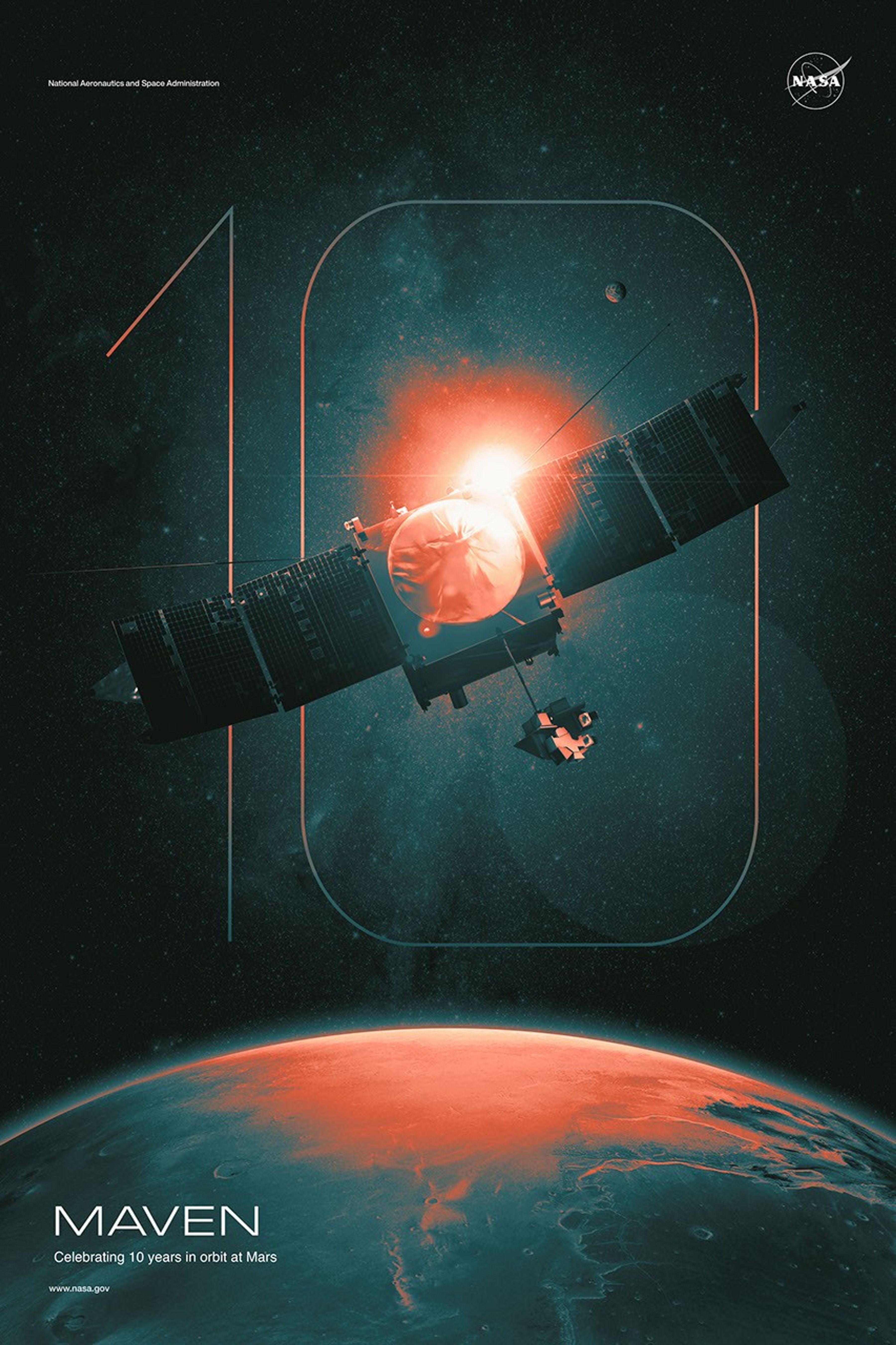
Image (Credit): Tenth anniversary poster for the MAVEN spacecraft from 2024. (NASA)
This time last year we were celebrating the 10th anniversary of NASA’s Mars Atmosphere and Volatile EvolutioN (MAVEN) spacecraft entering orbit around Mars. Today we are wondering about the future of that spacecraft after NASA lost contact with it.
As of earlier today, all NASA would say is the following:
The spacecraft and operations teams are investigating the anomaly to address the situation. More information will be shared once it becomes available.
MAVEN is part of the Mars Relay Network (MRN), which is used to transmit data from the Martian surface back to Earth. For instance, NASA’s two remaining rovers – Curiosity and Perseverance – utilize this network. Five NASA and European Space Agency spacecraft orbiting Mars are part of the MRN: MAVEN, Mars Odyssey, Mars Express, Mars Reconnaissance Orbiter, and ExoMars Trace Gas Orbiter.
The last thing we need now under this administration is a weak link to Mars since finding funds to further bolster the MRN will not be easy. So let’s hope for an easy fix.
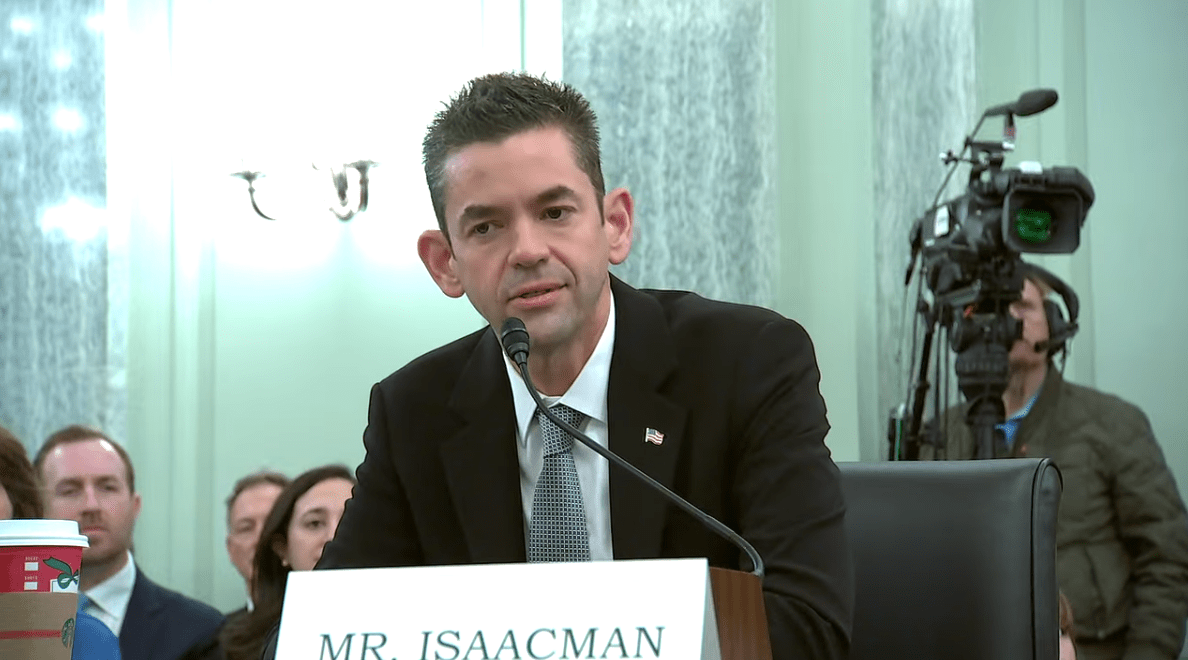
Image (Credit): Jared Isaacman answering questions at the December 3, 2025 Senate confirmation hearing. (Senate Committee on Commerce, Science, and Transportation)
Jared Isaacman appeared before the Senate Committee on Commerce, Science, and Transportation earlier today for his second confirmation hearing. Overall, everything went well and he should be ready for a full Senate vote next week that will make him NASA’s next administrator.
The success of the Artemis program that President Trump began during his first term. America will return to the Moon before our great rival, and we will establish an enduring presence to understand and realize the scientific, economic, and national security value on the lunar surface.
Along the way, we will pioneer the next ‘giant leap’ capabilities to extend America’sreach even further into space, including expanding and accelerating investments intonuclear propulsion and surface power programs. These efforts, in addition to industrypartners building reusable launch vehicles, we will set the stage for future missions toMars and beyond.
We will never accept a gap in capabilities again–not with our space station presence inlow Earth orbit or our ability to send American astronauts to the Moon.
We will strive to build an orbital and lunar economy that can fund the future we all wantto see in space and not rely exclusively on the taxpayer. We will begin making theinvestments now for the inevitable spacefaring future that is just on the horizon.
We will make the most efficient use of every dollar allocated–pushing for more xplanes, more rovers & telescopes, more exciting missions like Hubble, James Webb, and Dragonfly with the aim of enlightening the world through breakthrouh scientific discoveries–knowing that if NASA doesn’t do it, no one else will.
The third point about a “gap in capabilities” specifically addresses the hardware needed to get to the space station or the moon, but we are also facing a gap in our scientific capabilities given the loss of so much talent this year. The statement reads like a dime store space novel where all we need it a rocket and grit, but hardware can only get your to a location.
Living and thriving once we get to wherever we are going will depend upon many other factors that are outside the understanding of rocket engineers. Yet too many of the senior mission specialists with these needed skills are now sitting at home after being forced out or deciding to retire in the midst of recent chaos. This gap in this area only widened, and the full impact on the NASA’s space programs has yet to be realized. However, these personnel losses are likely to close the gap between the US and Chinese space programs to our detriment.
Maybe Mr. Isaacman needed to add a sixth goal to close this new gap in scientific capabilities created this year by the White House.
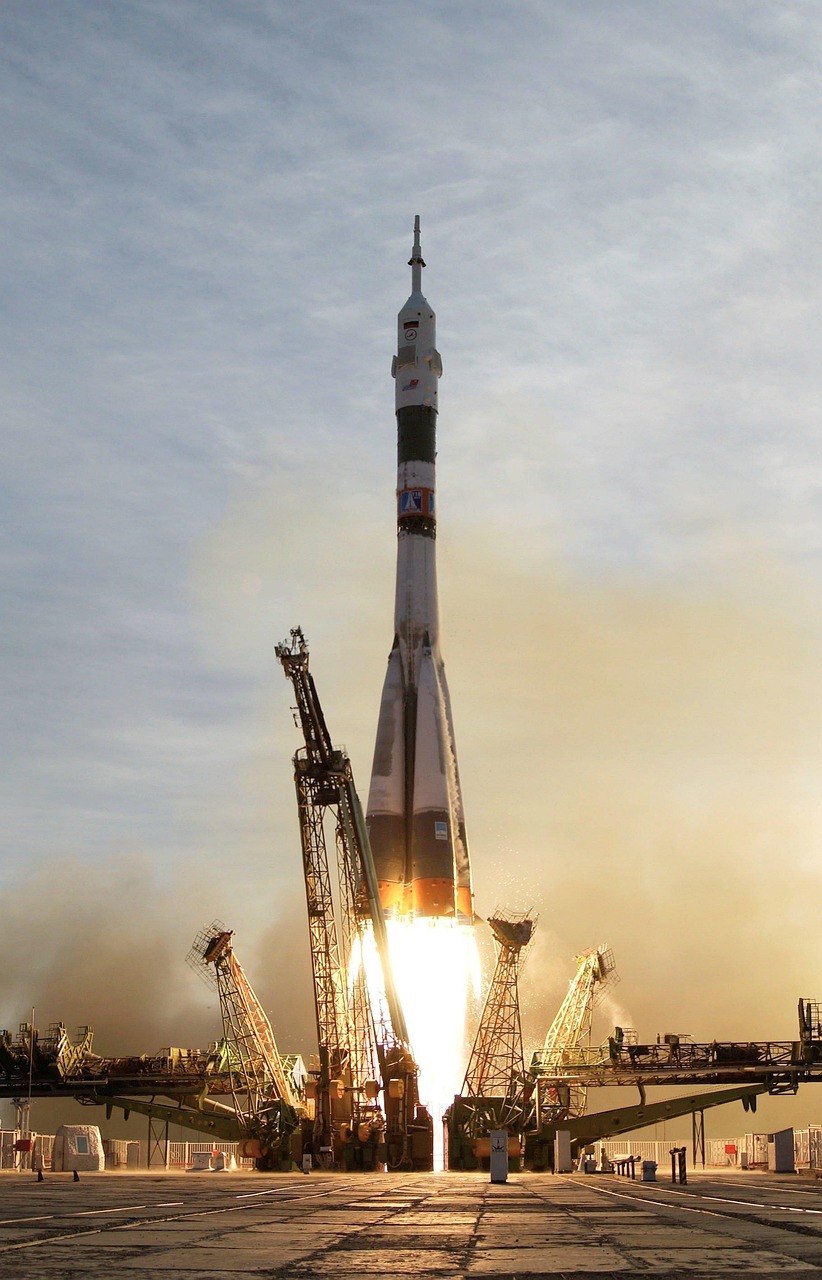
Russia’s only crewed-mission launch site has suffered major damage following a rocket launch on Thursday. The Baikonur Cosmodrome in Kazakhstan will be unable to host launches until repairs are made, according to the space agency Roscosmos, marking the first time in decades that Russia has lost the ability to send people to space. The launch of the Soyuz MS-28 spacecraft was otherwise successful, with none of the crew members injured.
Russian cosmonaut Oleg Artemyev has been removed from the prime crew of SpaceX’s Crew-12 mission to the International Space Station and replaced by fellow Roscosmos cosmonaut Andrey Fedyaev after sources alleged he photographed confidential SpaceX materials in California in violation of US export control rules, according to The Insider on December 2. The outlet reported that Trishkin also said NASA did not want the controversy around Artemyev to become public, while Artemyev was removed from training at SpaceX’s Hawthorne California, facility last week after allegedly photographing SpaceX engines and other internal materials on his phone and taking them off-site.
A new study published in PNAS from researchers at The University of Texas at Austin is the first to define large river drainage systems on the red planet. They outlined 16 large-scale river basins where life would have been most likely to thrive on the neighboring planet. “We’ve known for a long time that there were rivers on Mars,” said co-author Timothy A. Goudge, an assistant professor in the Department of Earth and Planetary Sciences at the UT Jackson School of Geosciences. “But we really didn’t know the extent to which the rivers were organized in large drainage systems at the global scale.”


 Our Awesome Universe