Space Quote: NASA Has Lessons for Automating American Industry

Credit: Image by David Yonatan González Aburto from Pixabay.

“At NASA, decades of designing humanoid robots for environments that don’t forgive narrow thinking revealed that the machines that failed were the ones built for a single scenario. The ones that succeeded could multitask and be reprogrammed– for deployment in different settings. The arm built for the Space Shuttle, for example, was designed to position an astronaut who would catch and later release a satellite. It turned out the robot was better at making the catch itself — but positioning astronauts proved useful for other tasks, like repairing the Hubble Space Telescope.”

-Statement by Dr. Robert Ambrose, Chairman of Robotics and Artificial Intelligence at alliant and former Chief of the Software, Robotics and Simulation Division at NASA. He was discussing robotics in a Fortune magazine story titled “Former NASA Robotics Chief: America is Building the Wrong Kind of Robots — and China Knows It.” It is nice to see that NASA can teach the private sector a few things about preparing for the future. The agency has a wealth of information that can be shared with the private sector and allied countries. We just need to recognize the treasure trove of information we have accumulated at NASA over the years and do our best to preserve it and build upon it.

Twelfth Starship Launch Successful

Credit: SpaceX

Fortunately, the first SpaceX Starship launch of the year (and the twelfth for the rocket) went well yesterday with only a few bumps along the way. While it was not perfect, given that it was the first test of a new version of the rocket, it was a good night for the rocket-maker and NASA.

Here is SpaceX’s description of some of the bumps last night:

Following stage separation, the Super Heavy booster performed a directional flip maneuver and attempted its boostback burn. It was unable to light all planned engines and performed a partial boostback burn that ended early. Super Heavy attempted to reignite its engines for the landing burn before experiencing a hard splashdown in the Gulf of America. During its ascent burn to space, Starship lost one of the Raptor 3 vacuum engines but demonstrated its engine-out capability and achieved its planned trajectory.

This latest test is encouraging, but would be more encouraging is a solid schedule of more tests this year to ensure the Starship will be ready for the Artemis III low Earth orbit tests next year. SpaceX is still significantly behind schedule on it launches. For instance, this twelfth launch was delayed many times.

Both SpaceX and Blue Origin are racing to be part of the Artemis III test in late 2027 to see if NASA is really ready for a crewed landing on the Moon in 2028. This latest launch brings SpaceX that much closer.

Pic of the Week: Crescent Mars

Image (Credit): Mars as captured on May 15, 2026 by NASA’s Psyche mission as it approached the planet for a gravity assist. (NASA/JPL-Caltech/ASU)

This week’s image comes from the Psyche spacecraft that is utilizing Martian gravity for its flight plan on its way to the asteroid Psyche in the asteroid belt. This image of a crescent Mars is one of many drive-by photos for both science and our enjoyment.

Here is more on this Martian part of the mission from NASA:

Because Psyche approached Mars from a high phase angle, the planet appeared as a thin crescent in the days running up to the close approach, lit by sunlight reflecting off its surface. In observations from the spacecraft’s multispectral imager, the crescent appeared brighter and extended farther around the planet’s disk than anticipated because of the strong scattering of sunlight through the planet’s dusty atmosphere. As Psyche passed from Mars’ nighttime skies to daytime, it took a rapid series of pictures of the surface around the time of closest approach.

“We’ve captured thousands of images of the approach to Mars and of the planet’s surface and atmosphere at close approach. This dataset provides unique and important opportunities for us to calibrate and characterize the performance of the cameras, as well as test the early versions of our image processing tools being developed for use at the asteroid Psyche,” said Jim Bell, the Psyche imager instrument lead at Arizona State University (ASU) in Tempe. “As the spacecraft continues its journey after the flyby, we’ll continue calibration imaging of Mars for the rest of the month as it recedes into the distance.”

NASA Now Has a Deputy Administrator

Image (Credit): NASA Deputy Administrator Matthew Anderson. (NASA)

Well, better late than never. This week the Senate confirmed Matthew Anderson, a retired U.S. Air Force colonel, as the new deputy administrator at NASA.

Last year, NASA provided this background information on Mr. Anderson:

Throughout his over 24-year tenure in the U.S. Air Force, Anderson culminated his career as the U.S. Transportation Command’s senior liaison officer to North American Aerospace Defense Command (NORAD), U.S. Northern Command (USNORTHCOM), and U.S. Space Command (USSPACECOM). He retired as a colonel Oct. 1, 2021. Anderson is currently a vice president and Space Force & Air Force client executive at CACI. He also serves as the chief growth officer at the Space Force Association.

An alum of the U.S. Air Force Academy, Embry-Riddle Aeronautical University, and the University of Colorado at Colorado Springs, Anderson holds degrees in biology, aeronautical science, and leadership & counseling.

He said all of the right things at his confirmation hearing in March, stating:

Make no mistake… we are on a shot clock, and the stakes are high. Stakes that directly affect the balance of power here on earth.

If confirmed, I will 100 percent support the Administrator in executing the President’s space policy. I will roll up my sleeves and tirelessly serve the talented workforce at NASA, be a great teammate with Congress, and beat China to the moon.

Together, we have the opportunity to usher in a new Golden Age of science and discovery,

It was a long road to this point, as well as a close vote (46-43), but the team is on board and its time to get all hands on deck so the new “Golden Age” can get started.

By the way, it is the Congress’ budget, and not the proposed White House budget, that provides the gold to pay for this program. The White House seems to have only enough gold to adorn its walls in the style of Louis XIV.

Note: The Senate vote on Jared Isaacman for NASA administrator was 67-30.

Space Stories: Martian Contract Questions, French Spacesuit Travels to ISS, and China Readies Next Space Station Mission

Image (Credit): View of Mars from the NASA Mars Global Surveyor MOC wide angle cameras. (NASA)

Here are some recent space-related stories.

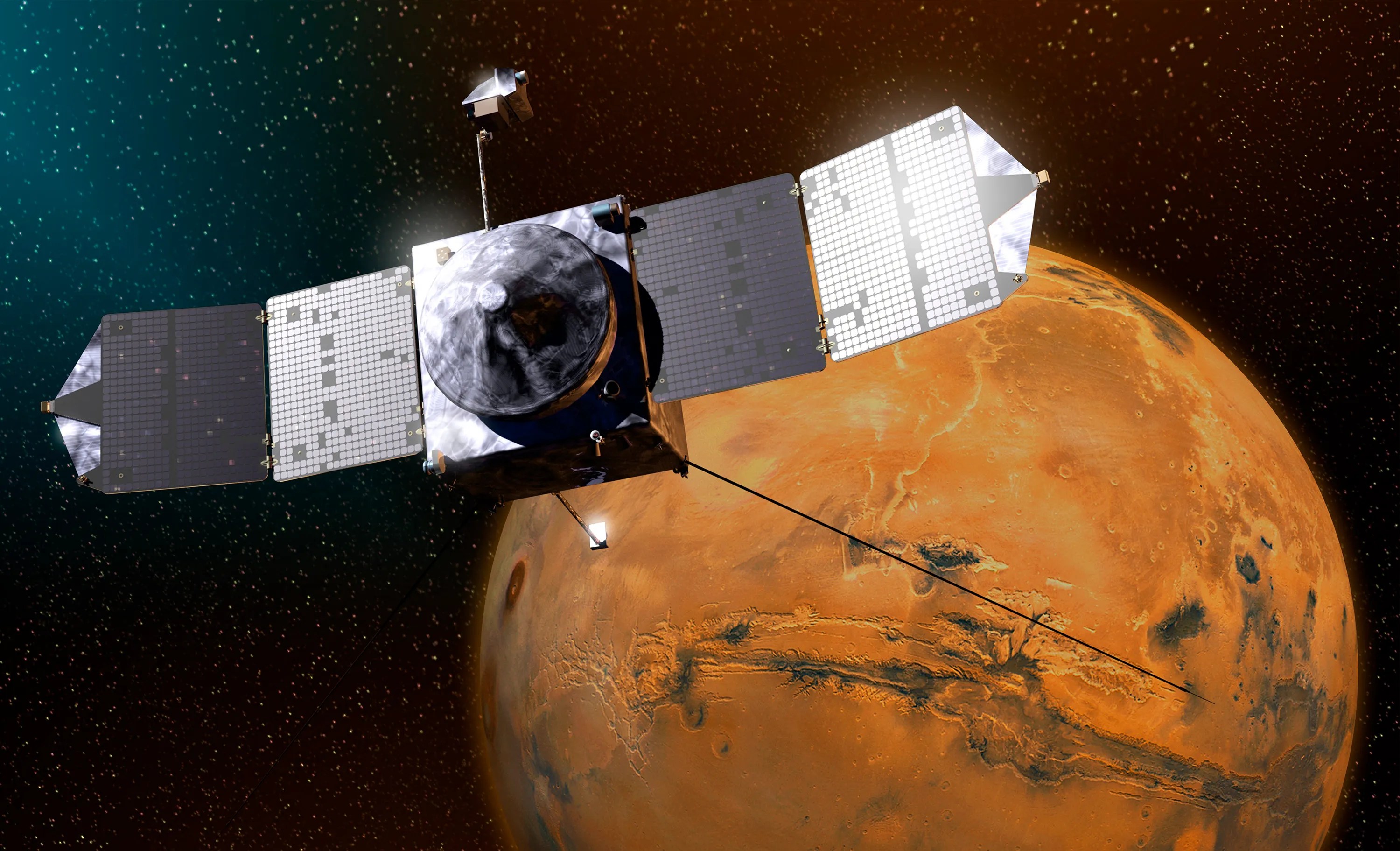
Ars Technica: One Mars Spacecraft, Two Senators, and a Cloud of Questions

NASA released a much-anticipated contract solicitation for a Mars-orbiting spacecraft late last week, kicking off what is sure to be a hotly contested and potentially controversial procurement. At issue is $700 million, already appropriated by Congress, to build a spacecraft, launch it to Mars, and once there to serve as a vehicle to relay communications between the red planet and Earth. But the stakes may be even bigger than this, including the possible resurrection of the recently canceled Mars Sample Return mission. As part of the new solicitation, NASA says it will conduct the acquisition “as a full and open competition.” But will it? That’s the question that several people involved with this procurement process are asking. And it could turn messy, quickly.

European Spaceflight: “French Spacesuit Prototype Delivered to the International Space Station

A European intravehicular activity (IVA) spacesuit prototype developed under a CNES-initiated programme was transported to the International Space Station (ISS) aboard a SpaceX Dragon spacecraft. The spacesuit will be tested aboard the station by ESA astronaut Sophie Adenot. The EuroSuit project was initiated by CNES in December 2023 as part of the agency’s Spaceship FR programme, which aims to foster the development of core technologies required for future crewed missions beyond low Earth orbit.

China Global Television Network: China to Launch Shenzhou-23 Crewed Mission to Space Station in Coming Days

The combination of the Shenzhou-23 crewed spacecraft and the Long March-2F Y23 carrier rocket was transferred to the launchpad at Jiuquan Satellite Launch Center in northwest China on Saturday, according to the China Manned Space Agency. All facilities and equipment at the launch site are in good condition. Various pre-launch functional inspections and joint tests will be carried out as scheduled in the coming days. The launch is planned to take place in the coming days.

Update: Here is a podcast version of this story if you sometimes prefer to digest the news in this way. It is created by AI. To note, it’s not replacing anything or anyone. It’s simply offering an option if listening while driving is preferable to you. I do not use AI in the written articles. I will also start posting the latest podcasts in the sidebar.