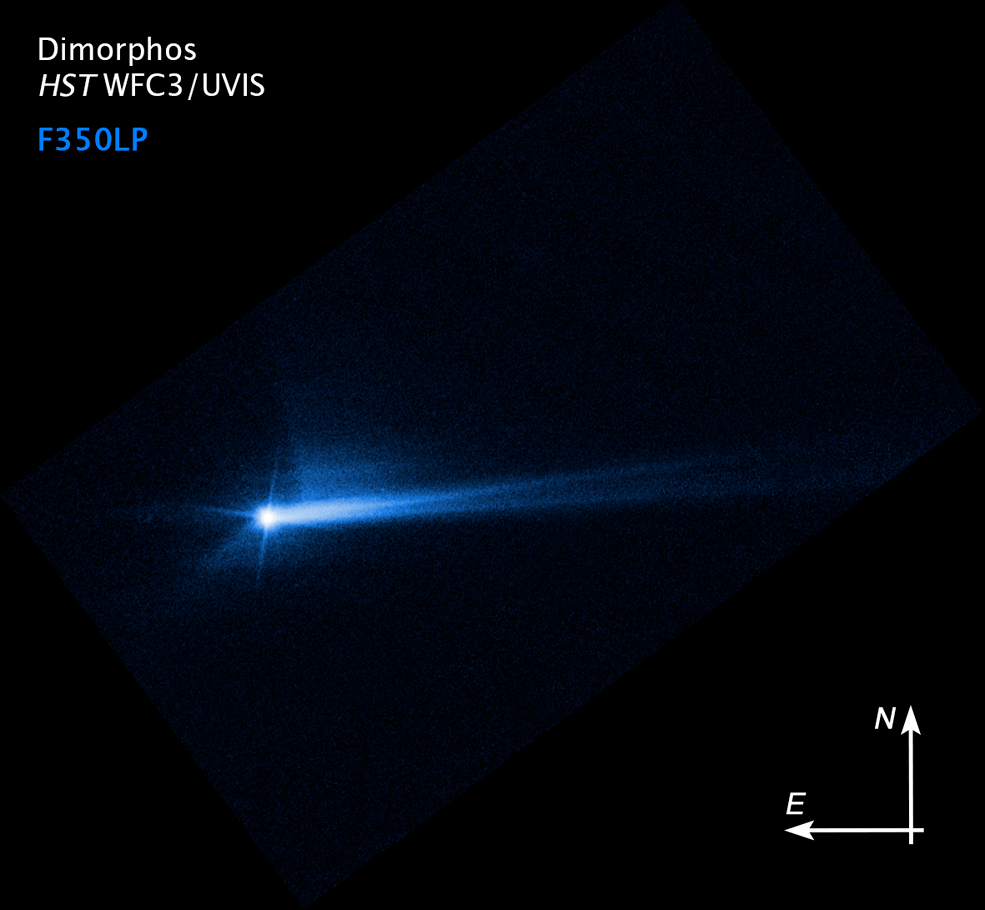
Image (Credit): The image above was taken on October 8, 2022 by NASA’s Hubble Space Telescope. It shows the debris blasted from the surface of Dimorphos 285 hours after the asteroid was intentionally hit by NASA’s DART spacecraft on September 26th. NASA stated that the shape of that tail has changed over time. ( NASA/ESA/STScI/Hubble)
NASA has saved the Earth, or it would have had the asteroid Dimorphos and its partner been heading towards us. That is the news from earlier today from the space agency. NASA’s Administrator Bill Nelson made the following comments regarding the results of the impact by the Double Asteroid Redirection Test (DART) spacecraft:
This mission shows that NASA is trying to be ready for whatever the universe throws at us. NASA has proven we are serious as a defender of the planet. This is a watershed moment for planetary defense and all of humanity, demonstrating commitment from NASA’s exceptional team and partners from around the world.
NASA scientists determined that the orbit of Dimorphos around its parent asteroid, Didymos, was truncated by 32 minutes as a result of the impact. Since minimum success would have been 1 minute 13 seconds, DART was a great success.
Hollywood may prefer a more dramatic method with oil rig astronauts and nuclear bombs, but sometimes a simple nudge will do the job.
“We are going to keep flying [to the] International Space Station as long as our new infrastructure [is being] buil[t]. We don’t know yet how it’s going to be built and what kind of modules we will have, but I’m sure that we will stay in international partnership when we fly [to the] ISS and [the] future station and future infrastructure is also going to be with international partnership.”
–Statement by Sergei Krikalev, executive director of human space flight programs at Roscosmos, during an October 5th briefing following the successful SpaceX launch of the latest crew to the International Space Station (ISS), which included Russian cosmonaut Anna Kikina. His comments were seen as part of a continuing Russian clarification of earlier comments about the Russians leaving the ISS in 2024. It appears the Russian will be staying with the station even longer, even if this support does not last until 2030.
Image (Credit): October 5, 2022 departure of a SpaceX Falcon 9 rocket from the Kennedy Space Center in Florida carrying NASA’s SpaceX Crew-5 mission to the ISS. (NASA/Joel Kowsky)
Earlier today, SpaceX Crew-5 successfully departed from NASA’s Kennedy Space Center in Florida on their way to the International Space Station (ISS). The four members on this flight are NASA astronauts Nicole Mann and Josh Cassada, Japan Aerospace Exploration Agency astronaut Koichi Wakata, and Roscosmos cosmonaut Anna Kikina. The population of the ISS will increase to 11 until 3 astronauts return to Earth a few days later.
Here is NASA’s bio on the new crew members:
As commander, Mann is responsible for all phases of flight, from launch to re-entry, and will serve as an Expedition 68 flight engineer. This will be her first spaceflight since becoming an astronaut in 2013. Mann was born in Petaluma, California, and will be the first indigenous woman from NASA in space. She is a colonel in the U.S. Marine Corps, and she served as a test pilot in the F/A-18 Hornet and Super Hornet.
Cassada is the spacecraft pilot and second in command for the mission. He is responsible for spacecraft systems and performance. Aboard the station, he will serve as an Expedition 68 flight engineer. This will be his first flight since his selection as an astronaut in 2013. Cassada grew up in White Bear Lake, Minnesota, and is a physicist and U.S. Navy test pilot.
Wakata will be making his fifth trip to space and as a mission specialist he will work closely with the commander and pilot to monitor the spacecraft during the dynamic launch and re-entry phases of flight. Once aboard the station, he will serve as a flight engineer for Expedition 68. With Crew-5’s launch, Dragon will be the third different type of spacecraft Wakata has flown to space.
Kikina will be making her first trip to space, and will serve as a mission specialist, working to monitor the spacecraft during the dynamic launch and re-entry phases of flight. She will be a flight engineer for Expedition 68.
October 1 is a significant date for two of the world’s largest space agencies.
On this day in 1958, NASA had its first day of operations after being created a few months earlier by President Eisenhower in the National Aeronautics and Space Act of 1958. Here is more about the creation of the Agency as noted by NASA’s History Division:
On this date the National Aeronautics and Space Administration began operation. At the time it consisted of only about 8,000 employees and an annual budget of $100 million. In addition to a small headquarters staff in Washington that directed operations, NASA had at the time three major research laboratories inherited from the National Advisory Committee for Aeronautics-the Langley Aeronautical Laboratory established in 1918, the Ames Aeronautical Laboratory activated near San Francisco in 1940, and the Lewis Flight Propulsion Laboratory built at Cleveland, Ohio, in 1941-and two small test facilities, one for high-speed flight research at Muroc Dry Lake in the high desert of California and one for sounding rockets at Wallops Island, Virginia. It soon added several other government research organizations.
Today NASA has a budget of about $24 billion and approximately 17,000 employees.
And on this day in 2003, the Japan Aerospace Exploration Agency (JAXA) was formed from a merger of three previous Japanese space agencies – the Institute of Space and Astronautical Science, the National Aerospace Laboratory of Japan, and National Space Development Agency of Japan.
Image (Credit): The Hubble Space Telescope orbiting Earth. (Hubblesite.org)
The Washington Postreports that NASA and SpaceX are looking into the idea of extending the life of the NASA/ESA Hubble Space Telescope, which has already been in service more than 30 years. The space telescope’s orbit has been deteriorating since 2009, when it was last visited for repairs. The current orbit should be okay until the mid-2030s, and then it will fall to Earth.
To keep the Hubble in service for even more years, it would need to be pushed into a higher orbit. This is where SpaceX comes in. It can assist NASA by moving Hubble just 40 miles higher in order to get another 15 to 20 years out of the space telescope.
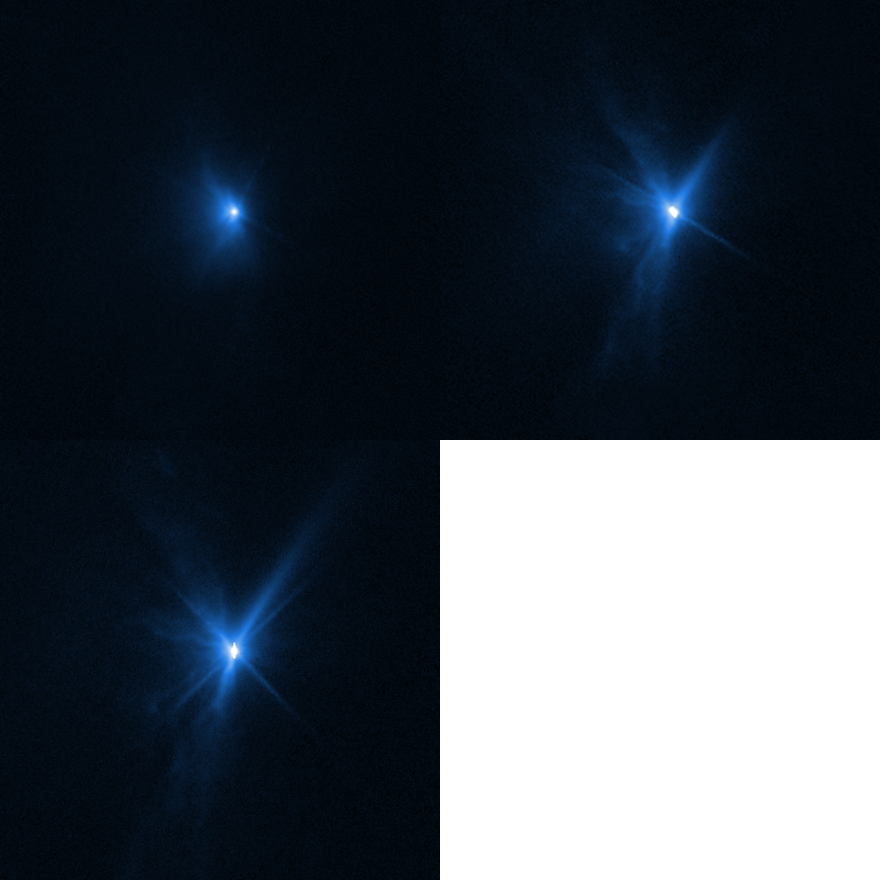
The article notes that the James Webb Space Telescope (JWST) was not developed to replace Hubble but rather to complement it. Hence, the extra life for Hubble means more and better astronomical observations over additional years in conjunction with the JWST. For instance, we will get more shots like the one below where the Hubble captured the Double Asteroid Redirection Test (DART) mission before and after it struck the asteroid.
Update: I have also included the JWST DART image below just to show the two space telescopes can work in tandem.
Image (Credit): This animated GIF combines three of the images NASA’s Hubble Space Telescope captured after NASA’s DART spacecraft intentionally impacted Dimorphos, a moonlet asteroid in the double asteroid system of Didymos. The animation spans from 22 minutes after impact to 8.2 hours after the collision took place. As a result of the impact, the brightness of the Didymos-Dimorphos system increased by 3 times. The brightness also appears to hold fairly steady, even eight hours after impact. (NASA, ESA, Jian-Yang Li (PSI); animation: Alyssa Pagan (STScI))
Image (Credit): This animation gif is a timelapse of images from NASA’s JWST. It covers the time spanning just before impact at 7:14 p.m. EDT, Sept. 26, through 5 hours post-impact. Plumes of material from a compact core appear as wisps streaming away from where the impact took place. An area of rapid, extreme brightening is also visible in the animation. (NASA, ESA, CSA, Cristina Thomas (Northern Arizona University), Ian Wong (NASA-GSFC); Joseph DePasquale (STScI))







 Our Awesome Universe