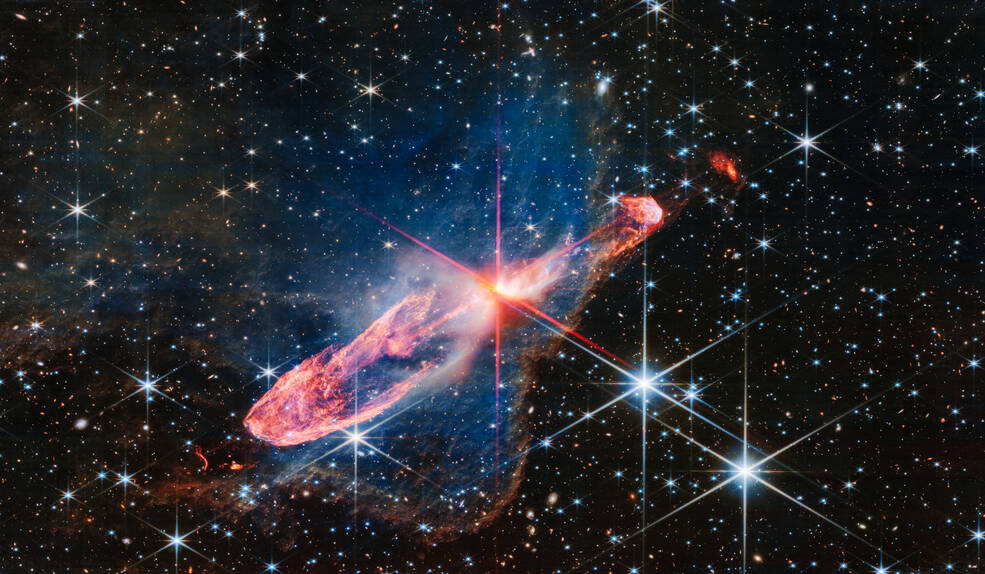
Image (Credit): November 28, 2022 image from NASA’s uncrewed Orion spacecraft when it was nearly 270,000 miles from Earth during the Artemis I flight test. (NASA)
This Sunday, November 11th, will see the return of the Orion spacecraft. Tune into NASA to watch Orion’s re-entry and spashdown. Live splashdown coverage will begin at 11 a.m. EST. The splashdown itself is scheduled for 12:39 p.m. EST. You can watch all of the coverage live on NASA TV, the agency’s website, and the NASA app.
Image (Credit): The Artemis I recovery team aboard the USS Portland in the Pacific Ocean. The team is out at sea ahead of the Dec. 11 Orion splashdown. (NASA)
Image (Credit): A trasch bag lying beneath the Apollo Lunar Module in 1969. (NASA)
Back in July 2019, Vox had a great article about the waste astronauts left behind on the Moon. In the article, “Apollo Astronauts Left Their Poop on the Moon. We Gotta Go Back for That Shit.,” we learn about approximately 96 bags of human waste left behind on the moon. The topic is relevant today because (1) we are talking about returning to the Moon under the Artemis mission and (2) we probably want to learn more about the lifespan of this waste before we continue to deposit it on the Moon, Mars, and elsewhere. So maybe it is time to revisit the poop.
Earlier, The Atlantic had another article that listed much more human debris on the Moon than just the 96 bags (of urine, feces, and vomit, mind you). Here is the incomplete list:
more than 70 spacecraft, including rovers, modules, and crashed orbiters;
5 American flags;
2 golf balls;
12 pairs of boots;
TV cameras;
film magazines;
96 bags of urine, feces, and vomit;
numerous Hasselbad cameras and accessories;
several improvised javelins;
various hammers, tongs, rakes, and shovels;
backpacks;
insulating blankets;
utility towels;
used wet wipes;
personal hygiene kits;
empty packages of space food;
a photograph of Apollo 16 astronaut Charles Duke’s family;
a feather from Baggin, the Air Force Academy’s mascot falcon, used to conduct Apollo 15’s famous “hammer-feather drop” experiment;
a small aluminum sculpture, a tribute to the American and Soviet “fallen astronauts” who died in the space race—left by the crew of Apollo 15;
a patch from the never-launched Apollo 1 mission, which ended prematurely when flames engulfed the command module during a 1967 training exercise, killing three U.S. astronauts;
a small silicon disk bearing goodwill messages from 73 world leaders, and left on the moon by the crew of Apollo 11;
a silver pin, left by Apollo 12 astronaut Alan Bean;
a medal honoring Soviet cosmonauts Vladimir Komarov and Yuri Gagarin; and
a cast golden olive branch left by the crew of Apollo 11.
In the 2022 movie Moonshot, we sent Martian trash back to Earth. But that was not the case with the Moon. And now China and Russia are clamoring to do the same in the near future. Will the Moon someday be marked with more trash heaps than craters?
One might argue that explorers throughout time have had to leave something behind. Think of the piles of trash as well as corpses left on the top of Mount Everest. The great sea explorers also left plenty of men, material, and ships at the bottom of the sea where they would remain unclaimed.
But the interesting part of the Vox story is the potential of life remaining in that trash and even producing new life. If such biological material can seed new life, then who can say whether the Earth was simply a rest stop for aliens on their way somewhere else, and we are the product of their poop.
One more thing. If we do manage to let the Earth slip away from us and flip into another Venusian nightmare, the Moon poop may be the only human biology for a future alien to analyze. We sent the Voyager and other spacecraft out into the void with recordings and data, but no one thought about adding a biological component. Well, now we have that surviving piece on the Moon should it be needed. If we can figure out what a Tyrannosaurus was eating millions of years ago, maybe future visitors can figure out what the astronauts were eating in 20th century Texas.
Intense stuff, and worth reading about when you have a moment.
Image (Credit): NGC 2260 in the constellation Vela. (NASA, ESA, and T. von Hippel (Embry-Riddle Aeronautical University); Processing: Gladys Kober (NASA/Catholic University of America))
This week’s image containing all of the sparkling stellar glitter is from the Hubble Space Telescope. Hubble continues to astound with an ongoing stream of amazing images.
This glittering group of stars, shining through the darkness like sparks left behind by a firework, is NGC 2660 in the constellation Vela, best viewed in the southern sky. NGC 2660 is an open cluster, a type of star cluster that can contain anywhere from tens to a few hundreds of stars loosely bound together by gravity. The stars of open clusters form out of the same region of gas and dust and thus share many characteristics, such as age and chemical composition. Unlike globular clusters – their ancient, denser, and more tightly-packed cousins – open clusters are easier to study since astronomers can more easily distinguish between individual stars. Their stars can be old or young, and they may disperse after a few million years into the spiral or irregular galaxies where they are born.
The spikes surrounding many of the stars in this image are “diffraction spikes,” which occur when the glow from bright points of light reflects off of Hubble’s secondary mirror support. The bright red object to the left with the very prominent diffraction spikes is a foreground star that is not part of the cluster. Hubble observed this open cluster as part of a program to study the ages of white dwarf stars in open clusters.
Image (Credit): View of the Earth from the Apollo 11 Command and Service Module. (NASA)
“Lunar orbit would be filled with many more satellites, including a lunar GPS network and a human space station capable of housing human astronauts that serves as a rest stop before they land on the moon’s surface. While there are no plans for a lunar city, there are proposals for a permanent outpost on the south pole of the moon, where crews might one day spend six-month rotations (China and Russia have announced plans for a lunar outpost, too). If NASA has its way, the lunar surface might eventually include a series of nuclear power plants, a resource extraction operation, and even something akin to moon internet. Given these plans, the US government estimates that the level of human activity in cislunar space over the next decade could exceed everything that’s happened there between 1957 and today, combined.”
-Quote from a November 22 Vox article, “The White House’s Plan to Colonize the Moon, Briefly Explained.” The article comments on the recently released report by the White House’s National Science & Technology Council, National Cislunar Science & Technology Strategy. By the way, the term “Cislunar space” in the report refers to “…the three-dimensional volume of space beyond Earth’s geosynchronous orbit that is mainly under the gravitational influence of the Earth and/or the Moon. Cislunar space includes the Earth-Moon Lagrange point regions…, trajectories utilizing those regions, and the Lunar surface.”
Image (Credit): The Earth is seen setting from the far side of the Moon just beyond the Orion spacecraft in this video taken on the sixth day of the Artemis I mission by a camera on the tip of one of Orion’s solar arrays. (NASA)
The Artemis I mission is going well. On day six (November 21), the Orion capsule had a successful flyby of the moon and traveled to within 81 miles of the lunar surface. After a slow start to the launch, NASA engineers must be somewhat relieved.
NASA provided an update on the mission yesterday. You can find many more details on the mission in that one hour briefing.
Stay tuned for some space records later this week, as noted by NASA:
Orion will travel about 57,287 miles beyond the Moon at its farthest point from the Moon on Nov. 25, pass the record set by Apollo 13 for the farthest distance traveled by a spacecraft designed for humans at 248,655 miles from Earth on Saturday, Nov. 26, and reach its maximum distance from Earth of 268,552 miles Monday, Nov. 28.
And be sure to stay abreast of the mission via the Artemis blog.