Image (Credit): The Soyuz MS-22 rocket launch from earlier today. (NASA/Bill Ingalls)
Earlier today, the Russian Soyuz MS-22 rocket launched from Kazakhstan and successfully placed three new inhabitants on the International Space Station (ISS): NASA astronaut Frank Rubio and Russian cosmonauts Sergey Prokopyev and Dmitri Petelin. The three will stay on the ISS for the next six month, while three cosmonauts will be returning to Earth next week after completing their own six month tours.
Even with all of the Russian posturing back on the surface, it is great to see the ISS team is remaining above the fray. That is, if you ignore the flag-waving antics of the three returning cosmonauts. Sorry, I could not leave it alone.
Image (Credit): Artist’s impression of the Chinese Space Station. (China Manned Space Program)
The China Global Television Network recently reported that China is looking into offering space rides to commercial passengers by 2025, including suborbital flights, cargo flights, and trips to Chinese Space Station. For instance, suborbital flights are expected to be priced at 2 and 3 million yuan (or $287,200 to $430,800).
Given the growing U.S. space industry with its own range of space flight options, it was only a matter of time that China would enter this commercial space race. Russia has been in the game the longest, having sold seats to U.S. astronauts hoping to reach the International Space Station (ISS) following the demise of the space shuttle.
Not to be outdone, NASA has also announced plans to take commercial passengers to the ISS at $55 million per seat. According to Tech Times, NASA is seeking commercial partners for two such flights per year starting as early as 2023. We have already discussed the Axiom Mission 1 (or AX-1 mission) to the ISS earlier this year at about the same price, so this is not a new idea. I guess the Axiom Mission 1 went well enough for NASA to see this as a regular operation.
A variety of space travel options from a variety of countries and commercial suppliers shows that playing in space can be both fun and profitable. Just ask Captain Kirk.
That is fine, as long as the tourists do not get in the way of the real work that is being conducted. With the taxpayers still footing most of the space-faring bill, we do not want space travel to be seen as only a luxury for the wealthy (similar to electric vehicles in the U.S., up to now). Space and related space travel should be seen as something belonging to everyone.
Image (Credit): (NASA/JPL-Caltech/University of Arizona)
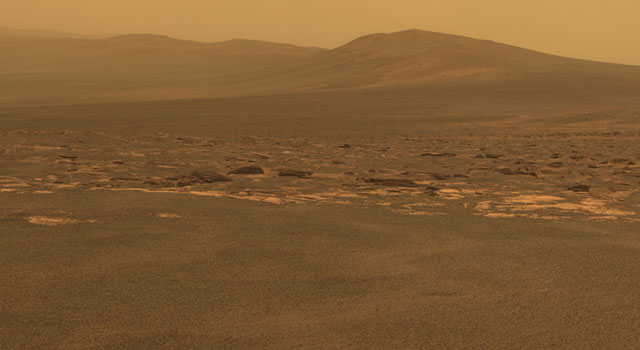
This week’s image is from NASA’s Mars Reconnaissance Observer. The Martian surface looks magical as we see the effects of water and ice. We tend to see Mars in one way – the view from a lander or rover showing a plain desert-like horizon (shown below) – but from above we can see it is so much more.
Both water and dry ice have a major role in sculpting Mars’ surface at high latitudes. Water ice frozen in the soil splits the ground into polygons. Erosion of the channels forming the boundaries of the polygons by dry ice sublimating in the spring adds plenty of twists and turns to them.
Spring activity is visible as the layer of translucent dry ice coating the surface develops vents that allow gas to escape. The gas carries along fine particles of material from the surface further eroding the channels. The particles drop to the surface in dark fan-shaped deposits. Sometimes the dark particles sink into the dry ice, leaving bright marks where the fans were originally deposited. Often the vent closes, then opens again, so we see two or more fans originating from the same spot but oriented in different directions as the wind changes.
Image (Credit): The view from NASA’s Mars Exploration Rover Opportunity showing a portion of the west rim of Endeavour crater. (NASA/JPL-Caltech/Cornell/ASU)
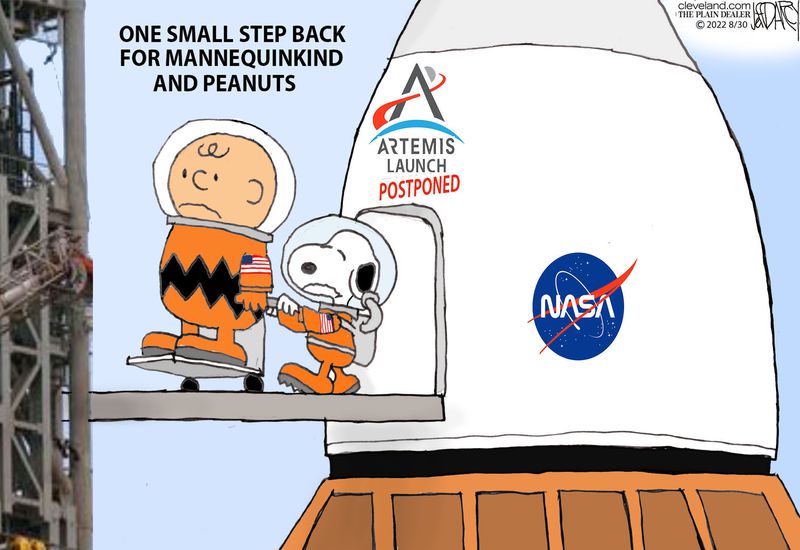
According to Artemis blog, NASA is looking at a new Artemis I launch date of either September 23 or September 27. The blog states NASA has requested the following launch periods:
Sept 23: Two-hour launch window opens at 6:47 a.m. EDT; landing on Oct. 18
Sept. 27: 70-minute launch window opens at 11:37 a.m.; landing on Nov. 5
Someone needs to update NASA’s Artemis I web-page, which as of today still shows a September 3, 2022 launch date.
Success is key for NASA to keep the momentum. Before the planned September 3rd launch, The Economist magazine (paper version) had an article titled “A Flying Turkey,” with the subtitle “The Space Launch System is yesterday’s rocket, powered by yesterday’s technology and brought about by yesterday’s thinking.” In addition to listing the Frankenstein approach used to cobble together a mission that makes reusable components non-reusable, it highlighted the ugly politics out of Alabama under Senator Shelby, calling the rocket system the “Senate Launch System.” The only endearing qualities of the Artemis missions appeared to be the commercial components under the last Artemis phase utilizing commercial partners.
This criticism is not new, but it will continue while NASA struggles to get Artemis I underway. We have already skipped out on the Moon for the last 50 years. Let’s get our heads back in the game!
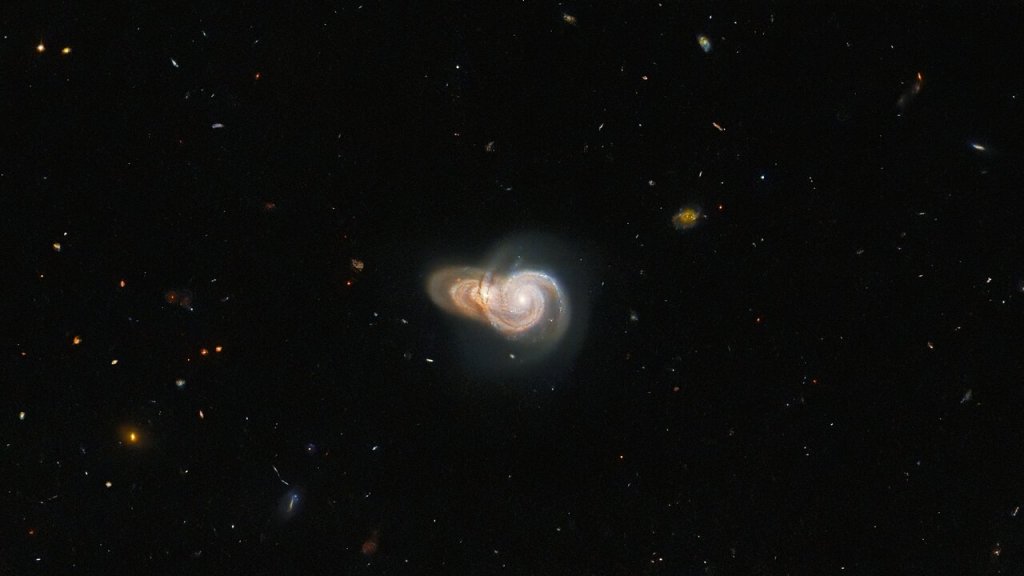
Image (Credit): Two spiral galaxies about 1 billion light-years away captured by the Hubble. (European Space Agency)
This week’s fascinating image from the NASA/ESA Hubble Space Telescope shows what appears to be two colliding spiral galaxies. A cropped version is shown below to highlight the colors. Here is more from ESA:
The two galaxies, which have the uninspiring names SDSS J115331 and LEDA 2073461, lie more than a billion light-years from Earth. Despite appearing to collide in this image, the alignment of the two galaxies is likely just by chance — the two are not actually interacting. While these two galaxies might simply be ships that pass in the night, Hubble has captured a dazzling array of interacting galaxies in the past.



 Our Awesome Universe