
A New Suit for the Moon Mission

Image (Credit): Space suits in the television series Lost in Space. (Netflix)

U.S. companies Axiom Space and Collins Aerospace have been tasked to build new suits for NASA’s astronauts. The suits will be worn as part of the Artemis Program returning astronauts to the Moon. First, the new suits will be tested and used on the International Space Station (ISS).

While both companies are still in the early stages of developing the next space suite, the $3.5 billion Extravehicular Activity Services (xEVAS) Contract will support this development and production.

In a press release, Mark Kirasich, deputy associate administrator of NASA’s Artemis Campaign Development Division, stated:

Our commercial partnerships will help realize our human exploration goals…We look forward to using these services for NASA’s continued presence in low-Earth orbit and our upcoming achievement of returning American astronauts to the Moon’s surface. We are confident our collaboration with industry and leveraging NASA’s expertise gained through over 60 years of space exploration will enable us to achieve these goals together.

You may recognize the name Axiom Space. It was the company that worked with SpaceX to put private citizens on the ISS with its Axiom Mission 1 (Ax-1). It is also developing the world’s first commercial space station, the Axiom Station.

Collins Aerospace, part of Raytheon Technologies, has plenty of experience with space suits. The company designed the spacesuit used by the Apollo mission astronauts who landed on the moon. It also designed the space suits currently in use for missions outside the ISS.

NASA’s FY 2023 Budget Request

Credit: NASA

So what else did NASA Administrator Bill Nelson share with the Senate Committee on Appropriations last week (beyond his comments about the International Space Station)? In his prepared statement regarding NASA’s $26 billion budget request, he highlighted a number of priorities for his agency, including:

  • the Artemis Program to bring astronauts back to the Moon and related exploration costs – $7.5 billion;
  • continued support for the ISS – $4.3 billion;
  • the space technology research and development portfolio for the Moon, Mars, and other areas, such as sending the CAPSTONE CubeSat to the Moon as a pathfinder for the Artemis program – $1.44 billion;
  • greater science funding for projects such as exploring solutions for bringing the samples of Martian rock and soil collected by the Perseverance rover to Earth through the Mars Sample Return mission – $8 billion; and
  • supporting the civil aviation manufacturing sector with test flights on its Low Boom Flight Demonstrator, which will enable environmentally and socially acceptable supersonic passenger flights, as well as continued work on the X-57 Maxwell, an all-electric aircraft – $971 million.

NASA certainly has a lot on its place, and I did not even highlight the focus on Earth iteself, such as the planned Earth System Observatory, which is an array of satellites, instruments, and missions designed to generate a 3D, holistic view of the entire planet.

We just provided a $40 billion aid package to Ukraine so that it can defend itself and have a better future. This $26 billion will take us out of the realm of Earth-bound conflicts and allow us to find our future in the stars, or at least the solar system. It is money well spent.

World’s First Liquid Mirror Telescope

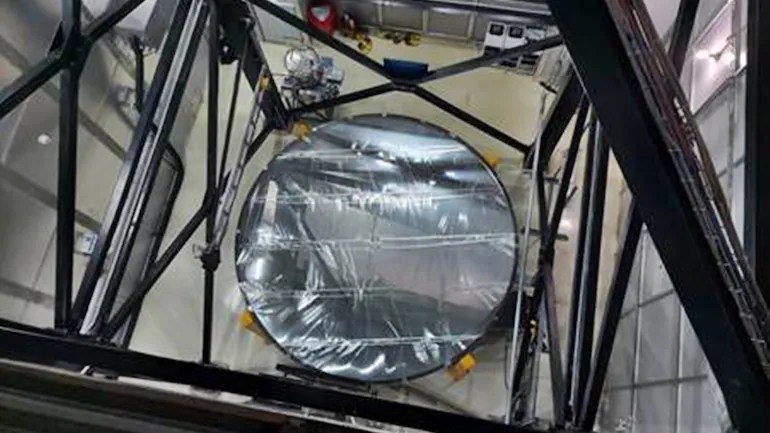
Image (Credit): Top view of the International Liquid Mirror Telescope located at the Devasthal Observatory of the Aryabhatta Research Institute of Observational Sciences showing the liquid mercury mirror covered by a thin mylar film. (India Today)

An earlier post mentioned NASA’s plans for a liquid mirror telescope in space. Well, India now has one here on Earth.

The Indian Express reports that the liquid mirror telescope was designed and built at the Advanced Mechanical and Optical Systems Corporation and the Centre Spatial de Liege, Belgium. While funded by Canada and Belgium, it will be maintained and operated by India. The article states:

India’s first liquid-mirror telescope, which will observe asteroids, supernovae, space debris and all other celestial objects from an altitude of 2,450 metres in the Himalayas, has seen its first light. It has now entered the commissioning phase and will start scientific observations some time in October this year.

Liquid mirror telescopes have a few advantages, including being inexpensive to build and providing a very efficient way to image a large area of the sky. A disadvantage is that such a telescope must lie flat on Earth and can only observe what passes overhead (unlike space where the lack of gravity may offer other options). Even so, India expects to obtain plenty of information using this new form of telescope.

A new way to view the heavens. This may be the start of something pretty amazing.

International Space Station: Russians Still Busy

Image (Credit): Five spaceships are parked at the space station including the SpaceX Dragon Freedom; the Cygnus space freighter; the Soyuz MS-21 crew ship; and the Progress 80 and 81 resupply ships.(NASA)

Earlier today, NASA announced that an uncrewed Russian cargo ship, Progress 81, arrived at the International Space Station (ISS) without incident. Work continues among the Americans and Russians aboard the ISS regardless of the situation on the ground, which is reassuring.

As NASA administrator Bill Nelson said last month at a Senate Appropriations Committee hearing, there have been a number of “misleading headlines” about the end of Russia’s participation in the ISS program. He also highlighed how US astronauts were able to work together with Soviets during the Cold war. Specifically, he stated:

I see nothing in the very even-keeled professional relationship between the cosmonauts and the astronauts, between mission control in Moscow and Houston, in the training of Russian cosmonauts in America and the training of American astronauts in Moscow and Baikonur…I see nothing that has interrupted that professional relationship, no matter how awful Putin is conducting a war with such disastrous results in Ukraine.

Pic of the Week:  Gypsum Dunes on Mars

Image (Credit): Gypsum dunes on Mars. (NASA, Univ. of Arizona’s Lunar & Planetary Laboratory)

This week’s amazing image was taken by the High Resolution Imaging Science Experiment (HiRISE) camera onboard NASA’s Mars Reconnaissance Orbiter launched in 2005. The University of Arizona’s Lunar & Planetary Laboratory, which operates HiRISE, described the image in this way:

This image suggestion outlines a contact between gypsum-rich dunes in Olympia Undae and flat-lying layers of the basal (or bottom) unit. Our goal is to look for a stratigraphic and compositional comparison between the dunes and the basal unit.

Olympia Undae, the largest continuous dune field on Mars,  is in the northern polar region of Mars.