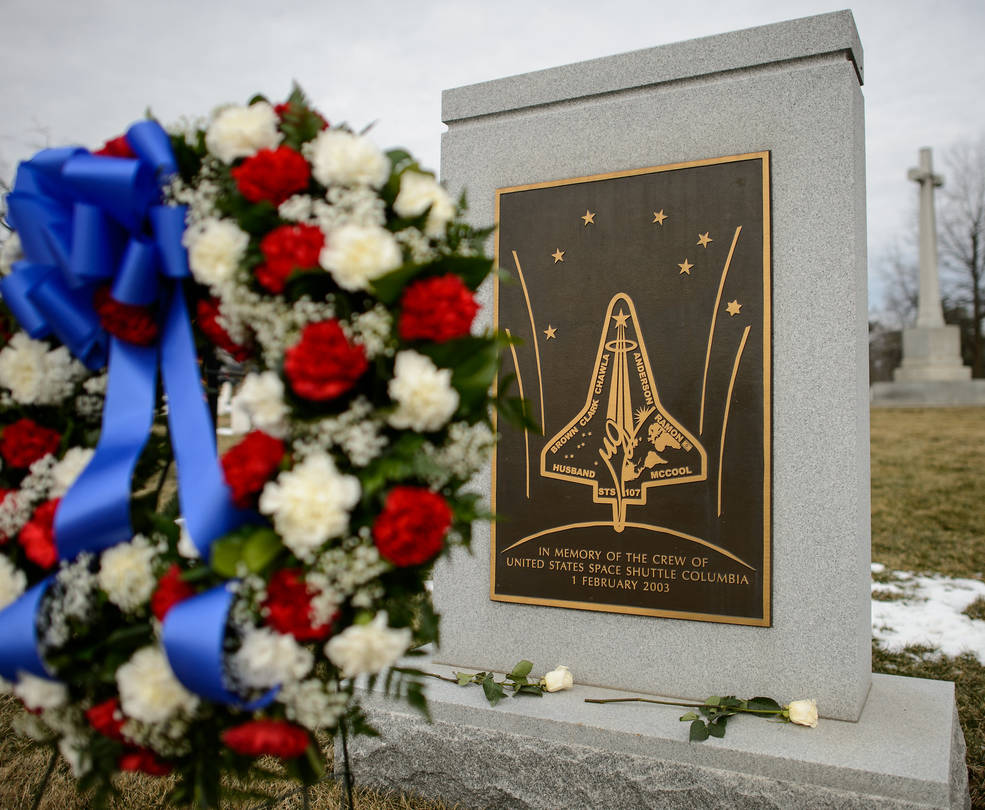
Image (Credit): Space Shuttle Columbia Memorial. (NASA)
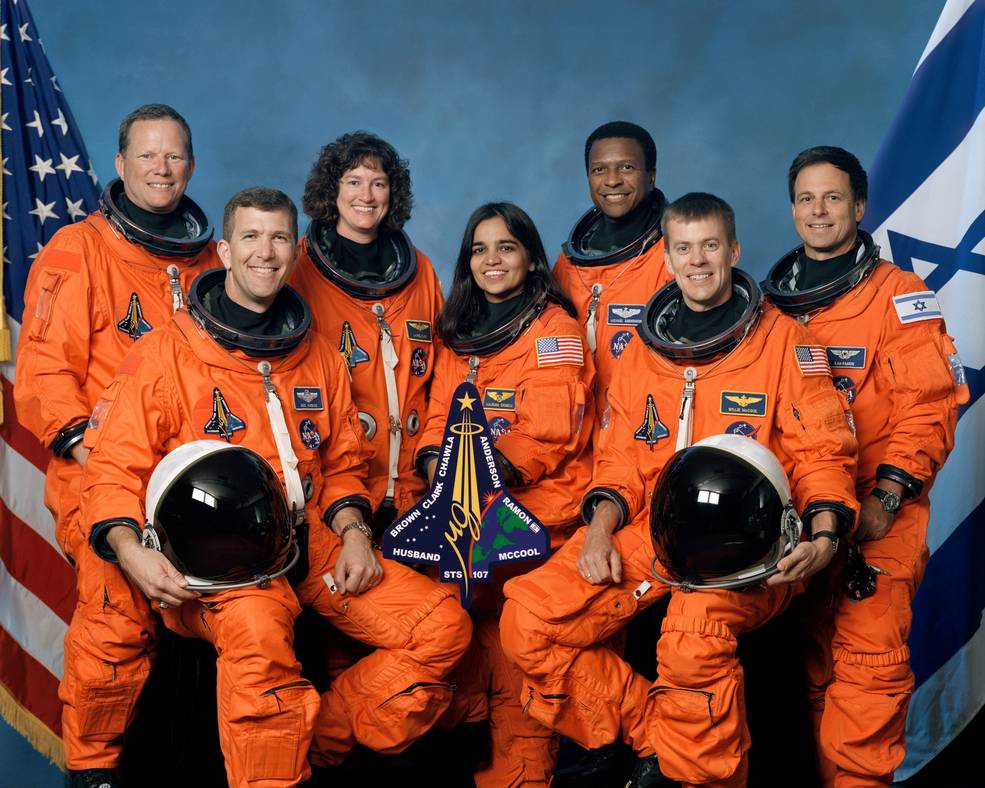
On this day in 2003, the STS-107 mission aboard NASA’s oldest space shuttle Columbia came to a horrible end when the shuttle disintegrated upon reentry. That day we lost crew members David M. Brown, Rick D. Husband, Laurel B. Clark, Kalpana Chawla, Michael P. Anderson, William C. “Willie” McCool, and Ilan Ramon. It was just 17 years after losing the crew on the space shuttle Challenger.
At the memorial service for the astronauts, President George W. Bush stated:
This cause of exploration and discovery is not an option we choose; it is a desire written in the human heart. We are that part of creation which seeks to understand all creation. We find the best among us, send them forth into unmapped darkness, and pray they will return. They go in peace for all mankind, and all mankind is in their debt.Yet, some explorers do not return. And the loss settles unfairly on a few.
You can learn more about the STS-107 mission here.
Image (Credit): STS-107 crew members David M. Brown, left, Rick D. Husband, Laurel B. Clark, Kalpana Chawla, Michael P. Anderson, William C. “Willie” McCool, and Ilan Ramon.(NASA)
Image (Credit): Former NASA astronauts Robert Behnken, left, and Douglas Hurley, right, and are seen after being awarded the Congressional Space Medal of Honor by Vice President Kamala Harris during a ceremony in the Eisenhower Executive Office Building. (NASA/Joel Kowsky)
On behalf of President Joe Biden, Vice President Kamala Harris awarded former NASA astronauts Douglas Hurley and Robert Behnken the Congressional Space Medal of Honor Tuesday for their bravery in NASA’s SpaceX Demonstration Mission-2 (Demo-2) to the International Space Station in 2020. Hurley and Behnken are the first recipients of the honor since 2006 and accepted the awards during a televised event in Washington.
Scientists using NASA’s new James Webb Space Telescope say they’ve been able to get a closer look at an asteroid that also hosts just the fifth ring system to be discovered in our solar system (the others circle Saturn, Jupiter, Uranus and Neptune). Astronomers initially discovered the rings in 2013 while watching Chariklo occult, or pass in front of, a distant star. To their surprise, two other smaller objects also appeared to pass in front of the background star for an instant. These turned out to be two thin rings around Chariklo.
In 2008, HR8799 was the first extrasolar planetary system ever directly imaged. Now, the famed system stars in its very own video. Using observations collected over the past 12 years, Northwestern University astrophysicist Jason Wang has assembled a stunning time lapse video of the family of four planets — each more massive than Jupiter — orbiting their star. The video gives viewers an unprecedented glimpse into planetary motion.
Image (Credit): Image from “Where is Juno” earlier today showing its approximate location in relation to other bodies in the solar system. (NASA)
Are we witnessing the slow blinding of the Juno spacecraft? NASA is having trouble receiving images from the spacecraft’s solar-powered JunoCam. As a result, of the 258 images recently obtained by NASA, only 44 were usable. NASA is still investigating this issue and hopes to come up with a way to mitigate it.
Launched in August 2011, Juno has been a reliable workhorse studying the secrets of Jupiter while also capturing amazing images of the planet and its 80+ moons since it entered into Jovian orbit on July 4, 2016. Its extended mission was supposed to last until September 2025, harvesting additional data to assist NASA’s upcoming Europa Clipper mission as well as the European Space Agency’s Jupiter Icy Moons Explorer (JUICE) mission.
While Juno has numerous scientific instruments that are still plugging away producing key data on Jupiter and its surroundings, the images were an important link between the mission and the public. The images shown below are just a small sample of what has been sent back (click here for more). It will be a sad day when we can no longer see the Jovian neighborhood in this way.
Image (Credit): The shadow of the moon Io on Jupiter. (NASA/JPL-Caltech/SwRI/MSSS)
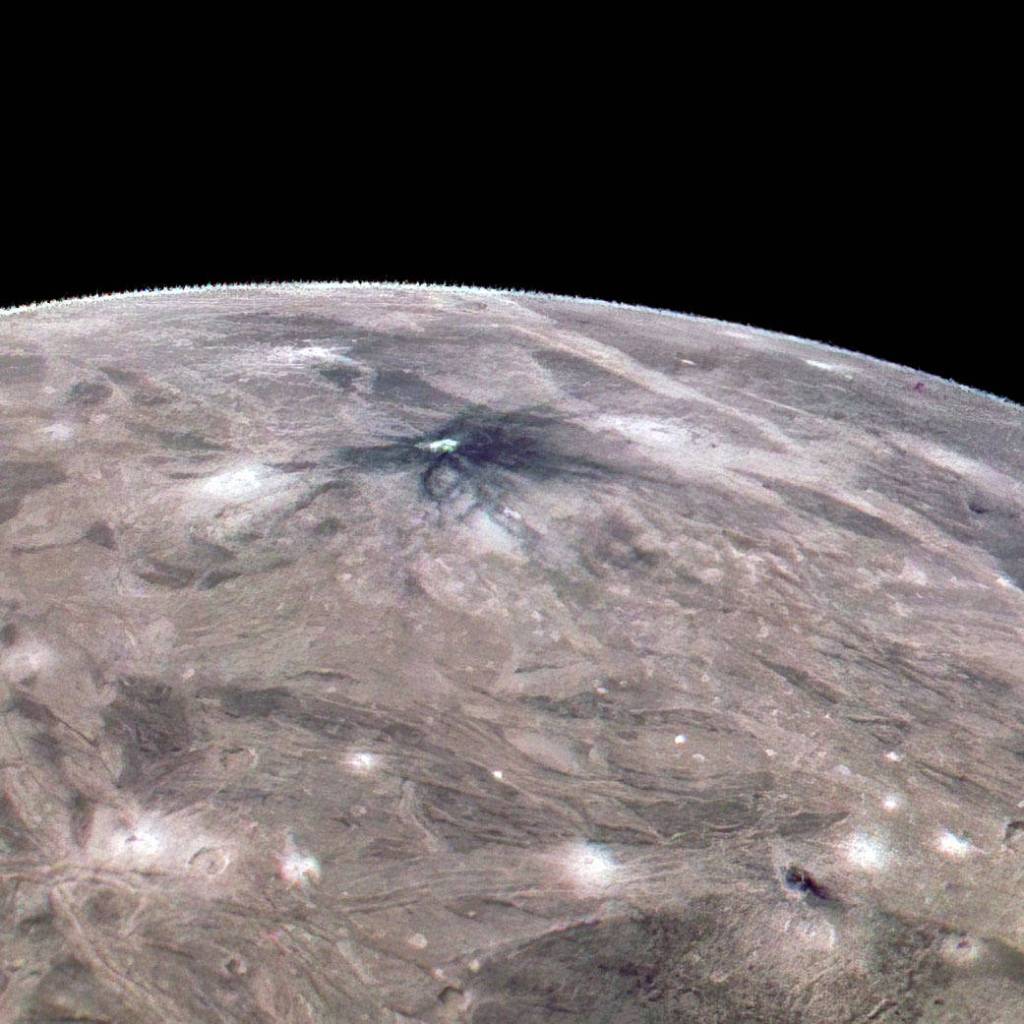
Image (Credit): The surface of Jupiter’s moon Ganymede. (NASA/JPL-Caltech/SwRI/MSSS)
Image (Credit): Jupiter’s south pole. (NASA/JPL-Caltech/SwRI/MSSS/John Landino)
“The space domain is critical to modern commerce, scientific discovery, and national security. The ability to accomplish leap-ahead advances in space technology through the DRACO nuclear thermal rocket program will be essential for more efficiently and quickly transporting material to the Moon and eventually, people to Mars.”
–Statement by Dr. Stefanie Tompkins, director of the Defense Advanced Research Projects Agency (DARPA), regarding its partnership with NASA on the Demonstration Rocket for Agile Cislunar Operations (DRACO) program to design and develop a nuclear thermal rocket engine that can bring a crewed mission to the Red Planet. It’s another encouraging step as we eventually move from the Moon to Mars.
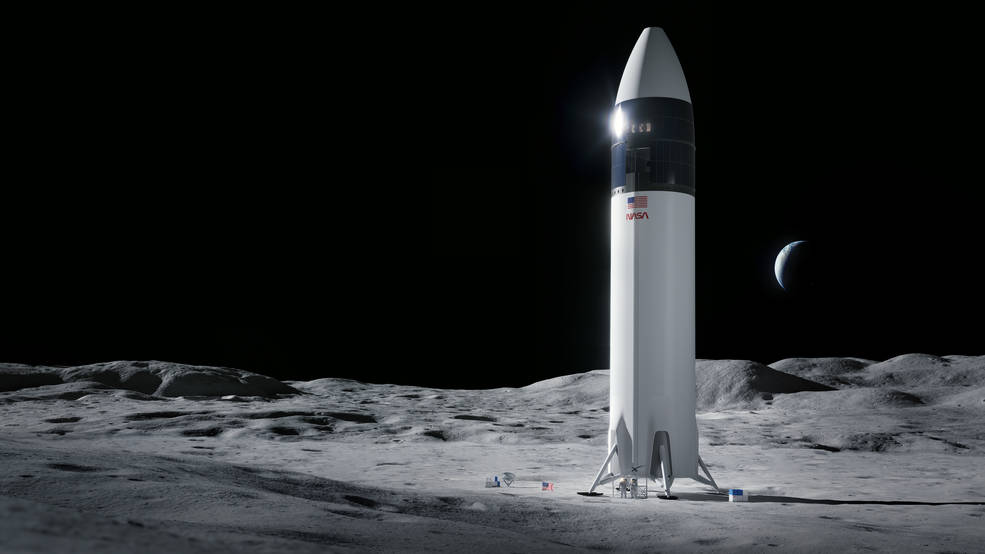
Image (Credit): Arstist’s rendering of SpaceX Starship human landing system design. (SpaceX)
The other week, NASA revealed an update on the Artemis III mission to the Moon in 2025. Now that Artemis I was a success and Artemis II is being readied, Artemis III is becoming much clearer on the horizon. The plan focuses on the first crew to land on the surface, noting that future missions will be involved in building the Gateway lunar space station.
While the Space Launch System (SLS) will get the crew into orbit on Orion, SpaceX has been chosen to bring this first crew to the moon. However, SpaceX will first need to test this human landing system on the Moon without a crew.
The landing site is likely to be on the Moon’s South Pole involving two astronauts who will take the SpaceX human landing system to the surface. They will conduct their research work in Axiom space suits.
It all may have become routine back in the 1970s, but NASA is demoing everything all over again to ensure new systems and new parties are up to par for this return to the Moon. The world is watching again, particularly China. We need to be perfect in this overdue first step back into human space travel.
You can view all of the parts of the mission in the graphic below.