A Day in Astronomy: Lunar Orbiter 4

Image (Credit): An artist’s image of NASA’s Lunar Orbiter at the Moon. (NASA)

On this day in 1967, NASA launched Lunar Orbiter 4 to continue a survey of the Moon (also conducted by three previous Lunar Orbiter missions) in preparation of the Apollo Moon missions. While NASA lost contact with the spacecraft on July 17th, the mission was a success. On October 6th, the spacecraft crashed onto the Moon’s surface. A total of five such missions were conducted, which mapped 99 percent of the Moon.

The rest is history with the successful Apollo missions, still the only program to land humans on the Moon. We shall see who follows in our footsteps, though we will be back on the Moon soon enough as part of the Artemis Program.

You can read more about the Lunar Orbiter missions at this NASA history link. The conclusion on the Lunar Orbiter missions states:

On September 2 Homer E. Newello Associate Administrator for Space Science and Applications, certified that the fifth mission was an unqualified success according to prelaunch objectives. Deputy Administrator Robert C. Seamans, Jr., concurred on September 6. Both NASA officials also assessed the whole program as successful; five missions had been flown out of five planned. Indeed the final Orbiter had capped an impressive effort by the Office of Space Science and Applications to bring man closer to stepping down upon the lunar soil and understanding where it was that he would be landing in the near future…

Five Orbiters had enabled the Manned Space Flight Network to train personnel in tracking and to check out equipment and computer programs for the manned lunar missions beginning with Apollo 8 in December 1968 and including Apollo 10 through 17, of which all but Apollo 10 and 13 landed on the Moon. (Apollo 10 tested the complete spacecraft in lunar orbit and Apollo 13 aborted its landing mission because an onboard oxygen tank exploded in cislunar space.) The Office of Manned Space Flight could not have obtained the needed tracking experience at a timely date if NASA had not flown the five Lunar Orbiter spacecraft.

Not the Remains of a UFO (Really!)

Image (Credit): Remains of the parachute and backshell used to get NASA’s Perseverance rover on Mars. (NASA/JPL-Caltech)

If you came across the wreckage above if your back yard you might think of a UFO or even Martians. Yet instead it is the remains of Earthlings on Mars.

The image comes from a little helicopter launched from NASA’s Perseverance rover on Mars. The Ingenuity Helicopter spotted the remains of the components used to bring the Perseverance rover to a safe landing on Mars last year. Here is more from NASA:

In the images of the upright backshell and the debris field that resulted from it impacting the surface at about 78 mph (126 kph), the backshell’s protective coating appears to have remained intact during Mars atmospheric entry. Many of the 80 high-strength suspension lines connecting the backshell to the parachute are visible and also appear intact. Spread out and covered in dust, only about a third of the orange-and-white parachute – at 70.5 feet (21.5 meters) wide, it was the biggest ever deployed on Mars – can be seen, but the canopy shows no signs of damage from the supersonic airflow during inflation. Several weeks of analysis will be needed for a more final verdict.

It makes me wonder about all the other debris spread across the martian surface. Martian winds will most likely cover much of the debris with time, unlike the surface of our Moon where the artifacts are likely to be apparent for a long time. You can see the impact of dusk on the Chinese Martial rover in an earlier story.

Image (Credit): Another view of the parachute and backshell used to get NASA’s Perseverance rover on Mars. (NASA/JPL-Caltech)

Pic of the Week: Martian Eclipse

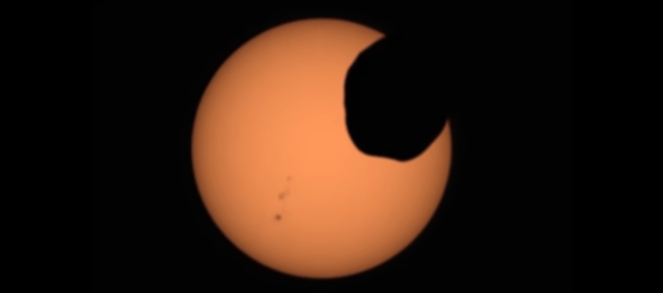
Image (Credit): Eclipse of the Sun by Phobos from the surface of Mars. (NASA/JPL-Caltech/ASU/MSSS/SSI)

This week’s pic is actually a video from NASA’s Perseverance Mars rover capturing Phobos as it partially blocks out the sun. You can see the video here and read more from NASA here.

It is certainly more dramatic than the two shots below from the Martian rover Opportunity in 2004. Deimos is just a speck within the image on the left.

Image (Credit): Eclipse of the Sun by Deimos (left) and Phobos (right) from the surface of Mars. (NASA/JPL/Cornell)

The Latest on Exocomets

Image (Credit): Artist’s drawing of exocomets around the young Beta Pictoris. (NASA/FUSE/Lynette Cook)

We have all heard about exoplanets and exomoons, but what about exocomets? It appears the bodies we can observe outside of our solar system are getting even smaller. In a Scientific American article, “Ukrainian Astronomers Discover ‘Exocomets’ around Another Star,” we learn about Ukrainian astronomers who found five such comets using data from NASA’s Transiting Exoplanet Survey Satellite (TESS).

The comets in question orbit the young star Beta Pictoris, which is about 65 light-years from Earth. This is not the first time comments were detected in this distant solar system’s debris disk. The researchers confirmed those earlier sighting as well. The planet-forming debris surrounding the star presents plenty of opportunities for comet sightings.

Such findings, using information from both the Kepler Space Telescope and TESS, continue to expand our understanding of these objects. Once we focus the James Webb Space Telescope on these little bodies, it should get even more interesting.

Extra: You can find the 2019 Astronomy article on the exocomets around Beta Pictoris here.

Pic of the Week: Stars and Planets over Portugal

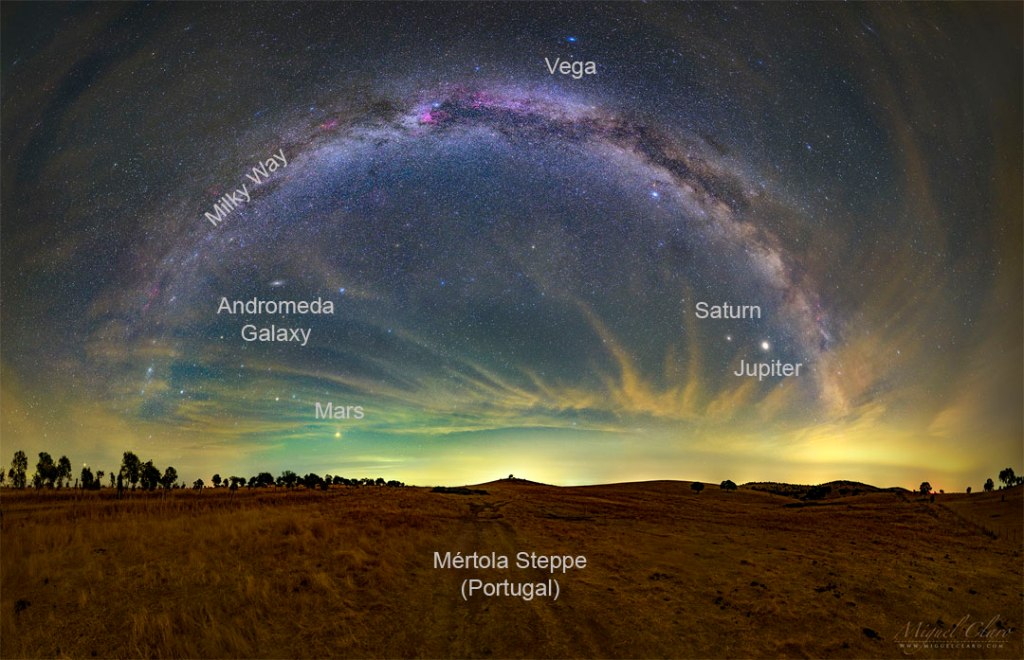
Image (Credit): Night sky in Portugal. (Miguel Claro, The World at Night, Dark Sky Alqueva)

This week’s photo is an amazing night shot in Portugal showing planets, stars, and galaxies. Here is the full description from NASA’s Astronomy Picture of the Day:

The mission was to document night-flying birds — but it ended up also documenting a beautiful sky. The featured wide-angle mosaic was taken over the steppe golden fields in Mértola, Portugal in 2020. From such a dark location, an immediately-evident breathtaking glow arched over the night sky: the central band of our Milky Way galaxy. But this sky had much more. Thin clouds crossed the sky like golden ribbons. The planet Mars appeared on the far left, while the planets Saturn and Jupiter were also simultaneously visible — but on the opposite side of the sky, here seen on the far right. Near the top of the image the bright star Vega can be found, while the far-distant and faint Andromeda Galaxy can be seen toward the left, just below Milky Way’s arch. As the current month progresses, several planets are lining up in the pre-dawn sky: Jupiter, Venus, Mars, and Saturn.