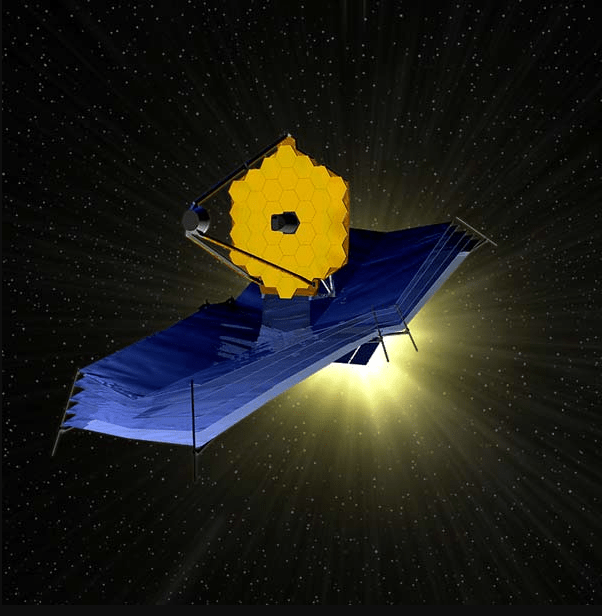
Image (Credits): Artist’s impression of the James Webb Space Telescope. (Northrop Grumman)
“In conclusion, to date, no available evidence directly links Webb to any actions or follow-up related to the firing of individuals for their sexual orientation. However, the research and this report make clear that the Lavender Scare was a painful chapter in our national history. Every effort was made to be as thorough in research and objective in analysis as possible. We must make great efforts to learn from the experience to guarantee that the core values of diversity, equity, accessibility, and inclusion are advanced, not only at NASA, but across the federal government. Only then can we ensure that dark episodes such as the Lavender Scare remain our history and not our future.”
-Concluding statement from the NASA Chief Historian’s report on James Webb, titled NASA Historical Investigation into James E. Webb’s Relationship to the Lavender Scare. As the reports notes, “The central purpose of this investigation was to locate any evidence that could indicate whether James Webb acted as a leader of or proponent for firing LGBTQ+ employees from the federal workforce.” It is sad summary of the federal government’s treatment of its gay employees following World War II, which represents a dark chapter in American history that we only recently left behind.
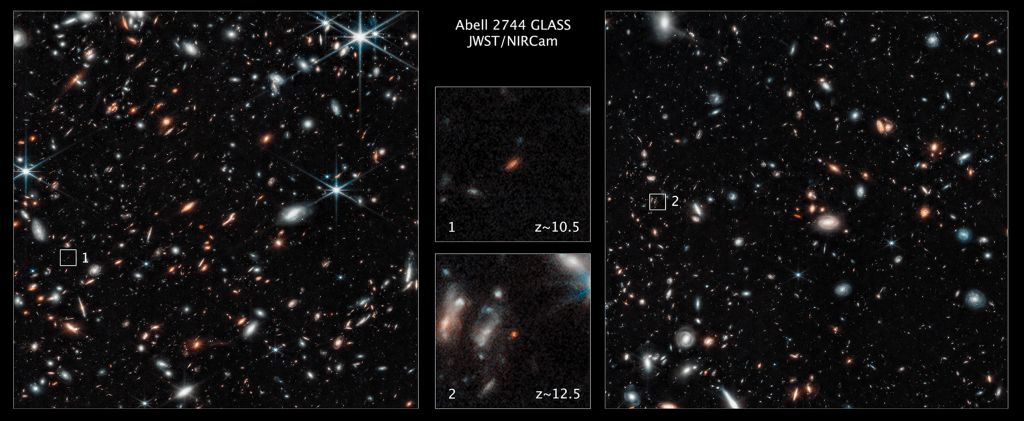
Image (Credit): Two of the farthest galaxies seen to date are captured in these Webb Space Telescope pictures of the outer regions of the giant galaxy cluster Abell 2744. The galaxies are not inside the cluster, but many billions of light-years farther behind it. The galaxy labeled (1) existed only 450 million years after the big bang. The galaxy labeled (2) existed 350 million years after the big bang. Both are seen really close in time to the big bang which occurred 13.8 billion years ago. These galaxies are tiny compared to our Milky Way, being just a few percent of its size, even the unexpectedly elongated galaxy labeled (1). (NASA, ESA, CSA, Tommaso Treu (UCLA), Zolt G. Levay (STScI))
With just four days of analysis, researchers found two exceptionally bright galaxies in the GLASS-JWST images. These galaxies existed approximately 450 and 350 million years after the big bang (with a redshift of approximately 10.5 and 12.5, respectively), though future spectroscopic measurements with Webb will help confirm…“These observations just make your head explode. This is a whole new chapter in astronomy. It’s like an archaeological dig, and suddenly you find a lost city or something you didn’t know about. It’s just staggering,” added Paola Santini, fourth author of the Castellano et al. GLASS-JWST paper.
When Mars was a young planet, it was bombarded by ice asteroids delivering water and organic molecules necessary for life to emerge. According to the professor behind a new study, this means that the first life in our solar system may have been on Mars.
Recently, hundreds of gold-rich stars have been detected by state-of-the-art telescopes worldwide. New simulations of galaxy formation, with the highest resolution in both time and mass, show that these gold-rich stars formed in progenitor galaxies, small galaxies which merged to create the Milky Way…According to the research, most gold-rich stars formed over 10 billion years ago in small, building-block galaxies―known as progenitor galaxies. Some but not all progenitor galaxies experience a neutron star merger, where large amounts of heavy r-process elements are produced and released, enriching that particular small galaxy. The predicted abundance of gold-enriched stars in the final Milky-Way-sized galaxy matches what is actually observed.
Image (Credit): NASA’s Space Launch System rocket carrying the Orion spacecraft launches on the Artemis I flight test, Wednesday, Nov. 16, 2022, from Launch Complex 39B at NASA’s Kennedy Space Center in Florida. (NASA/Bill Ingalls)
After multiple attempts, NASA’s Artemis I mission started earlier today when the Space Launch System took off from the Kennedy Space Center carrying the uncrewed Orion spacecraft. It was a successful start to 25 day mission.
For a third time now, I am providing the mission facts, which are more meaningful given that we have a true launch:
Launch date: Nov. 16, 2022
Mission duration: 25 days, 11 hours, 36 minutes
Total distance traveled: 1.3 miIlion miles
Re-entry speed: 24,500 mph (Mach 32)
Splashdown: Dec. 11, 2022
This first test of the rocket and capsule will get us to the Artemis II mission, which includes a crewed Orion capsule.
Apollo II Astronaut Michael Collins said “I think a future flight should include a poet, a priest and a philosopher . . . we might get a much better idea of what we saw.” At the moment we are sending dummies around the Moon, but let hopes the others follow shortly.
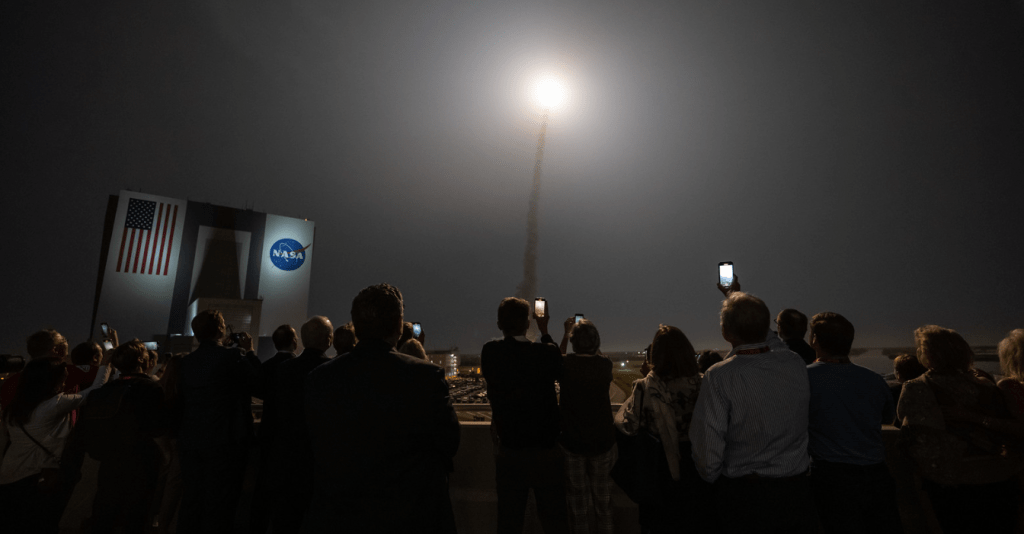
Image (Credit): Guests watch the Artemis I launch on November 16, 2022. (NASA/Bill Ingalls)
Image (Credit): Challenger STS-51L crew members Michael J. Smith, front row left, Francis R. “Dick” Scobee, Ronald E. McNair; Ellison S. Onizuka, back row left, S. Christa McAuliffe, Gregory B. Jarvis, and Judith A. Resnik. (NASA)
“The crew of the space shuttle Challenger honored us by the manner in which they lived their lives. We will never forget them, nor the last time we saw them, this morning, as they prepared for their journey and waved goodbye and ‘slipped the surly bonds of earth’ to ‘touch the face of God.'”
-Statement by President Ronald Reagan addressing the nation from the Oval Office at the White House on January 28, 1986 following the space shuttle Challenger disaster. It seems like a good time to remember the crew given the news this week about debris recovered from the space shuttle. You can find the entire White House address here.
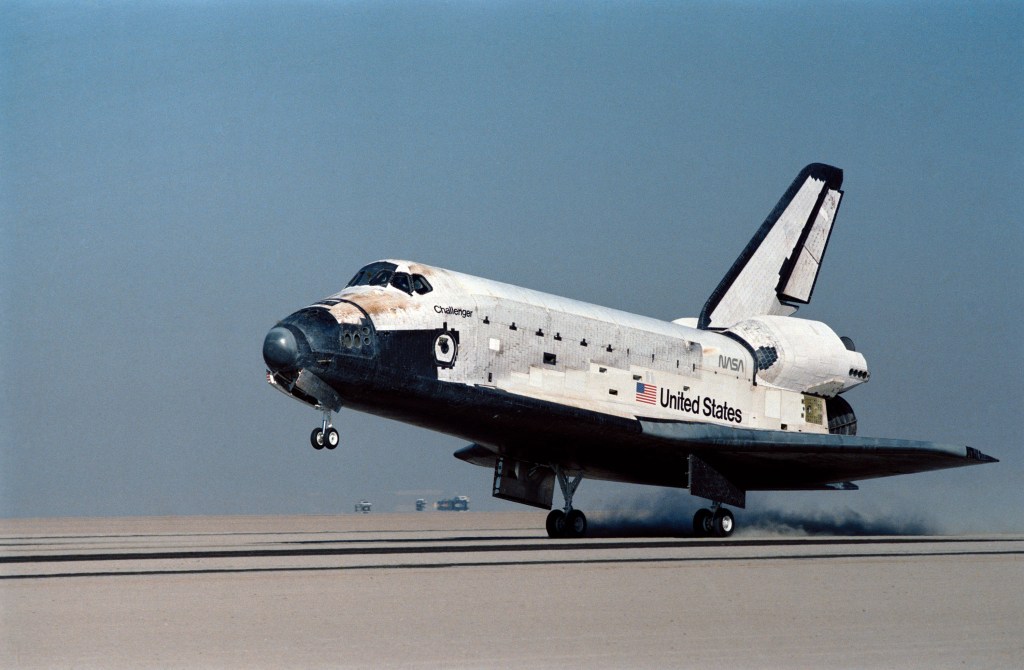
NASA leaders recently viewed footage of an underwater dive off the East coast of Florida, and they confirm it depicts an artifact from the space shuttle Challenger. The artifact was discovered by a TV documentary crew seeking the wreckage of a World War II-era aircraft. Divers noticed a large humanmade object covered partially by sand on the seafloor. The proximity to the Florida Space Coast, along with the item’s modern construction and presence of 8-inch square tiles, led the documentary team to contact NASA.
China has completed a first hot fire test of a fully-assembled powerful new engine that could power new launch vehicles and boost the country’s space capabilities. The full system test of the 500-ton-thrust, dual nozzle kerosene-liquid oxygen staged combustion cycle engine took place on Nov. 5, marking a milestone for the rocket engine.
A Northrop Grumman capsule delivered several tons of supplies to the International Space Station on Wednesday despite a jammed solar panel. The shipment arrived two days after launching from Virginia. Only one of the cargo ship’s two round solar panels opened following liftoff. Flight controllers tried in vain to open the stuck panel, but managed to draw enough power for the flight with just one.