A Liquid Lense? Ideas for Future Telescopes

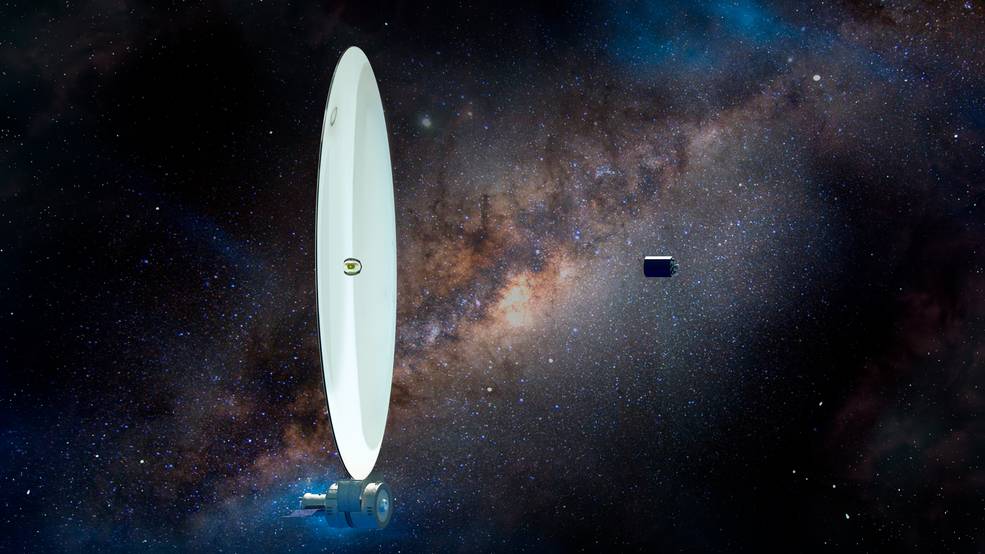
Image (Credit): Artist’s drawing of a possible future giant telescope being created in space using fluids. (NASA & Studio Ella Maru)

NASA has an interesting story about the development of liquid lenses for space telescopes. It’s a fascinating idea as we watch the slow assembly of the James Webb Space Telescope’s (JWST) 18-part mirror. This new approach, which could increase a telescope’s size 100 fold, will be tested aboard the International Space Station (ISS).

Edward Balaban, principal investigator of the Fluidic Telescope Experiment, or FLUTE, at NASA’s Ames Research Center in California’s Silicon Valley stated:

We thought, why not take advantage of the way liquids naturally behave in microgravity and apply it to the construction of large-scale telescopes or space-manufactured optical components that can have all kinds of uses. In microgravity, liquids take on shapes that are useful for making lenses and mirrors, so if we make them in space, they could be used to build telescopes that are dramatically bigger than was previously thought possible.

We are already expecting great things from the JWSP, but what could we learn with a telescope that is 100 times larger? I look forward to the results from the experiment aboard the ISS.

Pic of the Week: The Morning Star

Image (Credit): View of the Earendel star from the Hubble Space Telescope. (NASA)

This week’s image is the most distant star ever detected. It is from light that traveled 12.9 billion years to get to us, representing a star that existed about 1 billion years after the formation of the universe. It has been named Earendel, or “morning star” in Old English. You can learn more about this image from NASA’s Hubble site:

The find is a huge leap further back in time from the previous single-star record holder; detected by Hubble in 2018…The newly detected star is so far away that its light has taken 12.9 billion years to reach Earth, appearing to us as it did when the universe was only 7 percent of its current age, at redshift 6.2. The smallest objects previously seen at such a great distance are clusters of stars, embedded inside early galaxies…The research team estimates that Earendel is at least 50 times the mass of our Sun and millions of times as bright, rivaling the most massive stars known. But even such a brilliant, very high-mass star would be impossible to see at such a great distance without the aid of natural magnification by a huge galaxy cluster, WHL0137-08, sitting between us and Earendel. The mass of the galaxy cluster warps the fabric of space, creating a powerful natural magnifying glass that distorts and greatly amplifies the light from distant objects behind it…Astronomers expect that Earendel will remain highly magnified for years to come. It will be observed by NASA’s James Webb Space Telescope. Webb’s high sensitivity to infrared light is needed to learn more about Earendel, because its light is stretched (redshifted) to longer infrared wavelengths due to the universe’s expansion.

Image (Credit): Detailed view pinpointing the Earendel star from the Hubble Space Telescope. (NASA)

Status of NASA’s Martian Mission

Image (Credit): NASA’s Perseverance Rover on Mars. (NASA)

Now that we have learned a little more about China’s Martian rover, maybe we should check on NASA’s Perseverance Rover. According to a recent press release from NASA, earlier this month Perseverance started its three-mile trip to the river delta on the rim of Jezero Crater after already exploring the Martian surface for about 13 months. This delta may contain evidence of ancient microbial life. As with the Chinese rover mission, the collected samples will be returned to Earth via a later mission.

The Perseverance arrived on the Martian surface February 18, 2021. The mission has already shown success with the Ingenuity Helicopter, while the rover is showing greater abilities to self-navigate. All of this is proving to be promising for future robotic exploration of the planet.

You can get facts about the Perseverance mission here and ongoing updates here.

Cosmonauts Arrive at the International Space Station

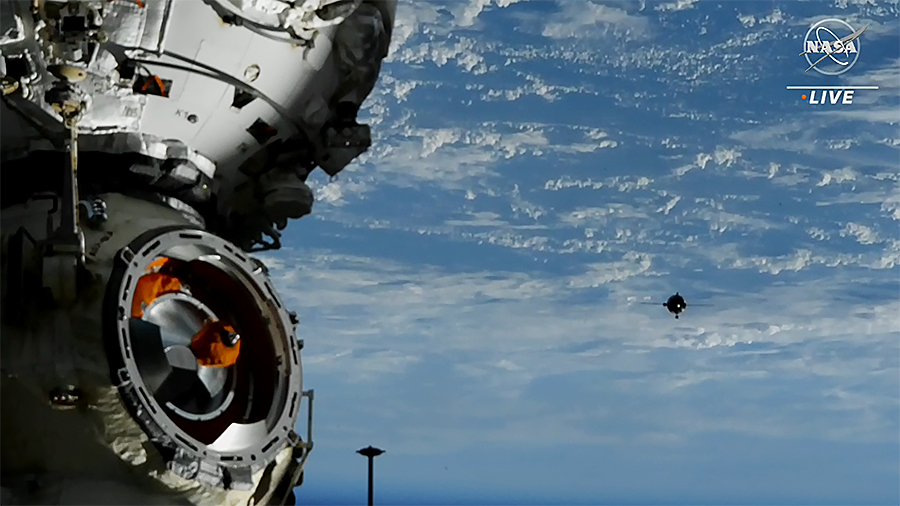
Image (Credit): The Soyuz MS-21 crew ship with three cosmonauts aboard approaches the International Space Station. (NASA)

On Friday, a Soyuz space capsule arrived at the International Space Station (ISS) with three Russian cosmonauts –  Oleg Artemyev, Denis Matveev, and Sergey Korsakov. This will bring the ISS crew to 10. On March 30th, three crew members will return to the surface of the Earth – NASA astronaut Mark Vande Hei and Russian cosmonauts Pyotr Dubrov and Anton Shkaplerov. You can read more about the mission here.

With the ongoing disagreements between the Russian and Western governments regarding Ukraine, it is good to see some normal operations related to the ISS. Let’s hope the science can continue in space while discussions continue back here on Earth to end the ongoing war.

Update: The media was abuzz regarding the blue and yellow outfits of the three astronauts arriving at the station. Was it support for Ukraine or their alma mater? One cosmonaut said there was simply an excess of yellow material. Another space mystery.

A Day in Astronomy: Orbiting Mercury

Image (Credit): Artist’s image of MESSENGER orbiting Mercury (NASA).

On this day in 2011, NASA’s MErcury Surface, Space ENvironment, GEochemistry, and Ranging (MESSENGER) probe became the first spacecraft to orbit Mercury. NASA prepared the 10-year summary below explaining MESSENGER’s accomplishments from the time it was launched on August 3, 2004 through August 1, 2014. The probe later impacted the surface of Mercury on April 30, 2015.

NASA issued this high-level summary of the mission:

The MESSENGER spacecraft fundamentally changed our understanding of Mercury during its four-year orbital exploration of the planet, returning nearly 300,000 photographs and a wealth of information from its instruments. The formatted data totaling more than 10 terabytes reside in NASA’s Planetary Data System archive. Among the major findings were that Mercury harbors water ice and organic compounds at its north pole, that volcanism played a major role in shaping the planet’s surface, and that Mercury’s surface materials are more volatile-rich and chemically reduced than expected.

Image (Credit): 10-Year Summary of MESSENGER’s activities as of August 1, 2014. (NASA)