Hubble and the Unexpected Asteroids

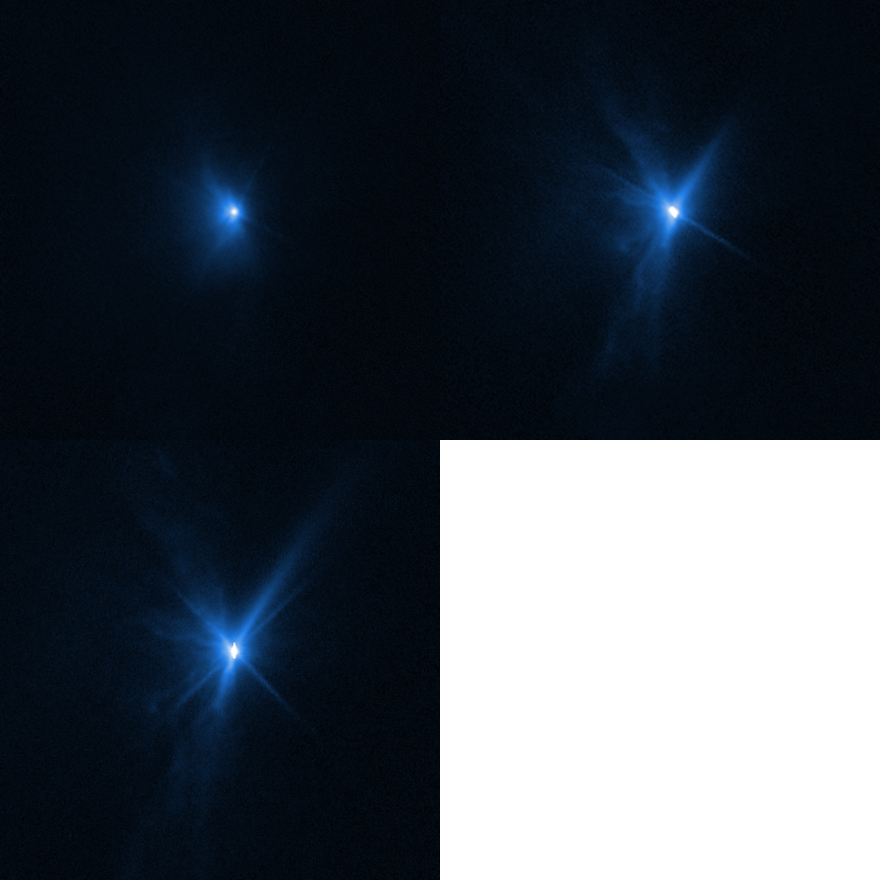
Image (Credit): This Hubble image is a mosaic of many exposures where some asteroids appear multiple times. (NASA, ESA, and B. Sunnquist and J. Mack/STScI)

The Hubble Space Telescope’s old data still holds some secrets. The European Space Agency (ESA) has reported that astronomers have found 1,031 unidentified asteroid trails in earlier data from the NASA/ESA Hubble Space Telescope. The asteroids were located by the Hubble Asteroid Hunter project, which defines the project in this way:

…we use archival images made by the Hubble Space Telescope to find asteroids observed by chance. The ESASky team compared the observation epoch and field of view of these images with the computed orbits of asteroids, to identify possible observations. The positions predicted by the algorithm, nevertheless, have some associated uncertainty because the ephemerides are not always known to great precision. This uncertainty increases with the amount of time between the last observation date and the date we predict the position for. Identifying the asteroids in the images (if present) and marking the exact position of their trail allows us to update the ephemerides and help us better characterise these objects.

More than 11,000 volunteers studied about 37,000 composite images taken by the Hubble between April 2002 and March 2021. The volunteers found about 1,000 asteroid trails, which when combined with other images spotted using artificial intelligence added to 1,701 asteroid trails. Of these, 1,031 are unidentified trails most likely associated with smaller asteroids. The analysis of these unidentified trails will continue.

This is a great example of the public assisting with astronomy and allowing for more timely results. It’s a helpful model for future astronomy endeavors.

Female Dummies in Space?

Image (Credit): The Helga manikin to be used on the Orion capsule to the Moon. (German Aerospace Center)

No, it is not a new television show or a rude comment, but rather a real plan to test the effects of space radiation on manikins that simulate the female body. The test is in preparation for future Artemis missions to the Moon. NASA is concerned about the effects of radiation on female astronauts since their anatomy is different than that of males and may be more prone to certain types of cancer.

As reported by Phys.org, the two manikins – Helga and Zohar – will fly aboard the Orion capsule for about six weeks as part of his first uncrewed flight to the Moon. While Helga will fly in the Orion capsule unprotected, Zohar will be wearing a radiation protection vest. In this way, scientists can study the full effect of the vest.

The experiment was designed by the German Aerospace Center (hence the German manikin names), which has conducted similar studies aboard the International Space Station (ISS). However, the radiation levels for a lunar mission will be much higher than that found on the ISS.

The Artemis mission will be the first time a female leaves low-Earth orbit , so it is essential that we know the potential impact of this trip on females. We wish the best to both Helga and Zohar.

A Day in Astronomy: Lunar Orbiter 4

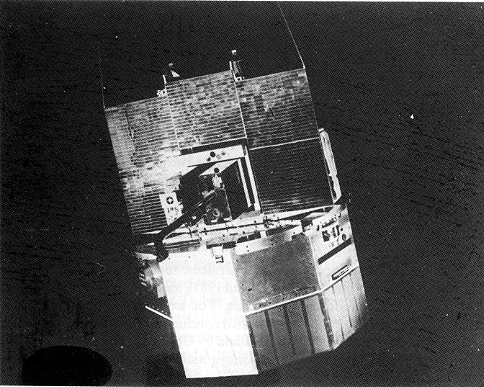
Image (Credit): An artist’s image of NASA’s Lunar Orbiter at the Moon. (NASA)

On this day in 1967, NASA launched Lunar Orbiter 4 to continue a survey of the Moon (also conducted by three previous Lunar Orbiter missions) in preparation of the Apollo Moon missions. While NASA lost contact with the spacecraft on July 17th, the mission was a success. On October 6th, the spacecraft crashed onto the Moon’s surface. A total of five such missions were conducted, which mapped 99 percent of the Moon.

The rest is history with the successful Apollo missions, still the only program to land humans on the Moon. We shall see who follows in our footsteps, though we will be back on the Moon soon enough as part of the Artemis Program.

You can read more about the Lunar Orbiter missions at this NASA history link. The conclusion on the Lunar Orbiter missions states:

On September 2 Homer E. Newello Associate Administrator for Space Science and Applications, certified that the fifth mission was an unqualified success according to prelaunch objectives. Deputy Administrator Robert C. Seamans, Jr., concurred on September 6. Both NASA officials also assessed the whole program as successful; five missions had been flown out of five planned. Indeed the final Orbiter had capped an impressive effort by the Office of Space Science and Applications to bring man closer to stepping down upon the lunar soil and understanding where it was that he would be landing in the near future…

Five Orbiters had enabled the Manned Space Flight Network to train personnel in tracking and to check out equipment and computer programs for the manned lunar missions beginning with Apollo 8 in December 1968 and including Apollo 10 through 17, of which all but Apollo 10 and 13 landed on the Moon. (Apollo 10 tested the complete spacecraft in lunar orbit and Apollo 13 aborted its landing mission because an onboard oxygen tank exploded in cislunar space.) The Office of Manned Space Flight could not have obtained the needed tracking experience at a timely date if NASA had not flown the five Lunar Orbiter spacecraft.

Not the Remains of a UFO (Really!)

Image (Credit): Remains of the parachute and backshell used to get NASA’s Perseverance rover on Mars. (NASA/JPL-Caltech)

If you came across the wreckage above if your back yard you might think of a UFO or even Martians. Yet instead it is the remains of Earthlings on Mars.

The image comes from a little helicopter launched from NASA’s Perseverance rover on Mars. The Ingenuity Helicopter spotted the remains of the components used to bring the Perseverance rover to a safe landing on Mars last year. Here is more from NASA:

In the images of the upright backshell and the debris field that resulted from it impacting the surface at about 78 mph (126 kph), the backshell’s protective coating appears to have remained intact during Mars atmospheric entry. Many of the 80 high-strength suspension lines connecting the backshell to the parachute are visible and also appear intact. Spread out and covered in dust, only about a third of the orange-and-white parachute – at 70.5 feet (21.5 meters) wide, it was the biggest ever deployed on Mars – can be seen, but the canopy shows no signs of damage from the supersonic airflow during inflation. Several weeks of analysis will be needed for a more final verdict.

It makes me wonder about all the other debris spread across the martian surface. Martian winds will most likely cover much of the debris with time, unlike the surface of our Moon where the artifacts are likely to be apparent for a long time. You can see the impact of dusk on the Chinese Martial rover in an earlier story.

Image (Credit): Another view of the parachute and backshell used to get NASA’s Perseverance rover on Mars. (NASA/JPL-Caltech)

Pic of the Week: Martian Eclipse

Image (Credit): Eclipse of the Sun by Phobos from the surface of Mars. (NASA/JPL-Caltech/ASU/MSSS/SSI)

This week’s pic is actually a video from NASA’s Perseverance Mars rover capturing Phobos as it partially blocks out the sun. You can see the video here and read more from NASA here.

It is certainly more dramatic than the two shots below from the Martian rover Opportunity in 2004. Deimos is just a speck within the image on the left.

Image (Credit): Eclipse of the Sun by Deimos (left) and Phobos (right) from the surface of Mars. (NASA/JPL/Cornell)