Where Should NASA Travel To In The Years to Come?

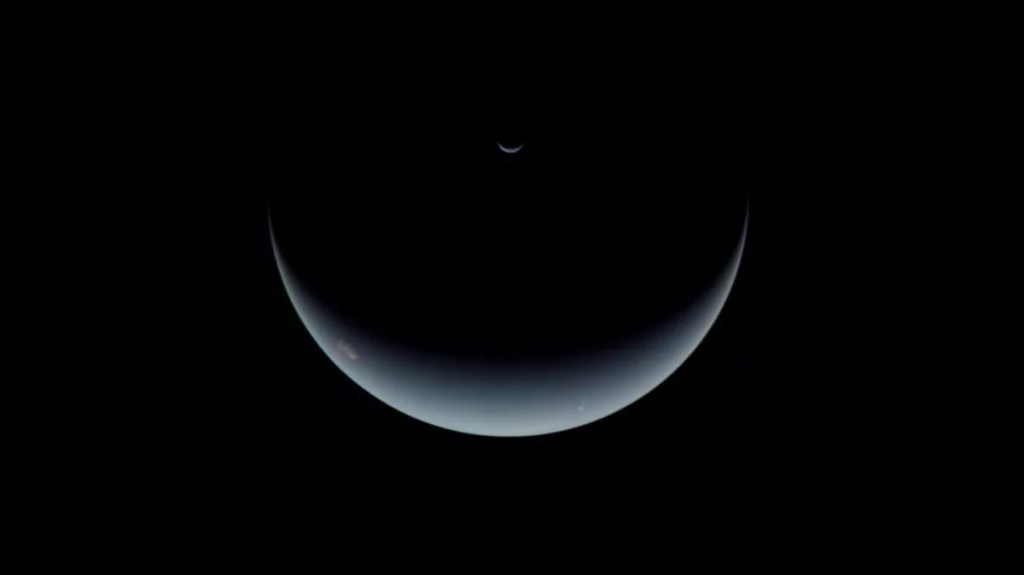
Source/Credit: Voyager 2 image of Neptune and Triton from NASA/JPL-Caltech/Björn Jónsson.

In a recent posting, the non-profit Planetary Society is recommending NASA consider a return to Neptune and its moon Triton, noting that such a mission was part of the plan in the last Decadal Survey in 2010 along with trips to Mars and Europa (both of which are underway). NASA was aiming for Uranus or Neptune, but the Planetary Society stated a preference for Neptune.

The last and only visit to Neptune back in 1989 with NASA’s Voyager 2 spacecraft providing our first close view of the planet. The Voyager 2 mission also led to the discovery of six new moons as well as four rings around the planet. Moreover, the mission detected what may be underground oceans on the moon Triton.

The Planetary Society believes Triton, most likely a captured object from the Kuiper Belt, should be the deciding factor for visiting Neptune rather than Uranus. A 2019 paper, “The NASA Roadmap to Ocean Worlds,” highlights the value of visiting Triton to learn more about its potential oceans:

Triton is deemed the highest priority target to address as part of an Ocean Worlds Program. This priority is given based on the extraordinary hints of activity shown by the Voyager spacecraft (e.g., plume activity; smooth, walled plains units; the cantaloupe terrain suggestive of convection)…and the potential for ocean-driven activity given by Cassini results at Enceladus. Although the source of energy for Triton’s activity remains unclear, all active bodies in the Solar System are driven by endogenic heat sources, and Triton’s activity coupled with the young surface age makes investigation of an endogenic source important. Further, many Triton mission architectures would simultaneously address Ice Giant goals on which high priority was placed in the Visions and Voyages Decadal Survey. Finally, as Triton likely represents a captured Kuiper Belt object (KBO), some types of comparative planetology with KBOs could also be addressed in a Triton mission. Before the next Decadal Survey, a mission study should be performed that would address Triton as a potential ocean world; such a study could be part of a larger Neptune orbiter mission. The Decadal Survey should place high priority on Triton as a target in the Ocean Worlds Program.

The next Decadal Survey is being prepared now and among the papers submitted for consideration is this one highlighted by the Planetary Society – “Neptune and Triton: A Flagship for Everyone.” This paper states that a large strategic mission, called a “Flagship Mission,” to Neptune and Triton would have may benefits:

A Flagship Mission to Neptune and Triton would provide many firsts, an orbiter and atmospheric probe would not only be feasible on a Flagship budget, but achievable given the current state of the technology required by such a venture. This bold mission of exploration would be the first to orbit an ice giant to study the planet, its rings, small satellites, space environment, and the planetsized moon, Triton, itself a captured dwarf planet from the Kuiper Belt and a geophysically reactivated twin of Pluto. Broadly, the mission would address the following questions: How do the interiors and atmospheres of ice giant (exo)planets form and evolve? What causes Neptune’s strange magnetic field, and how do its magnetosphere and aurora work? What are the origins of and connections between Neptune’s rings, arcs, and small moons? Is Triton an ocean world? What causes its plumes? What is the nature of its atmosphere? and how can Triton’s geophysics and composition expand our knowledge of dwarf planets like Pluto?

It sounds like a strong argument to me. I imagine the other 500 or so papers submitted as part of the upcoming Decadal Survey have some other great scientific missions in mind as well. I look forward to seeing the final recommendations to NASA.

SpaceX Junkets?

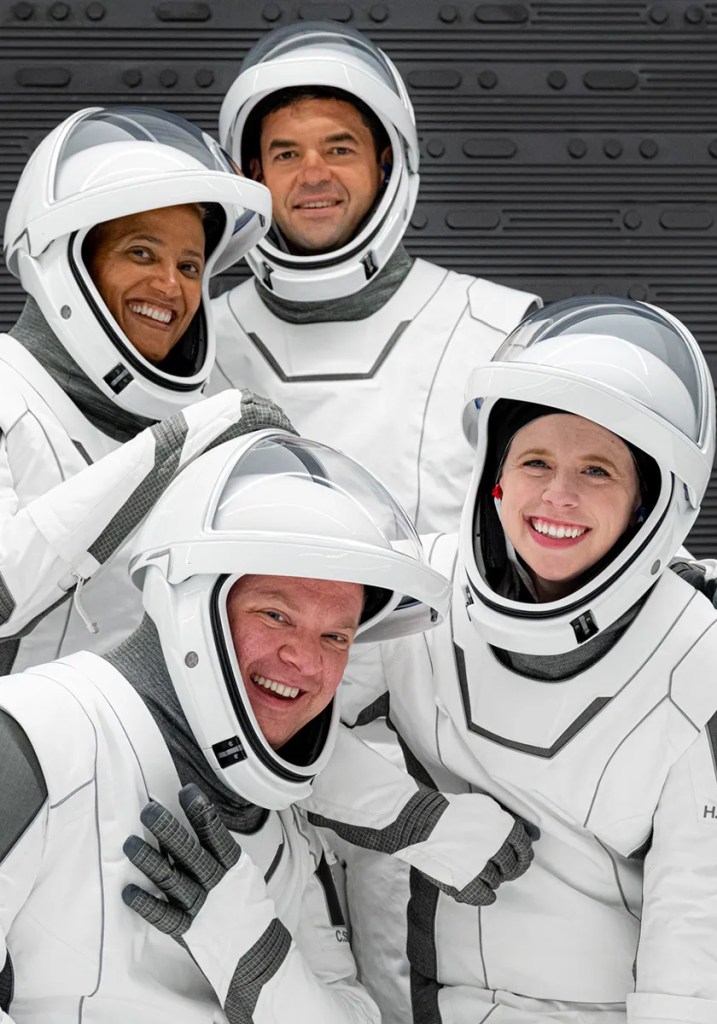
Source/Credit: Inspiration 4 crew from SpaceX.

I guess once was not enough. Billionaire Jared Isaacman wants to spend even more money sending private citizens into space aboard SpaceX spacecraft. He funded his first private flight last September, called Inspiration 4, and now wants to do three more of these flights. The first one raised funds for St. Jude Children’s Research Hospital, whereas it is not clear whether these other voyages also relate to charitable causes.

Space tourism is all the rage these days, with Captain Kirk going up on Blue Origin’s capsule and Virgin Galactic sending Sir Richard Branson into space in preparation of paying customers in the near future. SpaceX always seemed to have more serious goals, but I suppose a buck is a buck.

The first of these three new flights is planned for later this year and will include a spacewalk and science experiments. The second will involve SpaceX’s Dragon, which is currently used for trips to the International Space Station (ISS). The third will involve SpaceX’s Starship created for lunar missions under NASA’s Artemis program.

Apparently, these new missions are expected to “…serve a bigger purpose of opening up space for everyone and making humankind a multiplanetary species, and ideally, have a benefit for the things we’re trying to accomplish back here on Earth.” Once might ask whether this bigger purpose, such as space walks and science experiments, can already be performed by professional astronauts aboard the ISS. It is hard to believe these new vanity missions are critical. And maybe dangerous stunts on such missions should only be performed by a professional team, but Mr. Isaacman wants to command the mission. I cannot see how having an accident on one of these flights will benefit SpaceX. I can still remember the blow-back after sending (and losing) the first teacher to space.

Space is still a dangerous place. Maybe money should not trump everything, including common sense. This seems more like a bored corporate executive spending $500,000 on a new fire truck, setting a few old buildings on fire, and then going in with an inexperienced crew to have fun putting out the blaze while claiming he is advancing the science of firefighting. I am not convinced.

Source/Credit: Walmart.

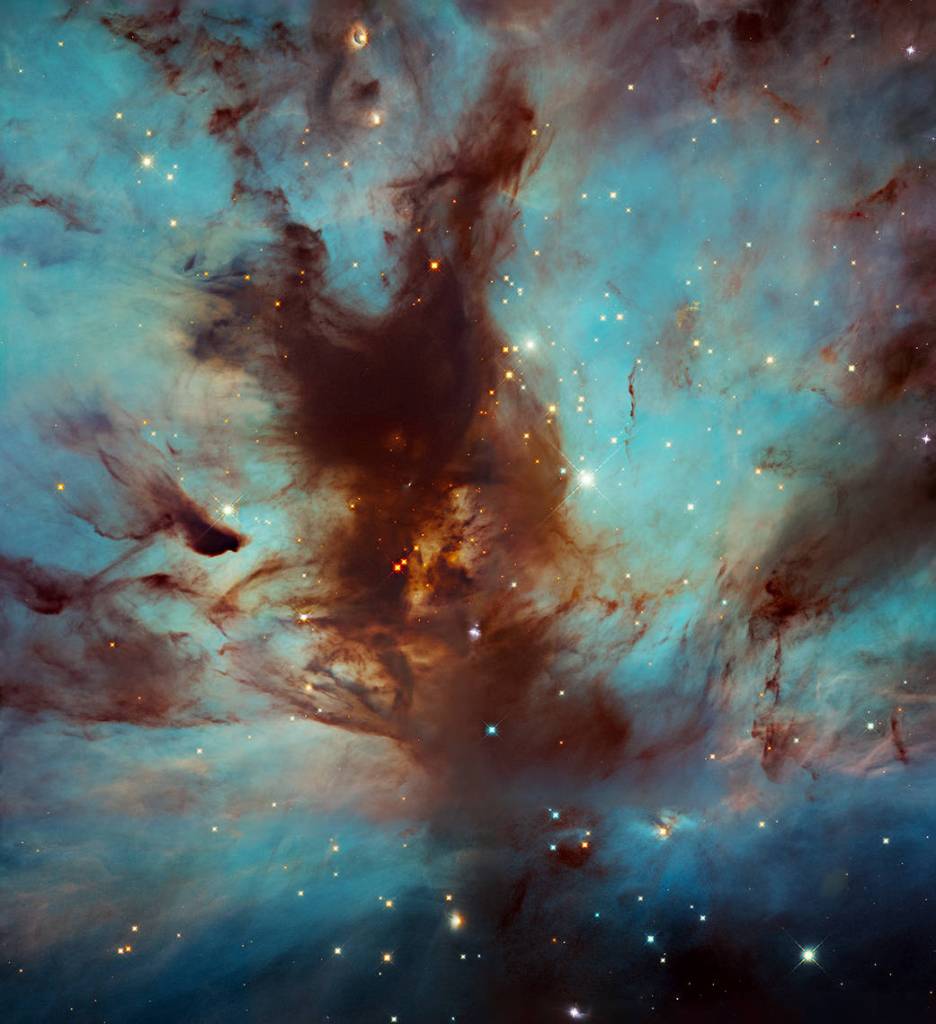
Pic of the Week: The Flame Nebula

Source/Credit: NASA, ESA, and N. Da Rio (University of Virginia); Processing: Gladys Kober (NASA/Catholic University of America).

This week’s image from the Hubble Space Telescope shows the Flame Nebula in the constellation Orion, as explained by NASA:

The Flame Nebula, also called NGC 2024, is a large star-forming region in the constellation Orion that lies about 1,400 light-years from Earth. It’s a portion of the Orion Molecular Cloud Complex, which includes such famous nebulae as the Horsehead Nebula and Orion Nebula. This image focuses on the dark, dusty heart of the nebula, where a star cluster resides, mostly hidden from view. Nearby (but not visible in this image) is the bright star Alnitak, the easternmost star in the Belt of Orion. Radiation from Alnitak ionizes the Flame Nebula’s hydrogen gas. As the gas begins to cool from its higher-energy state to a lower-energy state, it emits energy in the form of light, causing the visible glow behind the swirled wisps of dust.

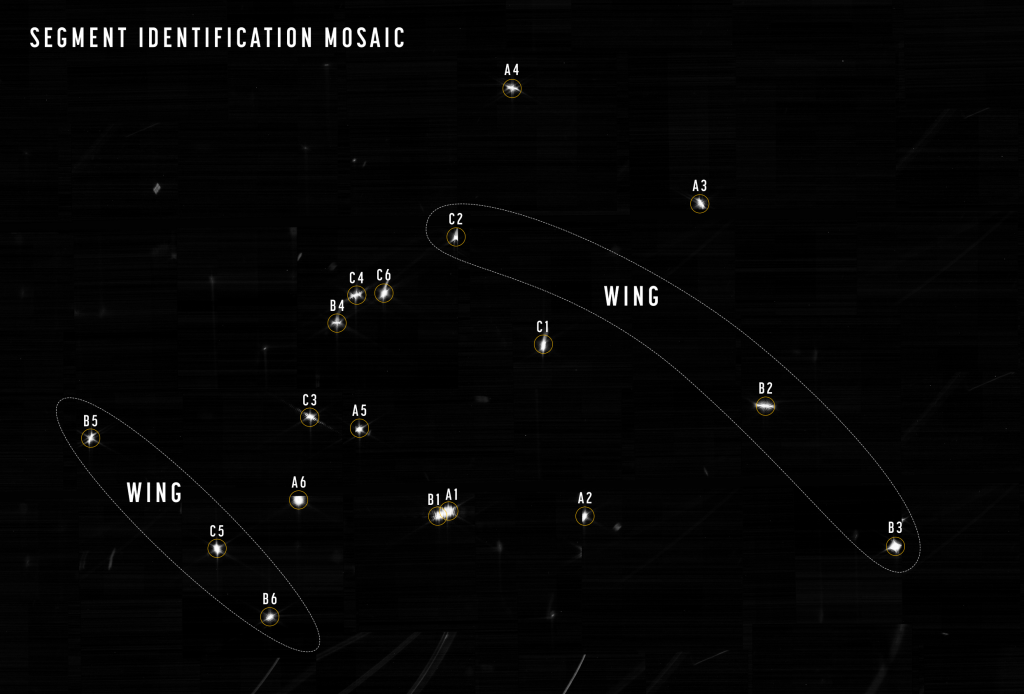
James Webb Space Telescope Selfie

Source/Credit: NASA.

NASA has shared the first images from the James Webb Space Telescope (JWST), which includes the selfie of the 18-part mirror shown above. The space telescope is still aligning these mirror segments before prime time, so we will probably see more selfies and related shots for the time being, such as the images below (one labeled) showing the 18 segment views of one star that will eventually become one view of one star.

Keep these raw images in mind once we start to see mind-blowing images from the JWST. This amazing device is just getting started. The first of these images should start to appear this summer.

Source/Credit: NASA.

Pic of the Week: Distant Dancing Galaxies

Source/Credit: Galaxy cluster (described below) from NASA.

The image above is from the Hubble Space Telescope and shared on NASA’s site last month under the title “Hubble Spots a Starship-Shaped Galactic Pair.” While the author of the story below sees the USS Enterprise from Star Trek, I see a decloaking Klingon Bird-of-Prey. Here is the full description from NASA:

The subject of this image is a group of three galaxies, collectively known as NGC 7764A. They were imaged by the NASA/ESA Hubble Space Telescope, using both its Advanced Camera for Surveys (ACS) and Wide Field Camera 3 (WFC3). The two galaxies in the upper right of the image appear to be interacting with one another — indeed, the long trails of stars and gas extending from them both give the impression that they have both just been struck at great speed, thrown into disarray by the bowling-ball-shaped galaxy to the lower left of the image. In reality, however, interactions between galaxies happen over very long time periods, and galaxies rarely collide head-on with one another. It is also unclear whether the galaxy to the lower left is actually interacting with the other two, although they are so relatively close in space that it seems possible that they are. By happy coincidence, the collective interaction between these galaxies have caused the two on the upper right to form a shape, which from our Solar System’s perspective, ressembles the starship known as the USS Enterprise from Star Trek!

NGC 7764A, which lies about 425 million light years from Earth in the constellation Phoenix, is a fascinating example of just how awkward astronomical nomenclature can be. The three galaxies are individually referred to as NGC 7764A1, NGC 7764A2 and NGC 7764A3, and just to be really difficult, an entirely separate galaxy, named NGC 7764, sits in the skies about a Moon’s distance (as seen from Earth) away. This rather haphazard naming makes more sense when we consider that many of the catalogues for keeping track of celestial bodies were compiled well over 100 years ago, long before modern technology made standardising scientific terminology much easier. As it is, many astronomical objects have several different names, or might have names that are so similar to other objects’ names that they cause confusion.

Source/Credit: Klingon Bird-of-Prey from wallpapercave.com.