Space Stories: Damaged Space Antenna, Dark Matter as Weighty Matter, and a Stable Ocean on Enceladus

Credit: Image by Clker-Free-Vector-Images from Pixabay

Here are some recent space-related stories of interest.

SpaceNews.com: Key Antenna in NASA’s Deep Space Network Damaged

One of the largest antennas in NASA’s Deep Space Network was damaged in September and may be out of service for an extended period, further straining the system. NASA’s Jet Propulsion Laboratory confirmed Nov. 10 that the 70-meter antenna at the Deep Space Network (DSN) site in Goldstone, California, has been offline since Sept. 16, with no timetable for its return to service.

University of Geneva: Dark Matter Does Not Defy Gravity, Study Suggests

Does dark matter follow the same laws as ordinary matter? The mystery of this invisible and hypothetical component of our universe—which neither emits nor reflects light—remains unsolved. A team involving members from the University of Geneva (UNIGE) set out to determine whether, on a cosmological scale, this matter behaves like ordinary matter or whether other forces come into play. Their findings, published in Nature Communications, suggest a similar behavior, while leaving open the possibility of an as-yet-unknown interaction. This breakthrough sheds a little more light on the properties of this elusive matter, which is five times more abundant than ordinary matter.

University of Oxford: Saturn’s Icy Moon May Host a Stable Ocean Fit for Life, New Study Finds

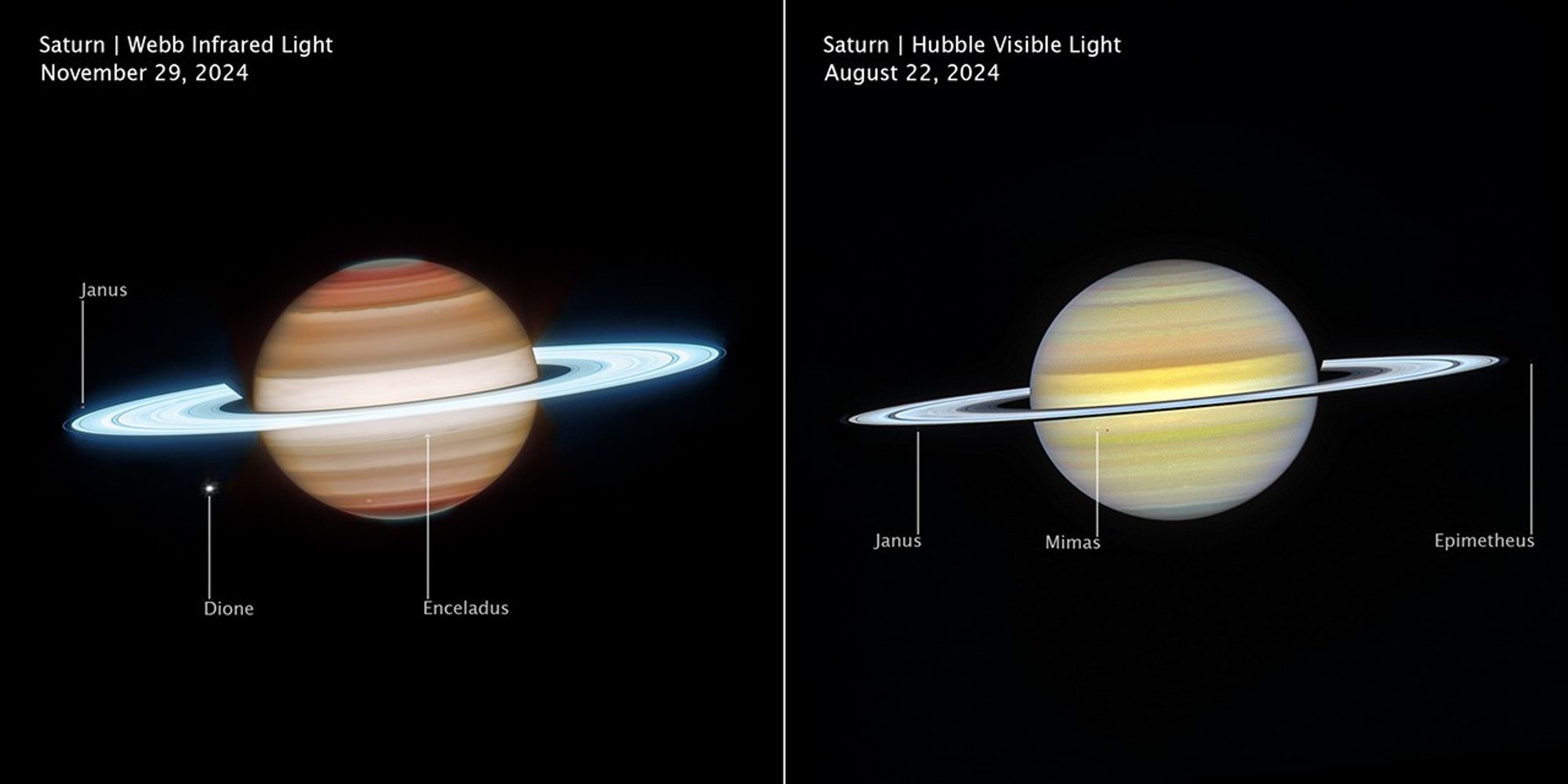
A new study led by researchers from Oxford University and Southwest Research Institute and the Planetary Science Institute in Tucson, Arizona has provided the first evidence of significant heat flow at Enceladus’ north pole, overturning previous assumptions that heat loss was confined to its active south pole. This finding confirms that the icy moon is emitting far more heat than would be expected if it were simply a passive body, strengthening the case that it could support life.

The New Glenn Launch to Mars Scheduled for Tomorrow

Image (Credit): Artist’s rending of the two EscaPADE probems approaching Mars. (NASA)

Blue Origin’s New Glenn rocket is scheduled to be launched tomorrow afternoon with two Martian probes on board. A lot is riding on tomorrow’s launch. The mission is important for Blue Origin, as it tests its new rocket with its first real mission. It is also important to NASA, which is using the probes to better understand the Martian atmosphere.

Blue Origin’s reusable New Glenn rocket will put it in direct competition with SpaceX for future NASA missions. This redundancy is needed, particularly with SpaceX seeming to struggle with its projects related to the Atemis lunar mission.

The $100 million Martian mission, called Escape and Plasma Acceleration and Dynamics Explorers (EscaPADE), involves a pair of identical spacecraft with a the goal of analyzing:

  1. how Mars’ magnetic field guides particle flows around the planet,
  2. how energy and momentum are transported from the solar wind through the magnetosphere, and
  3. what processes control the flow of energy and matter into and out of the Martian atmosphere.

The two probes will be launched towards Lagrange Point 2, where they will sit for more than a year before making an approach towards Mars. The probes are expected to go into orbit around Mars in September 2027.

Godspeed to Blue Origin and NASA.

Update: The launch has been delayed due to bad weather. The next attempt will be on November 12th.

Congresswoman Seeks More Data on Interstellar Comet

Congresswoman Anna Paulina Luna (R-FL) is very interested in obtaining some additional observational data from NASA regarding the interstellar comet known as 3I/ATLAS. In her letter to NASA (shown below), she said the information is “…of great importance to advancing our understanding of interstellar visitors and their interaction with our solar system.”

It appears this interest follows comments from Harvard scientist Avi Loeb about the object possibly being an alien spaceship.

All of this is starting to sound the plot in Arthur C. Clark’s book Rendezvous with Rama.

If at First You Don’t Succeed: Jared Isaacman is Really Back

Image (Credit): Artist’s rendering of Blue Origin’s Blue Moon Mark 1, which is a single-launch, lunar cargo lander. (Blue Origin)

President Trump has had a change of heart on Jared Isaacman, his initial nominee for NASA administrator until he withdrew that nomination earlier this year.

Earlier today, the President posted the following:

Jared’s passion for Space, astronaut experience, and dedication to pushing the boundaries of exploration, unlocking the mysteries of the universe, and advancing the new space economy, make him ideally suited to lead NASA into a bold new era.

So what has changed in the last few months to make Mr. Isaacman “ideally suited” to lead NASA as compared to when he was determine unsuitable? I cannot think of anything other than the end of the President’s feud with Elon Musk. Of course, that was recently replaced with Elon Musk’s feud with acting NASA Administrator Sean Duffy, who proposed reopening competition for the first manned Moon landing this century due to delays with SpaceX’s Starship.

Will Mr. Isaacman save Musk’s Moon mission? He may calm some of the acrimony for the time being, but any new NASA administrator had better have a solid plan to get Americans back on the Moon before China does. Mr. Isaacman may be friends with Mr. Musk, but should he be confirmed he will head a weakened space agency that is struggling with a complex Moon mission that may be much less complex without the Starship refueling plans. In fact, Blue Origin just submitted a new Moon mission plan that drops this refueling altogether.

It is not impossible the winds will shift again, leaving Mr. Isaacman adrift once more. That is how it is in Washington these days. Fickle leadership leads to fickle decision-making and fickle planning.

The Chinese are not having these issues at the moment as they aim to be on the Moon by 2030.

Space Stories: New Exoplanets in a Binary Star System, the Secret “Athena” Plan for NASA, and an Interstellar “Tunnel”

Credit: Pixabay.com.

Here are some recent space-related stories of interest.

University of Liege: Three Earth-sized Planets Discovered in a Compact Binary System

An international team of researchers has just revealed the existence of three Earth-sized planets in the binary stellar system TOI-2267 located about 190 light-years away. This discovery, published in Astronomy & Astrophysics, is remarkable as it sheds new light on the formation and stability of planets in double-star environments, which have long been considered hostile to the development of complex planetary systems.

ARSTECHNICA: Capitol Hill is Abuzz with Talk of the “Athena” Plan for NASA

In recent weeks, copies of an intriguing policy document have started to spread among space lobbyists on Capitol Hill in Washington, DC. The document bears the title “Athena,” and it purports to summarize the actions that private astronaut Jared Isaacman would have taken, were his nomination to become NASA administrator confirmed. The 62-page plan is notable both for the ideas to remake NASA that it espouses as well as the manner in which it has been leaked to the space community.

Earth.com: Interstellar “Tunnel” Found that Connects Our Solar System to Other Stars, According to Astronomers

Space can surprise even those who spend their lives studying it. People often think of our solar system as just a few planets and a bunch of empty space. Yet new observations suggest we have been living inside a hot, less dense region, and that there may even be a strange “cosmic interstellar channel,” or tunnel, connecting us to distant stars. After years of careful mapping, a new analysis reveals what appears to be a channel of hot, low-density plasma stretching out from our solar system toward distant constellations.