Space Stories: Dragon Docks with ISS, a Braille Astronomy Book, and an Exoplanet with No Atmosphere

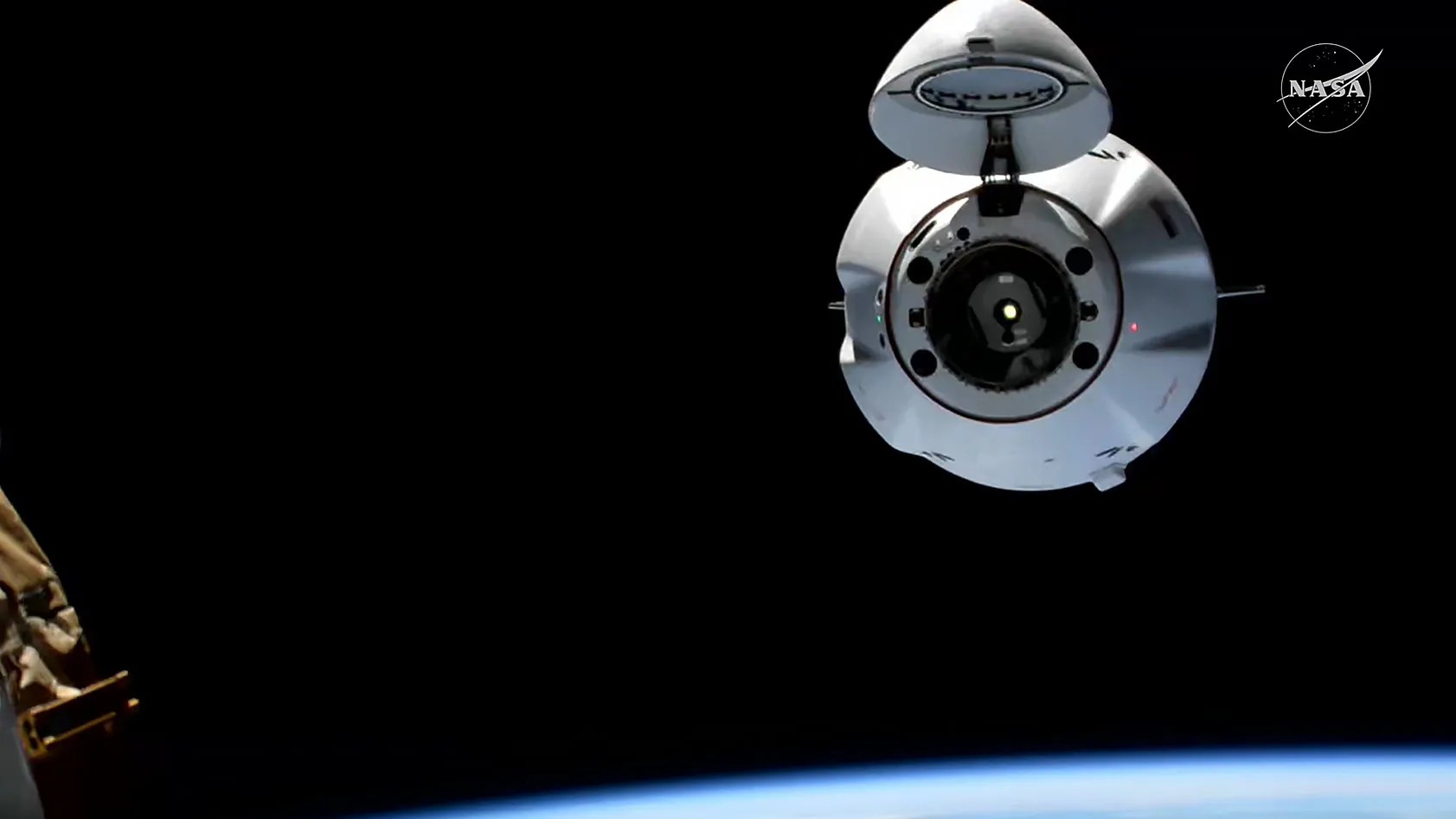
Image (Credit): The Dragon cargo capsule approaching the ISS. (NASA)

Here are some recent space-related stories of interest.

NASA: SpaceX Dragon Docks to Station Delivering New Science, Supplies

At 7:05 a.m. EDT, the SpaceX Dragon spacecraft docked to the forward port of the International Space Station’s Harmony module.  The spacecraft carried over 5,000 pounds of scientific investigations and cargo to the orbiting laboratory on SpaceX’s 33rd commercial resupply services mission for NASA. The mission launched at 2:45 a.m. on Aug. 24 atop a SpaceX Falcon 9 rocket from Space Launch Complex 40 at Cape Canaveral Space Force Station in Florida. 

Cincinnati Enquirer: New Braille Book from Cincinnati Astronomer Lets You See Constellations Without Your Eyes

Longtime readers will recognize the name Dean Regas, astronomy contributor to The Enquirer and former cohost of the PBS series “Star Gazers,” but they may not know that Regas is also the author of seven books about astronomy. His latest foray into the world of writing, “All About Orion,” is a children’s book focused on its namesake, Orion, with a twist: the book features braille writing and textile constellations as well as large print for blind and visually impaired children.

Universe Today: “Another Earth-like Exoplanet Crossed Off the List: JWST Shows that GJ 3929b Has No Atmosphere

The JWST’s latest exoplanet atmosphere target is GJ 3929 b. Astronomers discovered it in TESS data in 2022. “Our analysis confirms the planetary nature of the transiting planet GJ 3929 b,” the authors of the 2022 paper wrote. “Its mass and radius (~ 0.43 Earth masses and ~1.15 Earth radii) put it into the regime of small Earth-sized planets.” Earth-like planets attract attention for obvious reasons. Now the JWST’s results are in, and the once-promising planet appears to be barren.
Space Quote: Understanding NASA Interplanetary Transmissions and Applying it to SETI

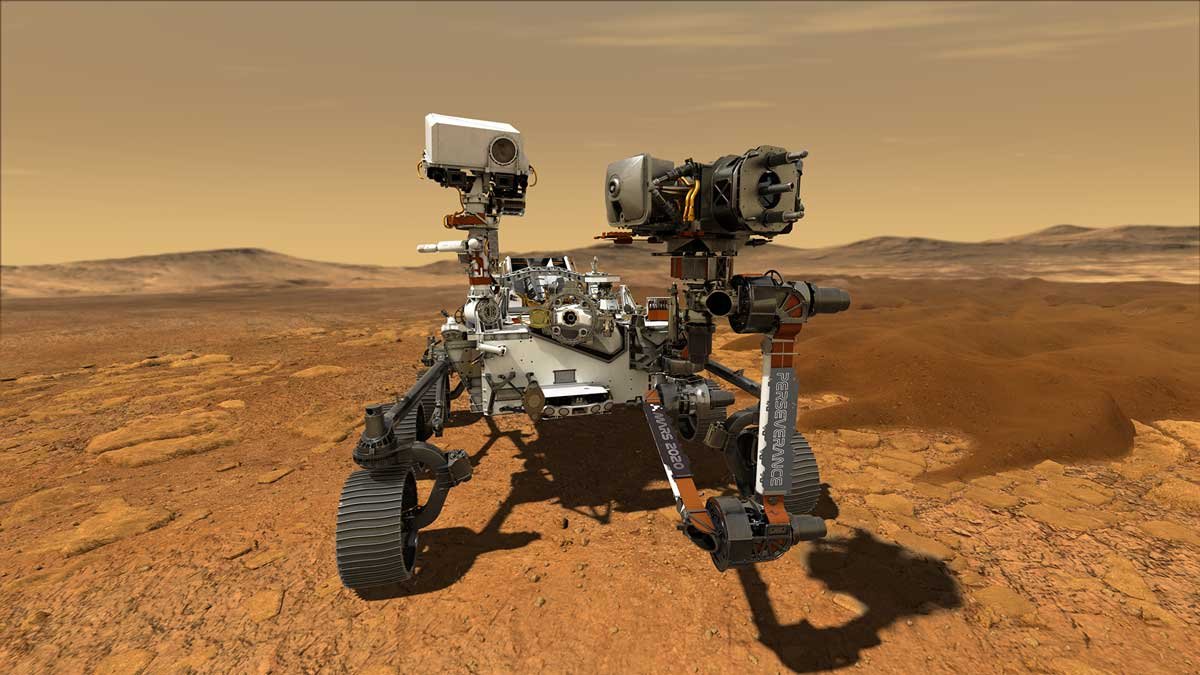
Image (Credit): Artist’s rending of the Perseverance Mars rover on the Martian surface. (NASA/JPL-Caltech)

”Based on data from the last 20 years, we found that if an extraterrestrial intelligence were in a location that could observe the alignment of Earth and Mars, there’s a 77% chance that they would be in the path of one of our transmissions — orders of magnitude more likely than being in a random position at a random time.”

Statement by Penn State graduate student Pinchen Fan, one of the authors of a recent study, Detecting Extraterrestrial Civilizations that Employ an Earth-level Deep Space Network. The study looked at NASA transmissions from Earth to space missions in the the solar system to determine if it could assist with the search for extraterrestrial intelligence (SETI).

Study Findings: Core Metamorphism Controls the Dynamic Habitability of Mid-sized Ocean Worlds—The Case of Ceres

Image (Credit): Dwarf planet Ceres. (NASA/JPL)

Science Advances abstract of the study findings:

Ceres’s surface mineralogy and density structure indicate an aqueous past. Observations from the Dawn mission revealed that Ceres likely hosted a global subsurface ocean in its early history, which was the site of pervasive aqueous alteration of accreted material. Subsurface environmental constraints inferred from Ceres’s surface mineralogy, combined with Ceres’s high abundance of carbon, suggest that the dwarf planet may have been habitable for microbial life. We present a coupled chemical and thermal evolution model tracking Ceres’s interior aqueous environment through time. If the rocky interior reached ≳550 K, then fluids released by rock metamorphism would have promoted conditions favorable for habitability by introducing redox disequilibrium into the ocean, a source of chemical energy for chemotrophs. We find that this period would have been between ~0.5 and 2 billion years after Ceres’s formation. Since then, Ceres’s ocean has likely become a cold, concentrated brine with fewer sources of energy, making it less likely to be habitable at present.

Citation: Samuel W. Courville, S.W., Castillo-Rogez J.C., Daswani, M.M. et al. Core metamorphism controls the dynamic habitability of mid-sized ocean worlds—The case of Ceres, Science Advances, Vol 11, Issue 34 (August 20, 2025).

https://doi.org/10.1126/sciadv.adt3283

Study-related stories:

The Register – “Dwarf Planet Ceres May Have Been Habitable – for Microbes – a Couple of Billion Years Back”

Perplexity – “Dwarf Planet Ceres May Have Harbored Ancient Microbial Life”

Astrobiology – “Ceres May Have Had Long-Standing Energy to Fuel Habitability”

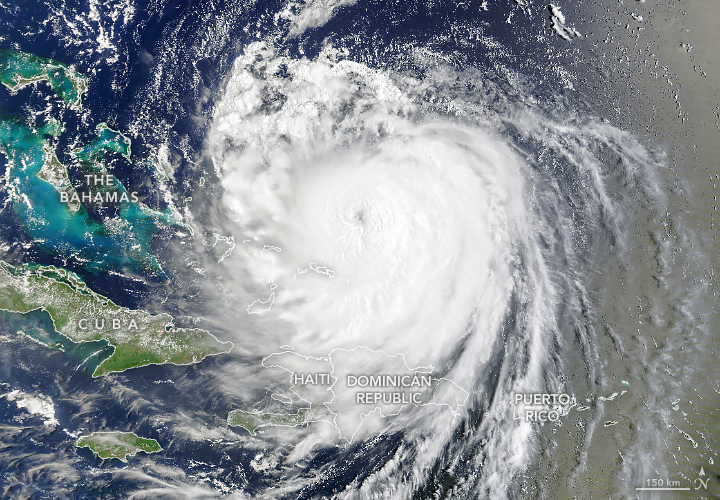
Pic of the Week: Hurricane Erin in the Caribbean Sea

Image (Credit): Hurricane Erin in the Caribbean Sea on August 18, 2025. (NASA Earth Observatory images by Michala Garrison, using MODIS data from NASA EOSDIS LANCE and GIBS/Worldview, and the Suomi National Polar-orbiting Partnership)

This week’s image is from the NASA Earth Observatory. It shows Hurricane Erin, the first Atlantic hurricane in the 2025 season, as it travels through the Caribbean Sea earlier this week. The image below labels the various islands in the image.

Image (Credit): Hurricane Erin in the Caribbean Sea on August 18, 2025 (with island identifiers). (NASA Earth Observatory images by Michala Garrison, using MODIS data from NASA EOSDIS LANCE and GIBS/Worldview, and the Suomi National Polar-orbiting Partnership)

Space Stories: New Glenn’s Martian Probes, AI Space Doctors, and Questions About a Mission to Uranus

Image (Credit): Blue Origin’s New Glenn Rocket. (Blue Origin)

Here are some recent space-related stories of interest.

Space.com: Blue Origin’s 2nd New Glenn Rocket Launch will Fly Twin NASA Mars Probes to Space on Sep. 29

Blue Origin is gearing up for the second-ever launch of its powerful New Glenn rocket, which will loft NASA’s ESCAPADE mission to Mars. The company says it has been working closely with NASA on preparations leading up to New Glenn’s next launch, dubbed NG-2, and is targeting no earlier than (NET) Sep. 29. The twin ESCAPADE (Escape and Plasma Acceleration and Dynamics Explorers) probes have been awaiting their turn aboard New Glenn, which was originally slated to carry the satellites on its maiden launch in January. However, NASA opted not to risk a costly mission delay due to the debut liftoff of the new rocket.

American Bazaar: NASA and Google Test AI Medical Assistant for Astronaut Missions

NASA, which is committing to a new era of human spaceflight with its Artemis mission, is working with Google to test a proof of concept for Crew Medical Officer Digital Assistant (CMO‑DA), a type of Clinical Decision Support System (CDSS). This has been created to allow astronauts to diagnose and treat symptoms when no doctor is available or communications to Earth are blacked out. “Trained on spaceflight literature, the AI system uses cutting-edge natural language processing and machine learning techniques to safely provide real-time analyses of crew health and performance,” Google representatives said in a statement.

Scientific American:“NASA Budget Cuts Could End U.S. Exploration of the Outer Solar System

In the spring of 2022 the U.S. space community selected its top priority for the nation’s next decade of science and exploration: a mission to Uranus, the gassy, bluish planet only seen up close during a brief spacecraft flyby in 1986. More than 2.6 billion kilometers from Earth at its nearest approach, Uranus still beckons with what it could reveal about the solar system’s early history—and the overwhelming numbers of Uranus-sized worlds that astronomers have spied around other stars. Now President Donald Trump’s proposed cuts to NASA could push those discoveries further away than ever—not by directly canceling the mission but by abandoning the fuel needed to pull it off.