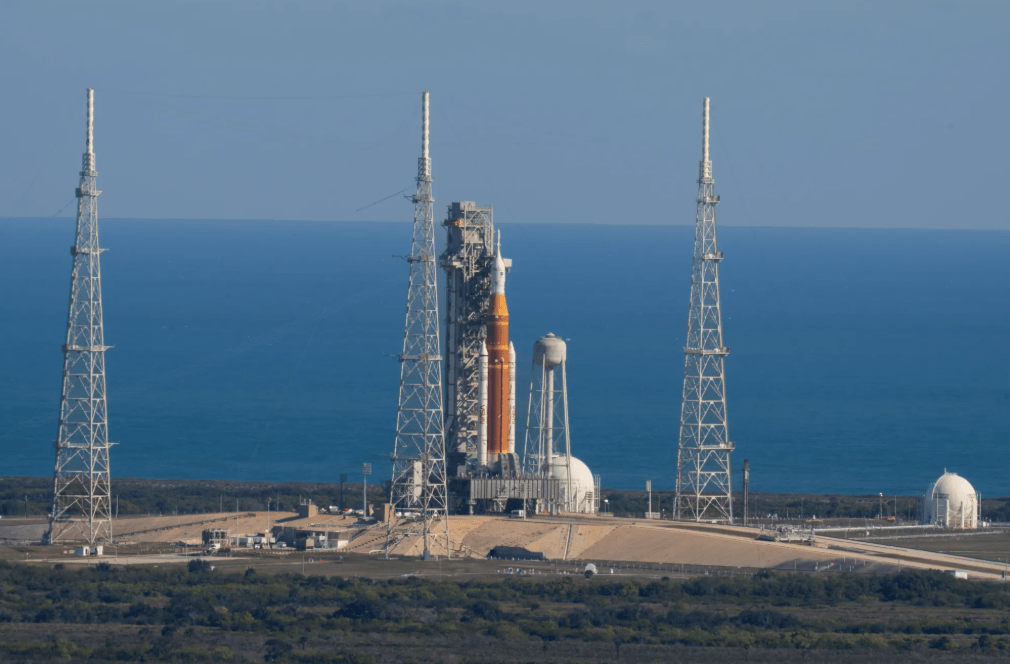
Image (Credit): NASA’s Artemis II mission preparations at Launch Complex 39B as of Thursday, January 29, 2026. (NASA/Jim Ross)
The cold weather on the East Coast continues to cause problems, this time for NASA and its planned launch of the Artemis II mission, which will take astronauts around the Moon. Originally scheduled for February 6th, the mission is being delayed two more days until February 8th to allow NASA more time for its wet dress rehearsal, otherwise known as its comprehensive pre-launch check. In the meantime, the four astronauts assigned to the mission will remain in quarantine.
Over the past several days, engineers have been closely monitoring conditions as cold weather and winds move through Florida. Managers have assessed hardware capabilities against the projected forecast given the rare arctic outbreak affecting the state and decided to change the timeline. Teams and preparations at the launch pad remain ready for the wet dress rehearsal. However, adjusting the timeline for the test will position NASA for success during the rehearsal, as the expected weather this weekend would violate launch conditions.
It has already been an unusual winter, so none of this is a great surprise.
Fingers crossed for some warmer weather so NASA can complete this mission and then eventually land humans on the Moon once again with the next mission – Artemis III.
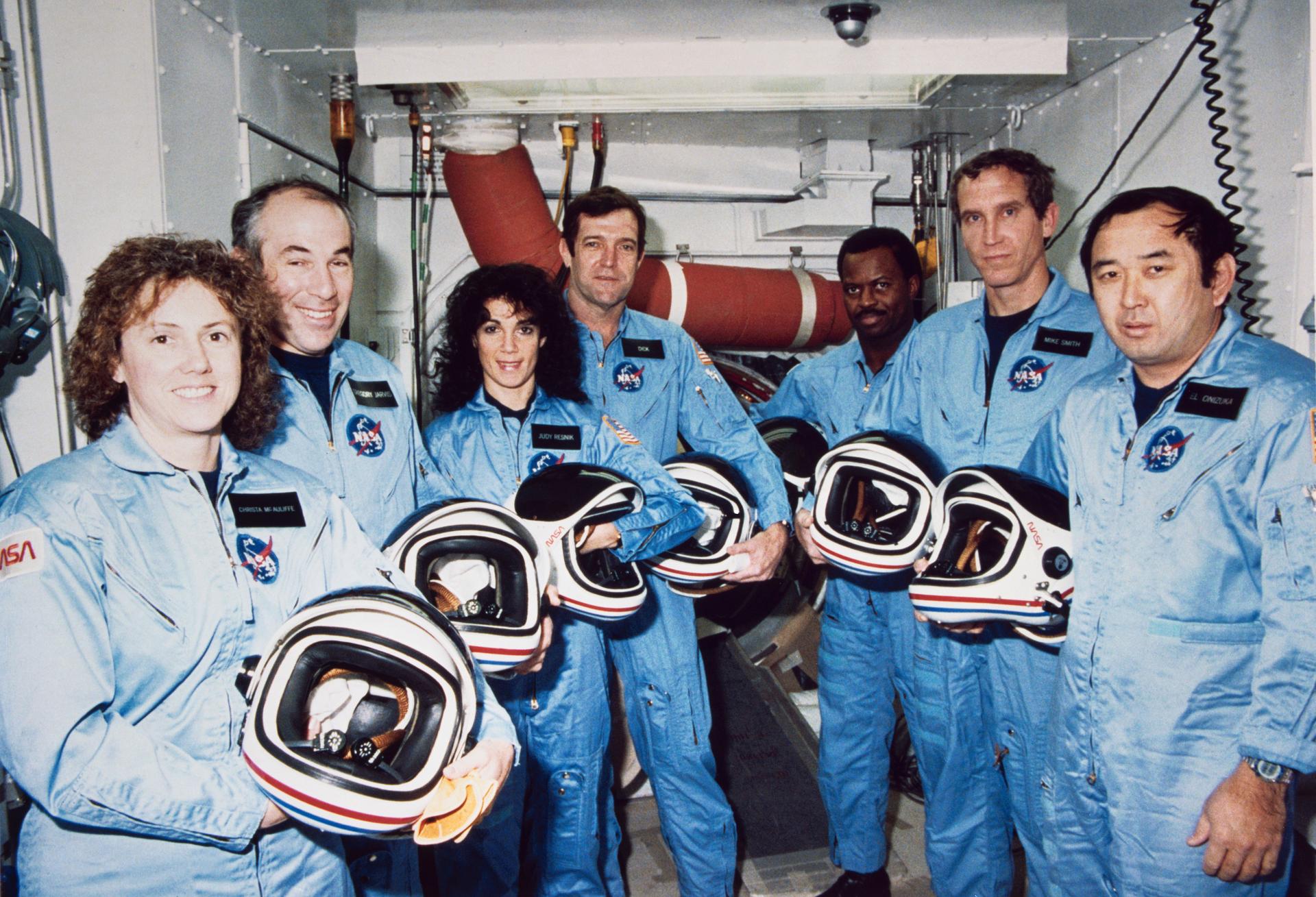
Image (Credit): The Challenger Shuttle crew from left to right – Teacher-in-Space payload specialist Sharon Christa McAuliffe; payload specialist Gregory Jarvis; and astronauts Judith A. Resnik, mission specialist; Francis R. (Dick) Scobee, mission commander; Ronald E. McNair, mission specialist; Mike J. Smith, pilot; and Ellison S. Onizuka, mission specialist. (NASA)
This week’s image shows the seven members of the Challenger Shuttle crew who perished less than two minutes into their flight on January 18, 1986. NASA determined that a leak in one of two Solid Rocket Boosters ignited the main liquid fuel tank.
I’ve always had great faith in and respect for our space program, and what happened today does nothing to diminish it. We don’t hide our space program. We don’t keep secrets and cover things up. We do it all up front and in public. That’s the way freedom is, and we wouldn’t change it for a minute. We’ll continue our quest in space. There will be more shuttle flights and more shuttle crews and, yes, more volunteers, more civilians, more teachers in space. Nothing ends here; our hopes and our journeys continue. I want to add that I wish I could talk to every man and woman who works for NASA or who worked on this mission and tell them: “Your dedication and professionalism have moved and impressed us for decades. And we know of your anguish. We share it.’‘
You can learn more about each of the crew members at this NASA site.
A long-standing idea in planetary science is that water-rich meteorites arriving late in Earth’s history could have delivered a major share of Earth’s water. A new study by Universities Space Research Association (USRA) and University of New Mexico argues that the Moon’s surface record sets a hard limit on that possibility: even under generous assumptions, late meteorite delivery since about 4 billion years ago could only have supplied a small fraction of Earth’s water...In a paper published in the Proceedings of the National Academy of Sciences, researchers led by Dr. Tony Gargano at USRA’s Lunar and Planetary Institute and the University of New Mexico analyzed a large suite of Apollo lunar regolith samples using high-precision triple oxygen isotopes. Earth has erased most of its early bombardment record through tectonics, and constant crustal recycling. The Moon, by contrast, preserves a continuously accessible archive: lunar regolith, the loose layer of debris produced and reworked by impacts over billions of years
The four astronauts who will soon become the first humans in more than half a century to fly on a lunar mission have begun the quarantine process – a crucial sign that NASA believes a launch could be imminent. Sequestering themselves away from others for the next several days ensures that the three Americans and one Canadian selected for a mission known as Artemis 2 are at low risk of becoming sick and jeopardizing the mission. The crew members have entered quarantine in Texas as NASA makes final preparations in Florida to ready the towering rocket that will get the mission off the ground as early as February.
The Long March 3B departed Xichang Satellite Launch Center in southwest China at 11:55 Eastern (1655 UTC) on January 16. Amateur footage confirmed the rocket left the pad on schedule. Then came silence. The China Aerospace Science and Technology Corporation (CASC) waited nearly 12 hours before acknowledging what observers already suspected. “The specific cause is under further analysis and investigation,” state media Xinhua reported…Less than 12 hours after the Long March 3B failure, Galactic Energy attempted something the company had been working toward for months: the first flight of its Ceres-2 rocket. After repeatedly postponed launch windows, the solid-fueled rocket finally lifted off from Jiuquan Satellite Launch Center at 11:08 p.m. Eastern on January 16 (0408 UTC, January 17). It didn’t work. Galactic Energy confirmed an anomaly had occurred and that investigation was underway.
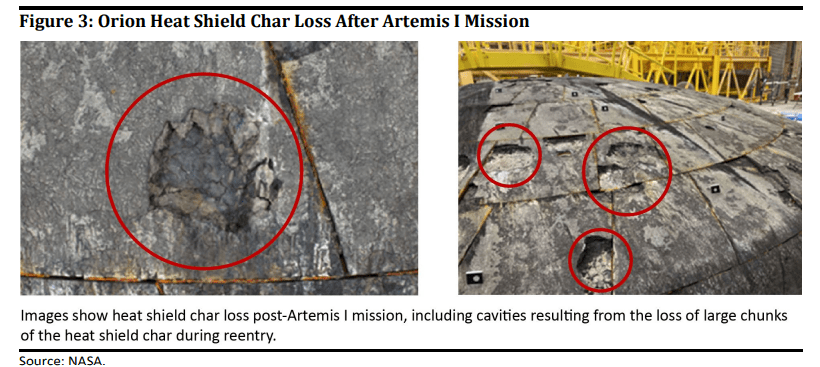
Credit: Taken from a 2024 NASA Office of the Inspector General report – NASA’s Readiness for the Artemis II Crewed Mission to Lunar Orbit (IG-24-011)
“What they’re talking about doing is crazy…We could have solved this problem way back when…Instead, they keep kicking the can down the road.”
-Statement by former astronaut Charlie Camarda, who does not believe the upcoming Artemis II mission is safe for the astronauts given his concerns about the Orion’s heat shield, as quoted by CNN. The news story cites others who state that the Orion heat shield issue has been resolved and the mission is ready to go. The Artemis II mission is set to launch as early as February 6th.
Image (Credit): The visual message on the Pioneer 10 and 11 plaques. (NASA Ames)
On this day in 2003, NASA heard its last message from Pioneer 10, the Jupiter space probe. Launched in 1972, it was the first spacecraft to cross the asteroid belt between Mars and Jupiter on its way to the outer planets. It is also one of only five spacecraft to leave our solar system.
If all goes well, in about 2 million years the Pioneer 10 spacecraft will encounter the star Aldebaran. Maybe some civilization in that solar system will be arguing about this object floating through the neighborhood the way we have argued about the origins of the interstellar object we call 3I/ATLAS.
Image (Credit): Mission patch for Pioneer 10 and 11. (NASA)