Pic of the Week: Spiral Galaxy UGC 11397

Image (Credit): The spiral galaxy UGC 11397 as captured by the Hubble Space Telescope. (ESA/Hubble & NASA, M. J. Koss, A. J. Barth)

This week’s image is from the Hubble Space Telescope. It is an image of the spiral galaxy UGC 11397, which is located about 250 million years light-years away.

At the time the light we are now seeing left UGC 11397, the Earth was a very different place. It was dealing with the Permian–Triassic mass extinction, also called the Great Dying. During this period about 94 percent of marine species and 70 percent of terrestrial vertebrate families disappeared from the planet.

Anyway, getting back to the image itself, here is a little more information from NASA to explain what you are seeing:

What sets UGC 11397 apart from a typical spiral lies at its center, where a supermassive black hole containing 174 million times the mass of our Sun grows. As a black hole ensnares gas, dust, and even entire stars from its vicinity, this doomed matter heats up and puts on a fantastic cosmic light show.

Material trapped by the black hole emits light from gamma rays to radio waves, and can brighten and fade without warning. But in some galaxies, including UGC 11397, thick clouds of dust hide much of this energetic activity from view in optical light. Despite this, UGC 11397’s actively growing black hole was revealed through its bright X-ray emission — high-energy light that can pierce the surrounding dust. This led astronomers to classify it as a Type 2 Seyfert galaxy, a category used for active galaxies whose central regions are hidden from view in visible light by a donut-shaped cloud of dust and gas.

Space Quote: Maybe We Will See Another Astronaut in the Senate

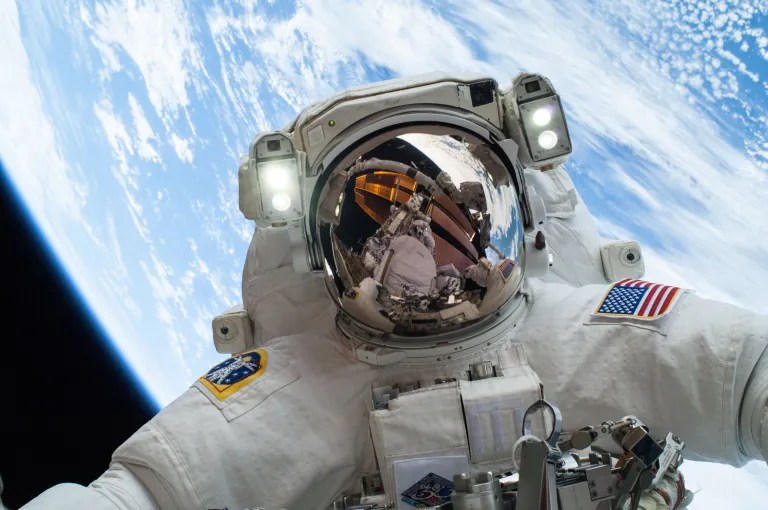
Image (Credit): NASA Astronaut Terry Virts. (NASA)

It is a disaster. You know, NASA’s budget overall is cut by a quarter — this is proposed — and the science budget is cut by half. Here in Houston — you know, I’m from Houston — it’s going to be a disaster. Thousands and thousands of people are going to lose their jobs. They’re already having profoundly negative effects on the space station’s science ability — the ability to do science on the International Space Station that I helped build and commanded. They are going to cut important space probes. I saw there’s going to be 41 space missions that are canceled. There’s over a dozen space missions that are currently in operation, things like New Horizons, Juno and others that are costing pennies on the dollar. These things are super cheap. We’ve already paid all the expense. We should just keep them operating, and they’re going to cancel those. It’s just a disaster.

-Statement by former NASA astronaut Terry Virts, who last week announced his plans to run the U.S. Senate in Texas to replace incumbent Senator John Cornyn. He made this statement after being asked “What is your take on the White House’s proposed NASA budget?” during an interview with Space.com.

Space Stories: New Stars in the Heavens, Moon Budget Passes Senate, and Lunar Trailblazer Needs to Call Home

Image (Credit): The Stingray nebula (Hen-1357), the youngest known planetary nebula. (Matt Bobrowsky, Orbital Sciences Corporation and NASA)

Here are some recent space-related stories of interest.

Live Science: 2 ‘New Stars’ Have Exploded into the Night Sky in Recent Weeks — and Both are Visible to the Naked Eye

A second “new star” has unexpectedly appeared in the night sky, less than two weeks after a near-identical point of light first burst into view without warning. The first nova, dubbed V462 Lupi, was initially spotted June 12 shining in the Lupus constellation, after its progenitor star suddenly became more than 3 million times brighter than normal. Then, on June 25, multiple astronomers detected another nova, dubbed V572 Velorum, within the Vela constellation, according to EarthSky.org. Astronomers normally expect to see a classical nova once a year at most, and more than one of these explosions shining simultaneously is almost unheard of.

TechCrunch: Congress Just Greenlit a NASA Moon Plan Opposed by Musk and Isaacman

Legacy aerospace giants scored a win Tuesday when the U.S. Senate passed President Trump’s budget reconciliation bill that earmarks billions more for NASA’s flagship Artemis program. The $10 billion addition to the Artemis architecture, which includes funding for additional Space Launch System rockets and an orbiting station around the moon called Gateway, is a rebuke to critics who wished to see alternative technologies used instead. Among those critics are SpaceX CEO Elon Musk and billionaire entrepreneur Jared Isaacman, who Musk proposed as the next NASA administrator.

The Register: NASA Gives Lunar Trailblazer a Few More Weeks to Pick Up the Phone

NASA has extended recovery efforts for its stricken Lunar Trailblazer spacecraft to mid-July, but is warning that if the probe remains silent, the mission could end. Contact with the small satellite was lost the day after its launch on February 26. Controllers were initially able to receive engineering data from the vehicle, but the telemetry indicated power system issues, and the spacecraft eventually fell silent.

Watching NASA on Netflix

Credit: NASA

I’m glad to hear that NASA is working with Netflix to expand the amount of space stories available to the public.

This summer Netflix will make NASA+ live programming available to its customers, meaning more of the public can watch interviews with astronauts, the launch of space missions, and the happenings aboard the International Space Station (ISS). NASA also has plenty of entertaining videos about astronomy, various space missions, and more.

For example, Netflix customers will have access to content such as the launch of Russia’s Progress 92 Cargo Craft from the Baikonur Cosmodrome in Kazakhstan to the ISS on July 3rd, as well as the docking of this cargo craft with the ISS on July 5th . Or how about NASA videos, such as “Other Worlds: Europa“?

Of course, all of this is already available to the public for free on NASA’s website, but maybe this can draw in those eager viewers searching around for something to watch and not already aware of the website.

Any attempts to bring more attention to NASA’s amazing science and ongoing discoveries is good publicity as well as great programming.

Upcoming Protest: NASA Needs Help!

Even if you cannot attend the protest on Monday, the site notes:

If you would rather not join this protest then there are still ways you can help. Please absolutely flood your representatives in Congress with pleas to save NASA. When you do, drive home the point that the cuts are happening now! Most of Congress seems to think that they will save NASA if they work out a budget for the coming fiscal year that funds NASA at previous levels. They don’t realize that NASA’s acting administrator, under pressure from the White House, OMB, and DOGE, are enacting “realignments” and cuts now. So please please please tell Congress that every day our nation is losing dedicated and brilliant career civil servants, contractors, and programs, that NASA is being fed into the woodchipper now. Congress must act immediately to save NASA, not wait for October 1!

For more information, visit https://sites.google.com/view/nasa-needs-help.