Image (Credit): The Expedition 74 crew members launched towards the space station earlier today aboard a Soyuz rocket from Baikonur Cosmodrome in Kazakhstan. (NASA/Bill Ingots)
This week’s image shows a Soyuz rocket sending a crew to the International Space Station (ISS) on Thanksgiving Day. One NASA astronaut and two Russian cosmonauts are thankful today that they are safe and sound on the ISS. NASA astronaut Chris Williams joined Roscosmos cosmonauts Sergey Kud-Sverchkov and Sergei Mikaev aboard a Soyuz rocket launched from Russia earlier today.
The three crew members of Expedition 74 join the Expedition 73 crew members already on the station, increasing the crew count to 10 members for the next few weeks. Expedition 74 is scheduled to begin on Monday, December 8th, once three members depart the ISS.
These crews change like clockwork, regardless of holidays, government shutdowns, or even hot wars back on the surface. This dedication to duty is something we can all be thankful for.
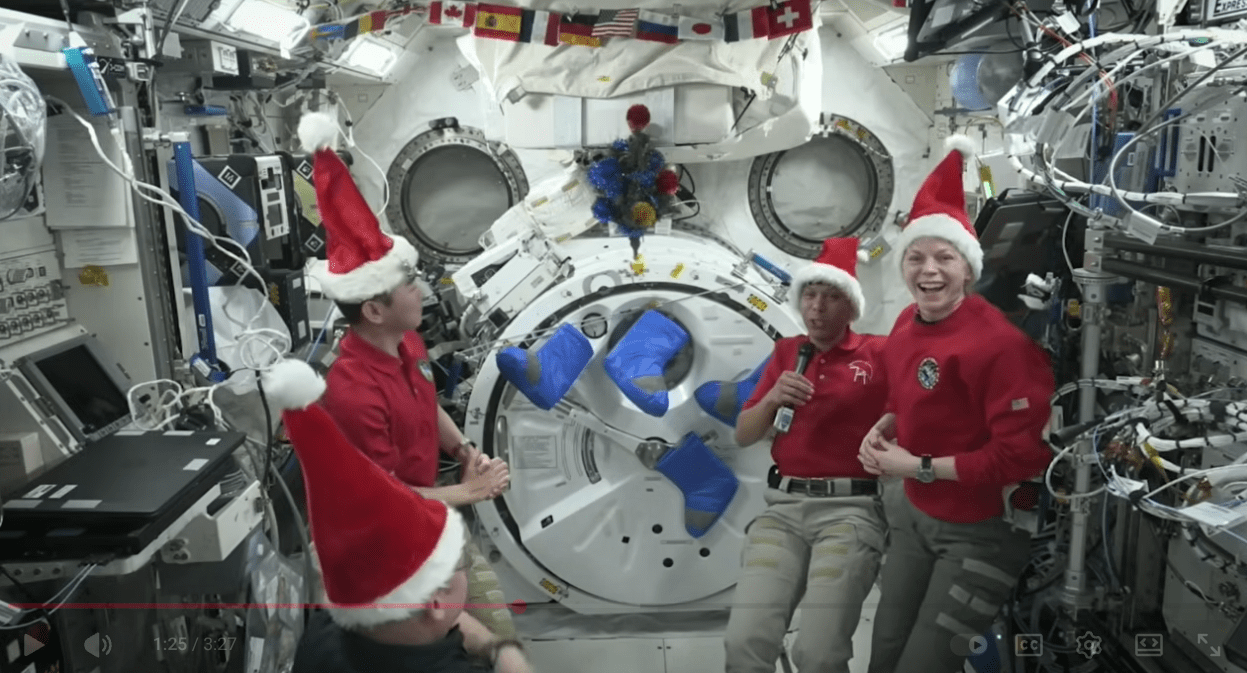
Image (Credit): NASA Expedition crew members (clockwise from the left) Zena Cardman, Mike Fincke, Jonny Kim, and JAXA astronaut Kimiya Yui recording their holiday message. (NASA)
The NASA Expedition 73 crew on the International Space Station (ISS) has recorded a Thanksgiving greeting for all of us down here looking up.
So what can the astronauts expect to eat for Thanksgiving? Astronaut Mike Fincke mentioned turkey and cranberry sauce, while astronaut Zena Cardman added mashed potatoes, crab meat, salmon, lobster, and more.
In a Florida Todaynews story, Steve Siceloff, a NASA public affairs officer, stated:
The crews’ holiday meals, including Thanksgiving, were flown up on NG-23 [on September 14]. On board the spacecraft was a special Holiday Bulk Overwrapped Bag (BOB) filled with festive foods like clams, oysters, crab meat, quail, and smoked salmon, along with shelf-stable treats such as candies, icing, almond butter, and hummus,
Happy Thanksgiving wishes to the ISS crew as well as everyone back here on Earth.
The Thirty Meter Telescope (TMT) was conceived more than two decades ago as the largest and most advanced telescope in the Northern Hemisphere. However, the telescope has encountered significant roadblocks, from funding uncertainties — now heightened by President Trump’s proposed budget cuts — to local resistance to building the telescope on Mauna Kea, a volcanic mountain in Hawai‘i that’s sacred to native communities. Now, the telescope might find a new home in La Palma on the Canary Islands of Spain. In July, the Spanish government offered to host the telescope, with an investment of up to €400 million ($460 million) to help cover some of the costs. In a brief statement posted on November 11th, the TMT announced that it is officially considering the move to La Palma.
In its latest shakeup to the Commercial Crew Program, NASA announced on Monday it has reduced the number of missions Boeing is required to fly to the International Space Station and changing the next flight from a crew mission to a cargo mission. The original contract NASA awarded to Boeing and SpaceX called for each to fly an uncrewed demonstration flight to the ISS, followed by a crewed demo mission and then conduct six regular crew rotation missions.
In the airless, radiation-saturated void outside of the International Space Station, researchers tested whether a common moss species known as Physcomitrium patens could survive at all, and if it could, for how long. The answers are yes and probably forever if it wants...Tomomichi Fujita, the study’s lead author, thinks moss could last up to 15 years in space, knowledge that could help build future extraterrestrial farms or entire ecosystems on the Moon or Mars.
Image (Credit): October 2, 2025 image of comet 3I/ATLAS as captured by the High Resolution Imaging Science Experiment (HiRISE) camera aboard NASA’s Mars Reconnaissance Orbiter. (NASA/JPL-Caltech/University of Arizona)
Harvard Professor Avi Loeb is not satisfied with NASA’s comments this week that the interstellar object streaming through our Solar System is a normal comet.
NASA’s representatives should have emphasized what we do not understand about 3I/ATLAS rather than insist that it is a familiar comet from a new birth environment…We should not “judge a book by its cover,” because we all know about the Trojan Horse which appeared unthreatening to the guardians of the City of Troy. When monitoring an interstellar visitor, we should not fall prey to traditional thinking but scrutinize new interpretations. The public resonates with science as a learning experience, where the collection of evidence leads the way to new knowledge rather than reinforces variants on past knowledge.
Trojan Horse? That is certainly an alarming way of looking at this foreign object. Professor Loeb is not backing down one bit on his concerns, and refers back to his 12 puzzles, one of them being:
Its nucleus is about a million times more massive than 1I/`Oumuamua, an interstellar object discovered in 2017, and a thousand times more massive than 2I/Borisov, discovered in 2019, while moving faster than both, altogether with a likelihood of less than 0.1 per cent (see here and here). This suggests that it may have targeted the inner solar system rather than being drawn from the reservoir of icy rocks.
Again, using terms like “targeted” is certainly garnering a lot of interest by outside observers.
Maybe this will be settled next month with new images. Or maybe this will be a continuing controversy. Even if it goes nowhere, I think we can expect another book from Professor Loeb.
Image (Credit): Dust spirals surrounding Wolf-Rayet Apep, as captured by the JWST. (NASA, ESA, CSA, STScI, Y. Han (Caltech), R. White (Macquarie University), A. Pagan (STScI))
This week’s embryonic image comes from the James Webb Space Telescope (JWST). It shows what NASA calls “four serpentine spirals of dust” around a pair of Wolf-Rayet stars. Such stars are rare, with NASA estimating that only a thousand can be found in our galaxy consisting of hundreds of billions of stars. And binary Wolf-Rayet stars are even rarer.
NASA notes that the JWST, or Webb, provided a much better image of the spiraling dust:
Observations taken prior to Webb only detected one shell, and while the existence of outer shells was hypothesized, searches using ground-based telescopes were unable to uncover any. These shells were emitted over the last 700 years by two aging Wolf-Rayet stars in a system known as Apep, a nod to the Egyptian god of chaos...Webb also confirmed that there are three stars gravitationally bound to one another in this system. The dust ejected by the two Wolf-Rayet stars is “slashed” by a third star, a massive supergiant, which carves holes into each expanding cloud of dust from its wider orbit. (All three stars are shown as a single bright point of light in Webb’s image.)