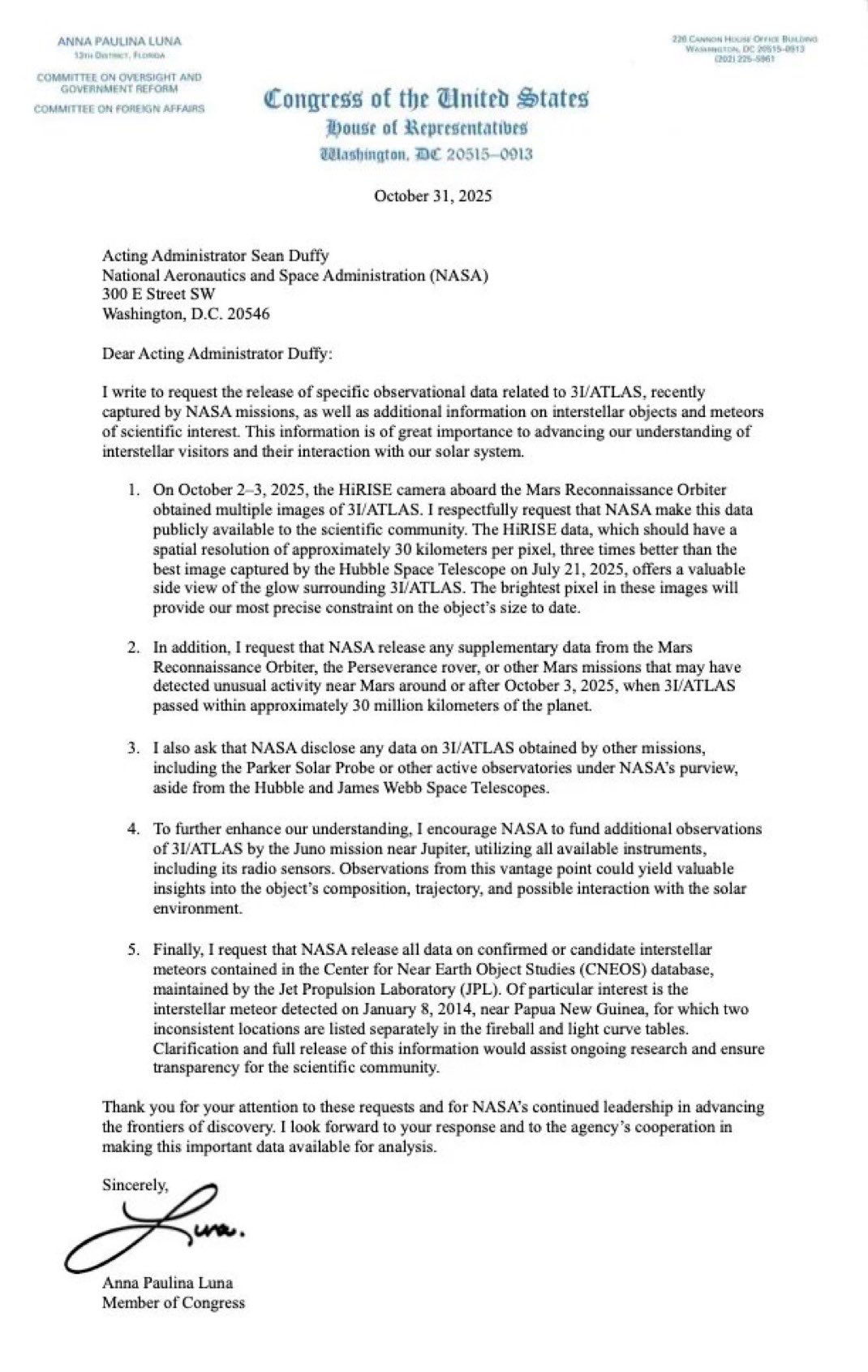
Congresswoman Anna Paulina Luna (R-FL) is very interested in obtaining some additional observational data from NASA regarding the interstellar comet known as 3I/ATLAS. In her letter to NASA (shown below), she said the information is “…of great importance to advancing our understanding of interstellar visitors and their interaction with our solar system.”
It appears this interest follows comments from Harvard scientist Avi Loeb about the object possibly being an alien spaceship.
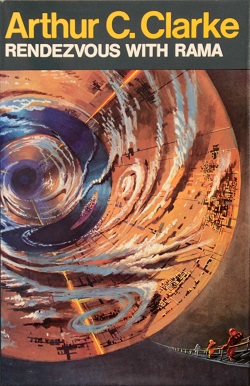
All of this is starting to sound the plot in Arthur C. Clark’s book Rendezvous with Rama.
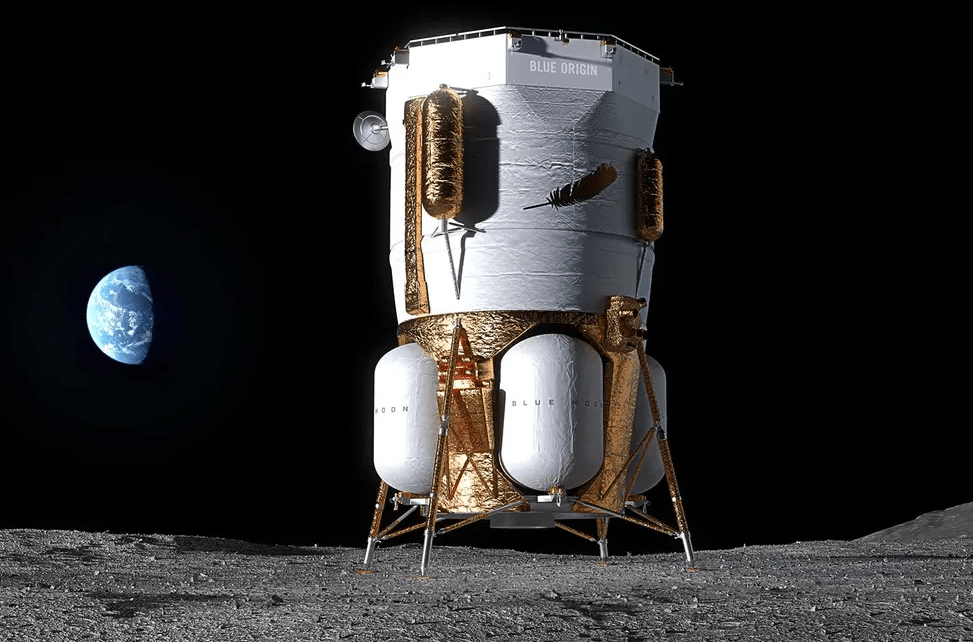
Image (Credit): Artist’s rendering of Blue Origin’s Blue Moon Mark 1, which is a single-launch, lunar cargo lander. (Blue Origin)
President Trump has had a change of heart on Jared Isaacman, his initial nominee for NASA administrator until he withdrew that nomination earlier this year.
Earlier today, the President posted the following:
Jared’s passion for Space, astronaut experience, and dedication to pushing the boundaries of exploration, unlocking the mysteries of the universe, and advancing the new space economy, make him ideally suited to lead NASA into a bold new era.
So what has changed in the last few months to make Mr. Isaacman “ideally suited” to lead NASA as compared to when he was determine unsuitable? I cannot think of anything other than the end of the President’s feud with Elon Musk. Of course, that was recently replaced with Elon Musk’s feud with acting NASA Administrator Sean Duffy, who proposed reopening competition for the first manned Moon landing this century due to delays with SpaceX’s Starship.
Will Mr. Isaacman save Musk’s Moon mission? He may calm some of the acrimony for the time being, but any new NASA administrator had better have a solid plan to get Americans back on the Moon before China does. Mr. Isaacman may be friends with Mr. Musk, but should he be confirmed he will head a weakened space agency that is struggling with a complex Moon mission that may be much less complex without the Starship refueling plans. In fact, Blue Origin just submitted a new Moon mission plan that drops this refueling altogether.
It is not impossible the winds will shift again, leaving Mr. Isaacman adrift once more. That is how it is in Washington these days. Fickle leadership leads to fickle decision-making and fickle planning.
The Chinese are not having these issues at the moment as they aim to be on the Moon by 2030.
An international team of researchers has just revealed the existence of three Earth-sized planets in the binary stellar system TOI-2267 located about 190 light-years away. This discovery, published in Astronomy & Astrophysics, is remarkable as it sheds new light on the formation and stability of planets in double-star environments, which have long been considered hostile to the development of complex planetary systems.
In recent weeks, copies of an intriguing policy document have started to spread among space lobbyists on Capitol Hill in Washington, DC. The document bears the title “Athena,” and it purports to summarize the actions that private astronaut Jared Isaacman would have taken, were his nomination to become NASA administrator confirmed. The 62-page plan is notable both for the ideas to remake NASA that it espouses as well as the manner in which it has been leaked to the space community.
Space can surprise even those who spend their lives studying it. People often think of our solar system as just a few planets and a bunch of empty space. Yet new observations suggest we have been living inside a hot, less dense region, and that there may even be a strange “cosmic interstellar channel,” or tunnel, connecting us to distant stars. After years of careful mapping, a new analysis reveals what appears to be a channel of hot, low-density plasma stretching out from our solar system toward distant constellations.
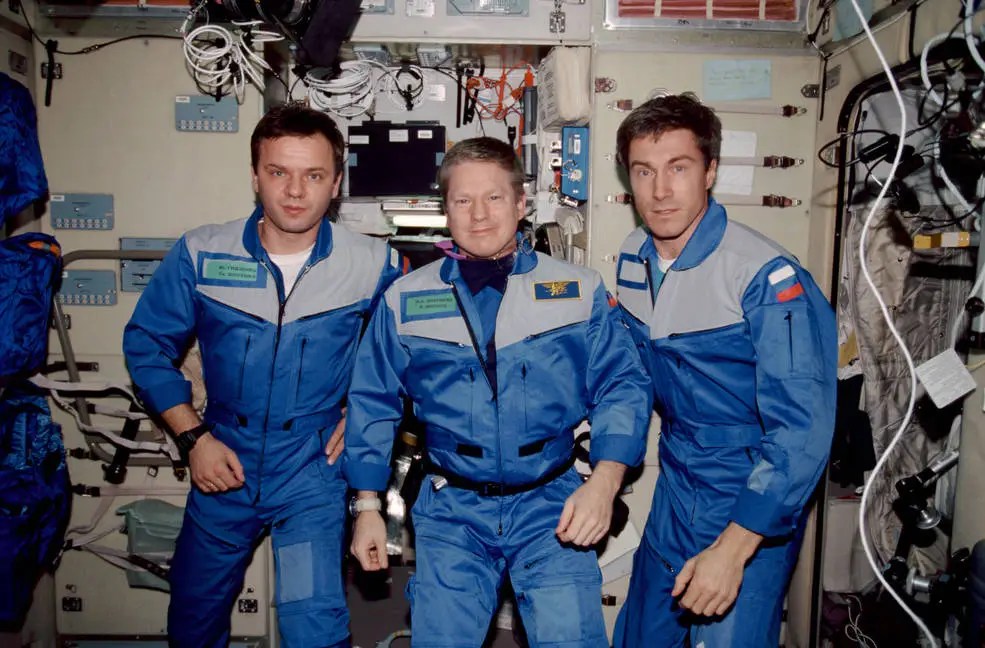
Image (Credit): The Expedition 1 crew of Yuri P. Gidzenko (left), William M. Shepherd, and Sergei K. Krikalev in the ISS’s Zvezda Service Module. (NASA)
It was 25 years ago on this day that the Expedition 1 crew arrived at the International Space Station (ISS), which marked the beginning of very successful space collaboration between five space agencies from the United States, Russia, the European Union, Japan, and Canada.
The Expedition 1 crew, arriving at the ISS aboard a Russian Soyuz capsule, consisted of NASA astronaut William M. Shepherd and Russian cosmonauts Yuri P. Gidzenko and Sergei K. Krikalev. This first mission of four months focused on the continued assembly of the station, with the Expedition 2 crew arriving in March 2001 aboard Space Shuttle Discovery.
In 24 hours, the space station makes 16 orbits of Earth, traveling through 16 sunrises and sunsets.
The living and working space in the station is larger than a six-bedroom house (and has six sleeping quarters, two bathrooms, a gym, and a 360-degree view bay window).
A spacecraft can arrive at the space station as soon as four hours after launching from Earth.
The space station travels an equivalent distance to the Moon and back in about a day.
Image (Credit): Drawing of the International Space Station with all of the elements labeled. (NASA)
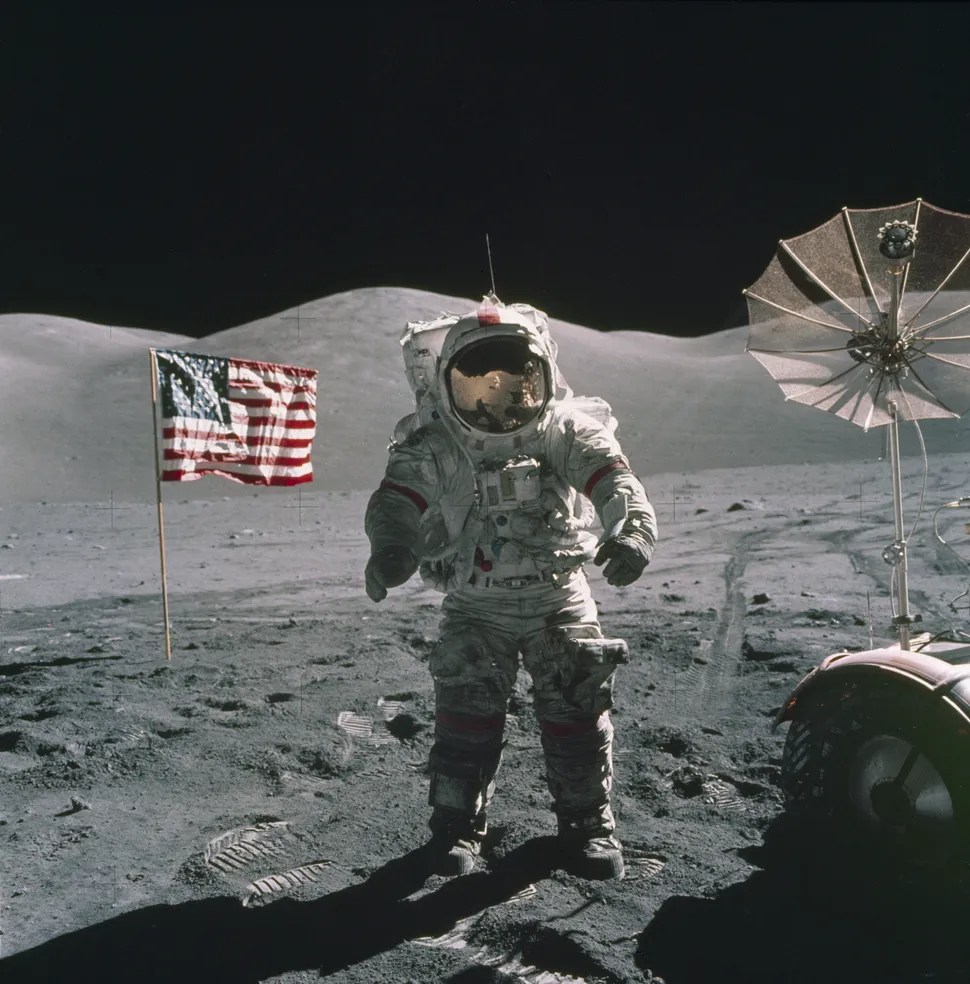
Image (Credit): Apollo 17 commander Eugene Cernan on the surface of the Moon. He was the last US astronaut to walk on the Moon. (NASA)
Acting NASA Administrator had to time time out of his day (or at least a staff member had to) to respond to a dumb comment by, let us say, a less-than-scientifically minded Kim Kardashian. She had earlier shared her doubts about whether the United States ever placed astronauts on the Moon. Of course, it is not an original sentiment, but it does gain traction in this social media age where dumb comments are golden.
Yes, @KimKardashian, we’ve been to the Moon before… 6 times!
And even better: @NASAArtemis is going back under the leadership of @POTUS.
We won the last space race and we will win this one too
I left out the little cartoons of a rocket and an American flag from the tweet, but you get the point.
We can all certainly agree with Mr. Duffy’s first point about the Moon landings, but the matter of the new space race is still up in the air. In that regard, he and NASA still have much more to do.
Maybe Ms. Kardashian can use her influence in a more helpful way by pushing for more NASA funding. If she really believes we missed the mark last time, maybe she can help ensure this new space race is a success. Hell, we can even put her name on the side of one of the rocket boosters.