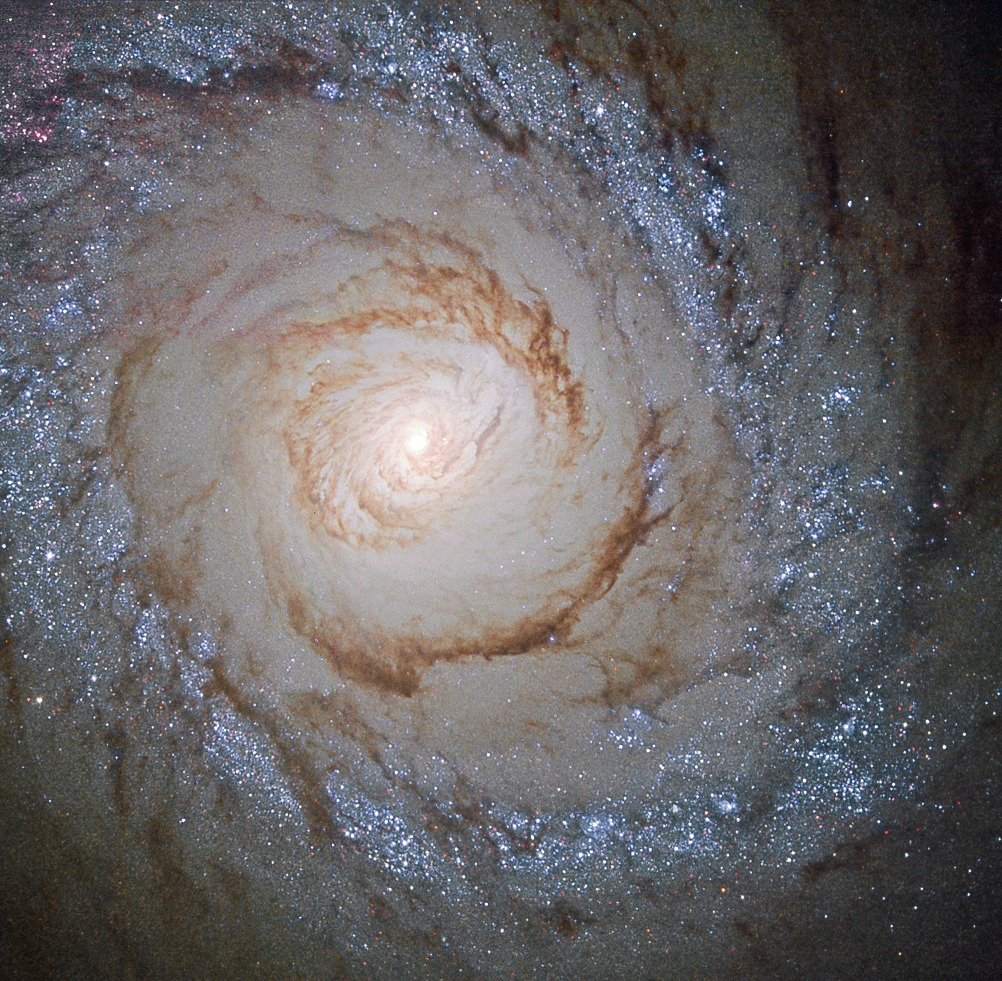
Pic of the Week: The Starburst Galaxy

Image (Credit): Starburst Galaxy Messier 94. (ESA/Hubble and NASA)

This week’s image is from the Hubble Space Telescope. It was shared on NASA’s Astronomy Picture of the Week website last month. The sparkling galaxy, Messier 94, is about 15 million light-years away.

Here is NASA’s description of what you are seeing above:

Beautiful island universe Messier 94 lies a mere 15 million light-years distant in the northern constellation of the hunting dogs, Canes Venatici. A popular target for earth-based astronomers, the face-on spiral galaxy is about 30,000 light-years across, with spiral arms sweeping through the outskirts of its broad disk. But this Hubble Space Telescope field of view spans about 7,000 light-years or so across M94’s central region. The sharp close-up examines the galaxy’s compact, bright nucleus and prominent inner dust lanes, surrounded by a remarkable bluish ring of young, massive stars. The massive stars in the ring appear to be less than about 10 million years old, indicating the galaxy experienced a corresponding well-defined era of rapid star formation. As a result, while the small, bright nucleus is typical of the Seyfert class of active galaxies, M94 is also known as a starburst galaxy. Because M94 is relatively nearby, astronomers can explore in detail reasons for the galaxy’s burst of star formation.

Note: I swapped out the earlier protostar image for this one when I realized I was duplicating an earlier entry.

Space Stories: Even More Space Tourists, Upcoming Asteroid Encounter, and Copernicus Had Help

Image (Credit): New Shepard’s NS-31 Mission crew. (Blue Origin)

Here are some recent stories of interest.

ABC News: Blue Origin Mission with All-female Crew, Including Katy Perry, Completes Space Trip

Blue Origin’s all-female crew, which included pop star Katy Perry, completed their trip into space Monday morning. The flight lasted around 11 minutes and traveled more than 60 miles above Earth, according to Blue Origin, passing the Kármán line, which at 62 miles above sea level is considered to be the boundary between Earth’s atmosphere and outer space. Along with Perry, the crew included Blue Origin owner Jeff Bezos’ journalist fiancée, Lauren Sanchez, who is also a helicopter pilot.

NASA: NASA’s Lucy Spacecraft Prepares Second Asteroid Encounter

NASA’s Lucy spacecraft is 6 days and less than 50 million miles (80 million km) away from its second close encounter with an asteroid; this time, the small main belt asteroid Donaldjohanson. This upcoming event represents a comprehensive “dress rehearsal” for Lucy’s main mission over the next decade: the exploration of multiple Trojan asteroids that share Jupiter’s orbit around the Sun.

University of Sharjah: Copernicus May Have Leaned on Ancient Muslim Astronomer in Developing his Cosmological System

New research has revealed that the cosmological model developed by Nicolaus Copernicus, the renowned European Renaissance polymath, bears striking resemblance to the one designed by an Arab Muslim astronomer nearly two centuries earlier. The research conducted at the University of Sharjah is a comparative and analytical study which examines in parallel the writings of Copernicus in correlation with the works of the 14th century Muslim astronomer Ibn al-Shatir.

Space Quote: Senator’s Warning About NASA Cuts

Image (Credit): NASA’s Goddard Space Flight Center in Greenbelt, Maryland. (NASA)

“When you pull the plug on major space science, it’s like eating your seed corn; it’s so damaging to our entire ecosystem when it comes to American leadership and innovation in this area…We will lose engineers, we will lose others to China. In fact, they are launching a major space exploration initiative.”

Statement by Maryland Senator Chris Van Hollen commenting on potential DOGE cuts after visiting NASA’s Goddard Space Flight Center just outside the Washington, DC Beltway. The Center is home to the nation’s largest organization of scientists, engineers and technologists who build spacecraft, instruments and new technology to study Earth, the sun, our solar system, and the universe.

Planetary Society Decries NASA Budget Cuts

Image (Credit): Artist’s rendering of the Nancy Grace Roman Space Telescope, which is one of the programs that NASA may need to cut as a result of proposed budget cuts. (Institute of Space and Aeronautical Science)

Earlier today, the Planetary Society issued a press release condemning recently announced proposed science cuts at NASA. This is the same week that the Senate heard from the nominee for NASA Administrator, Jared Isaacman, who stated in his written testimony:

I am an advocate for science. During these missions to space, my crew & I performed approximately 50 science and research experiments. I have also publicly supported the Chandra x-Ray Observatory and offered to fund a mission to extend the life and capabilities of the Hubble space telescope.

In its press release, the Planetary Society pulled no punches:

Days ago, the Administration’s nominee to lead NASA called for a “new golden age of science and discovery” at the agency. The proposed budget from within the White House — which cuts NASA science by 47% — would plunge NASA into a dark age instead.

If enacted, this budget would force the premature termination of dozens of active, productive spacecraft. These spacecraft are unique assets: their instrumentation and capabilities cannot be replaced without billions of dollars of new taxpayer investment. No commercial or private space companies can fill this gap.

This budget would halt the development of nearly every future science project at NASA, wasting billions of dollars of taxpayer funds already spent on these projects, abandoning international and commercial partners, and surrendering U.S. leadership in space science to other nations.

This budget would eviscerate space science research, withering the nation’s STEM talent pipeline by removing opportunities to train future scientists and engineers.

The Planetary Society condemns this proposal for NASA and for NASA science. We urge Congress to swiftly reject this proposal and restore funding for NASA’s Science Mission Directorate. We remain committed to joining with all stakeholders to protect and promote U.S. leadership in the scientific exploration of space.

It is time to write to Congress about these cuts. The Planetary Society provided a helpful page to do this.

It is also a good time to get a full time Administrator to fight for the agency if Mr. Isaacman’s comments can be believed.

Today’s NASA Nominee Hearing

It appears Mr. Isaacman will become the next NASA Administrator based on his careful answering of questions at his nomination hearing, but there was some weakness in his support for a Moon mission in both his prepared testimony as well as his answers to later questions.

In his prepared statement, Mr. Isaacman’s emphasis was Mars with reluctant support for something happening on the Moon:

As the President stated we will prioritize sending American astronauts to Mars. Along the way, we will inevitably have the capabilities to return to the Moon and determine the scientific, economic, and national security benefits of maintaining a presence on the lunar surface.

I read that as him saying a return to the Moon is an option.

Chairman Cruz was far more adamant about a Moon mission in his opening statement, saying:

The Artemis missions and the entire Moon-to-Mars program, which have enjoyed consistent bipartisan support, serve as the stepping stone to landing American astronauts on Mars. In fact, this stepping stone approach is the law as enacted by Congress. We must stay the course. An extreme shift in priorities at this stage would almost certainly mean a Red Moon—ceding ground to China for generations to come. I am hard pressed to think of a more catastrophic mistake we could make in space than saying to Communist China, ‘The moon is yours. America will not lead.’

In the question and answer period, Senator Cruz asked about the return to the Moon and received this weak response from Mr. Isaacman:

I don’t think we have to make any tough trades here, Senator. I think if we can concentrate our resources at the world’s greatest space agency, we don’t have to make a binary decision of moon versus Mars or moon has to come first versus Mars.

So Chairman Cruz continued:

If China beats us to the moon, what consequences might America face?

Mr. Isaacman replied:

We certainly cannot lose…If we do not lead the way and we’re following, we may be following forever, the consequence of which could be extraordinary.

That response sounds a little better, though it may upset Mr. Musk who has a preference for Mars, particularly a Mars mission that has federal funds going to his company.

It appears Mr. Isaacman has forgotten that the Moon is a stepping stone to Mars and not a speed bump. NASA is almost ready for a nearby Moon mission that can be accomplished in weeks, but a Mars mission that will take years is not even close to ready, no matter what Mr. Musk says.

Republicans and Democrats need to hold Mr. Isaacman’s feet to the fire to ensure the Artemis program is fully funded and continues before any designs are set for a Mars mission.