“You’re floating, and your body, all these little aches and pains, and everything heal up, and you feel like you’re 30 years old again and free of pain, free of everything, and ready to do your mission work. So, I love being in orbit. It’s a great place to be for me and my physiology.”
-Comment by NASA astronaut Don Pettit during a press conference after his return to Earth from the International Space Station. The 70-year-old spent 220 days on the station. His 70th birthday was the same day he returned to Earth aboard a Russian Soyuz spacecraft.
The first 27 satellites for Amazon’s Kuiper broadband internet constellation were launched into space from Florida on Monday, kicking off the long-delayed deployment of an internet-from-space network that will rival SpaceX’s Starlink. The satellites are the first of 3,236 that Amazon plans to send into low-Earth orbit for Project Kuiper, a $10 billion effort unveiled in 2019 to beam broadband internet globally for consumers, businesses and governments – customers that SpaceX has courted for years with its powerful Starlink business.
As NASA ramps up plans to return to the moon and, eventually, Mars, it is moving forward with plans to shrink its workforce by incentivizing employees to leave government...NASA officials have told employees they may receive a second “deferred resignation” offer to allow staff to take paid leave until they exit government by Sept. 30, as well as early retirement and buyouts, to incentivize departures from the agency. These options were submitted as part of NASA’s reduction-in-force and reorganization plan, employees who attended the meetings in which the plans were shared said, which all agencies had to turn over to the Office of Personnel Management and the White House in recent weeks.
To better understand the physics behind the interaction of exhaust from the commercial human landing systems and the Moon’s surface, engineers and scientists at NASA’s Marshall Space Flight Center in Huntsville, Alabama, recently test-fired a 14-inch hybrid rocket motor more than 30 times. The 3D-printed hybrid rocket motor, developed at Utah State University in Logan, Utah, ignites both solid fuel and a stream of gaseous oxygen to create a powerful stream of rocket exhaust.
“In my early 20s, I was fortunate to experience business success at a young age, and I spent time in casinos as an immature hobby…The legal matters referenced were, in fact, forms of negotiation and were all resolved promptly. The incident at the border, following my return from the Olympics, stemmed from a payment issue that had already been resolved, which is why I was detained for only a few hours.”
-Statement by NASA Administrator nominee Jared Isaacman in a Reuters news article discussing his past arrest on fraud charges as well as lawsuits in two states for writing $2 million in bad checks to casinos. One of the casinos cited in the article is Donald Trump’s Taj Mahal casino in Atlantic City, now out of business. The early ties to Trump are interesting, particularly given Mr. Trump’s problem with his finances as well. So this is what we have coming into NASA – a man who likes to gamble large amounts and not pay his bills. Now he wants to gamble with the taxpayers’ money. This is not an auspicious start.
Credit: Image by OpenClipart-Vectors from Pixabay.
Elon Musk has decided to step away from the Department of Government Efficiency (DOGE) after watching his reputation crater, his car company falter, and his rockets litter the Caribbean. Plus he damaged NASA, the space agency that funds his company SpaceX. Maybe he finally realized that a plumber has no business pretending to be brain surgeon.
The most disturbing part of Musk’s short time with the government is his lies about fraud, attacks on government employees, and horrible math regarding savings. For example, regarding the US Agency for International Development, he called it a “criminal organization” and then said it is “Time for it to die.” He never took the time to even understand the organization or verify his “findings”, most of which were wrong. I cannot believe a single Fortune 500 company would want this guy anywhere near its operations. So why would you trust any organization headed by this man?
We can only hope this means he will start to take the development of Starship seriously, since his company is still contracted to assist NASA with its Artemis mission to the Moon. So far in 2025, SpaceX has lost both of its Starship rockets (#7 and #8) over the Caribbean, though it was scheduled to conduct 25 tests in 2025, or twice a month.
Mr. Musk may know nothing about government programs, but he is supposed to know something about rockets. He cannot bully or lie his way out of this one. As with Tesla, performance and promises is everything, and he seems to be struggling.
And now before he can come close to meeting his NASA commitments, he is promising to send Starship to Mars next year, tweeting ““Starship will hopefully depart for Mars at the end of next year with Optimus explorer robots!”.
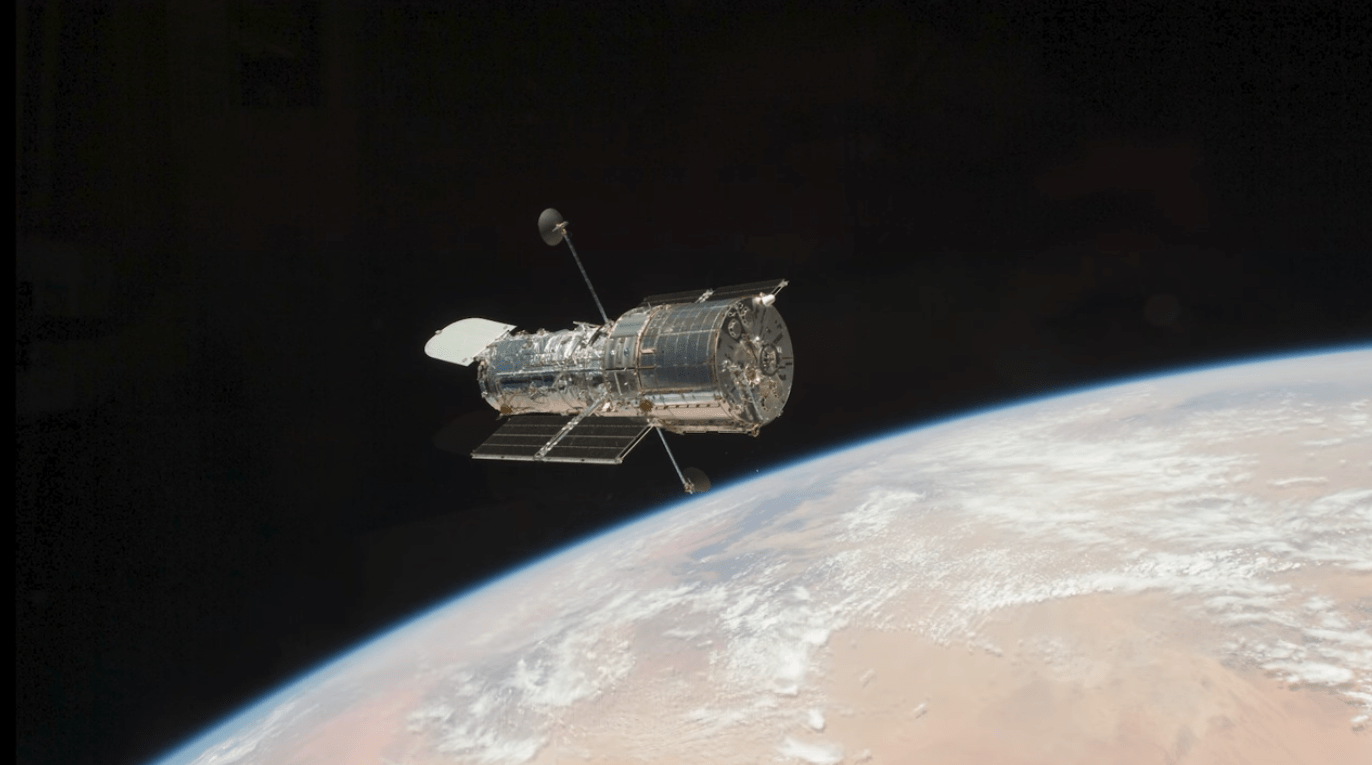
Image (Credit): The Hubble Space Telescope in low-Earth orbit. (NASA)
This year marks the 35th anniversary of the Hubble Space Telescope. It was launched on April 24, 1990 aboard the Space Shuttle Discovery. The telescope was expected to have a service life of 35 years, though it is still going strong with various proposals to update the telescope and keep it operating for years to come.
To mark the occasion, NASA put together a video highlighting missions and related images. The celebration will continue throughout the year with new images and other selected items.
Hubble is currently located 326 miles (525 km) above Earth’s surface. If you could drive straight up, you could reach it in about the same time it would take you to drive from Baltimore, Maryland to Boston, Massachusetts.
Hubble races through its orbit at about 17,000 miles per hour (27,000 kph), completing an orbit about every 95 minutes. That means it sees 15 sunrises every day.
While Hubble is speeding around Earth, it can lock onto a target without deviating more than 7/1000th of an arcsecond, or about the width of a human hair seen at a distance of one mile.





 Our Awesome Universe