Space Quote: Great Teamwork Saved Starliner

Image (Credit): Boeing’s Starliner spacecraft is docked to the Harmony module of the ISS on July 3, 2024. (NASA)

“”Thankfully, these folks are heroes. And please print this. What do heroes look like? Well, heroes put their tank on and they run into a fiery building and pull people out of it. That’s a hero. Heroes also sit in their cubicle for decades studying their systems, and knowing their systems front and back. And when there is no time to assess a situation and go and talk to people and ask, ‘What do you think?’ they know their system so well they come up with a plan on the fly. That is a hero. And there are several of them in Mission Control.”

-Statement by NASA astronaut Butch Wilmore in a recent interview with Ars Technica about his risky trip on the Boeing Starliner to the International Space Station (ISS). The Starliner experienced thruster problems that threatened the success of the mission. Butch Wilmore attributes much of his safe mission to the talents of the NASA team supporting him from Mission Control at Johnson Space Center in Houston.

Protect NASA Astrobiology Research

Image (Credit): Artist’s conception of a planetary lineup showing habitable-zone exoplanets with similarities to Earth, featured on the far right. (NASA/Ames/JPL-Caltech)

The astrobiology community is looking for individuals to show their support for NASA’s efforts in this area. In a white paper highlighting the benefits of astrobiology research, some of the key points are:

  • Preserve Astrobiology Leadership: Astrobiology is a pillar of NASA’s mission with a storied legacy that must be safeguarded.
  • Unprecedented Discoveries Ahead: Mars, Ocean Worlds, and exoplanet missions in the coming decades could finally answer one of humanity’s most profound questions: “are we alone?
  • Public Passion and Impact: The public passionately supports the search for life – a pursuit that inspires, unites, and advances STEM engagement.
  • NASA’s Unique Role: NASA’s unique capabilities and infrastructure position it as a leader in astrobiology, working in collaboration with U.S. academia and industry to advance this field.
  • Preserve Astrobiology at Its Peak: Astrobiology is thriving; workforce and research funding reductions must not derail our best chance to find life beyond Earth.

At a time of unprecedented threats to NASA’s program and mission, it is important to send a message to Congress and others that we have just begun to understand the universe and its potential for other forms of life, and now is not the time to back away.

The paper notes:

As NASA navigates the administration’s government-wide workforce optimization initiative, it is vital that we do not undermine astrobiology research – a field at the very heart of our agency’s purpose and future. Acting leadership has rightly stated that any reductions must align with mission needs. Few needs are more central to NASA’s science mission than understanding life’s existence beyond Earth.

The same site provides a link to an endorsement page.

I expect this is one of many initiatives to bring attention to the threats facing our space program. It is true that some efficiencies can be found in government with the right level of analysis and careful consideration of existing programs (as has been done in the past), but that is not happening right now with the random and unexplainable cuts.

The Artemis II Mission Has a Patch

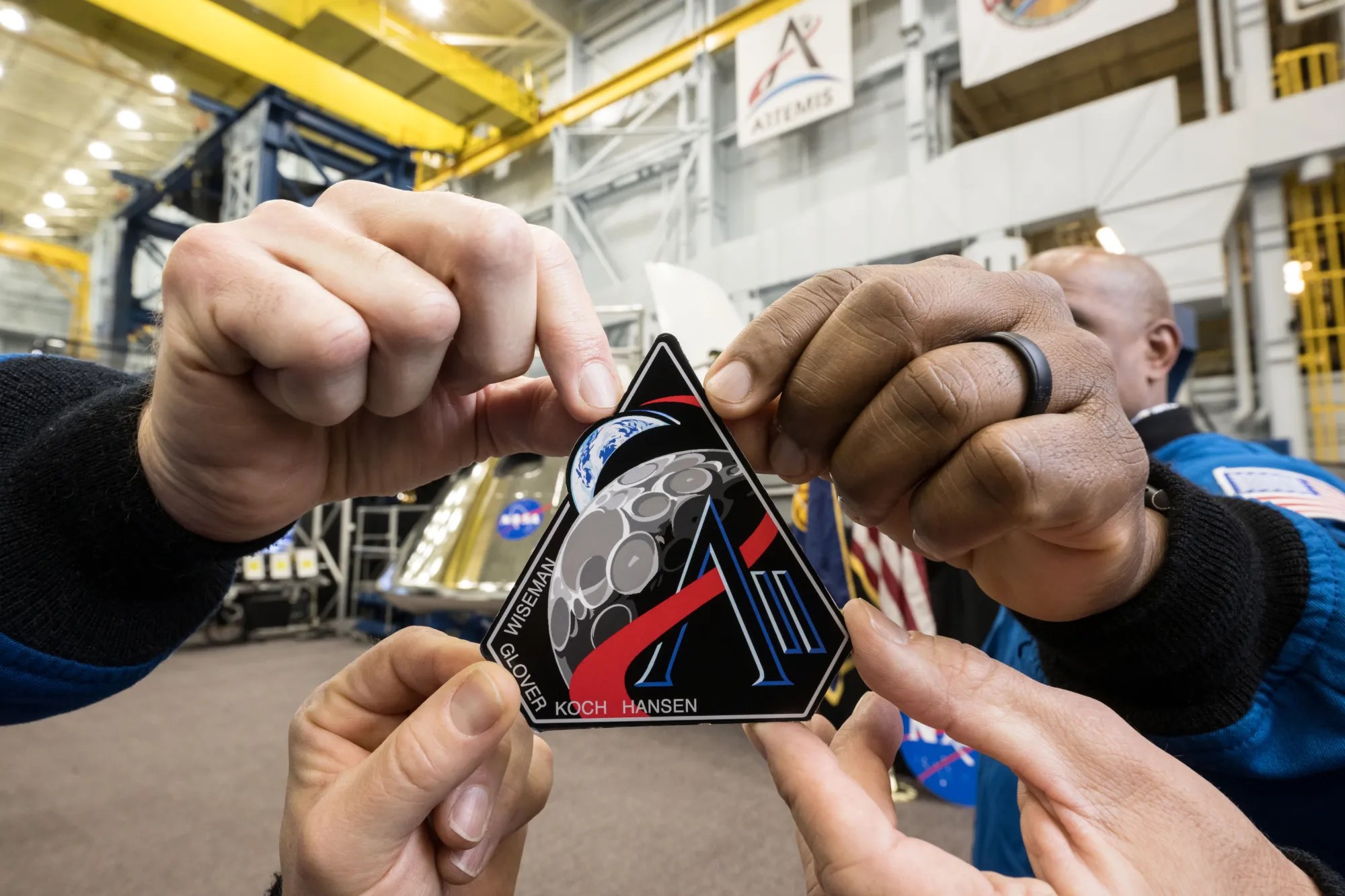
Image (Credit): Mission patch for the Artemis II mission. (NASA)

This week NASA unveiled the new mission patch for the Artemis II mission to return astronauts to lunar orbit (shown above). The Artemis II crew designed the patch with the hope that the mission to the Moon will occur next year. The four astronauts selected for the crew are NASA Commander Reid Wiseman, pilot Victor Glover, and mission specialist Christina Koch, and Canadian Space Agency mission specialist Jeremy Hansen.

The crew also provided this description of the new mission patch:

The Artemis II test flight begins when a mighty team launches the first crew of the Artemis generation. This patch designates the mission as “AII,” signifying not only the second major flight of the Artemis campaign, but also an endeavor of discovery that seeks to explore for all and by all. Framed in Apollo 8’s famous Earthrise photo, the scene of the Earth and the Moon represents the dual nature of human spaceflight, both equally compelling: The Moon represents our exploration destination, focused on discovery of the unknown. The Earth represents home, focused on the perspective we gain when we look back at our shared planet and learn what it is to be uniquely human. The orbit around Earth highlights the ongoing exploration missions that have enabled Artemis to set sights on a long-term presence on the Moon and soon, Mars.

Now we have to do everything possible to make this mission happen before things fall apart at NASA or all of the attention shifts to a less likely quick mission to Mars.

Pic of the Week: Cosmic Tornado

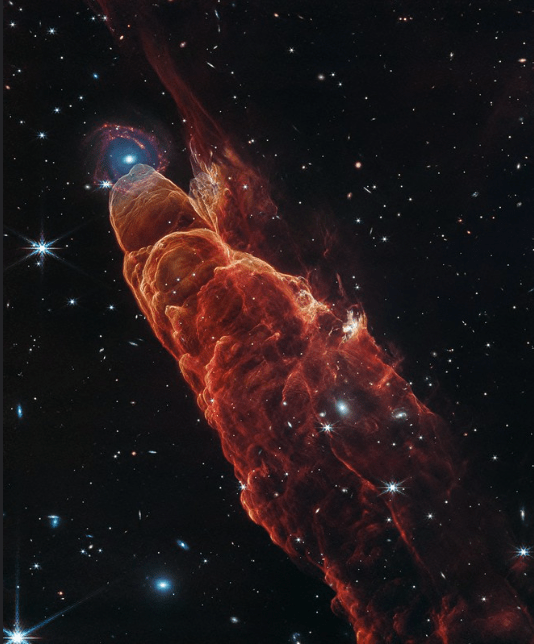
Image (Credit): Herbig-Haro 49/50 captured by the JWST. (NASA, ESA, CSA, STScI)

This week’s image is from the James Webb Space Telescope (JWST). The transparent red cloud in the middle of the image, nicknamed the “cosmic tornado,” is outflow of gas and dust from a newly formed star. Moreover, the bright blue glow at the top of the cloud has nothing to do with what you are seeing. The blue glow is a distant spiral galaxy.

Here is more about the image from NASA:

Angled from the upper left corner to the lower right corner of the image is a cone-shaped orange-red cloud known as Herbig-Haro 49/50. This feature takes up about three-fourths of the length of this angle. The tip of the cone positioned at the upper left appears translucent with a rounded end. Coincidently, a background spiral galaxy appears right near the tip too. The galaxy has a concentrated blue center that fades outwards to blend in with red spiral arms. The cones-shaped feature widens slightly from tip down to the lower right. Along the way there are additional rounded edges, like edges of a wave, and intricate foamy-like details. The nebula appears even more translucent to the lower right providing a clearer view of the black background of space. The black background of space is clearer, speckled with some white stars and smaller, more numerous, fainter white galaxies.

Upcoming Hearing on NASA Nominee

The process continues to bring on a new NASA Administrator, even as Elon Musk and his DOGE team do all they can to cripple the agency.

The nomination hearing for Jared Isaacman, announced earlier today by the Senate Committee on Commerce, Science, and Transportation, will take place next Wednesday, April 9, at 10am. The hearing will be streamed live via the Committee’s website as well as YouTube.

The same hearing will also discuss the nomination of Olivia Trusty to be a Member of the Federal Communications Commission, so it is not clear how much time will be dedicated to the NASA piece. Generally, the nominee reads from a prepared statement and the Senators who show up that day pepper the nominee with a few questions.

These hearings are usually pretty tame, but that may not be the case if Mr. Isaacman’s ties with Elon Musk become a topic. A recent Wall Street Journal story stated that Mr. Isaacman was hand-picked by Mr. Musk, which followed Mr. Isaacman paying SpaceX an undisclosed amount to go into orbit last year.

It has also been reported that Mr. Isaacman’s own companies may come under scrutiny because of their DEI initiatives, a big no-no with the White House and the ever-destructive DOGE.

Maybe it will be an interesting hearing.