Space Stories: Farewell to Bill Nelson, an Unpredictable Universe, and Ponds and Lakes on Mars

Image (Credit): Bill Nelson appearing before the Senate Committee on Commerce, Science, and Transportation on April 21, 2021 as the nominee to be the 14th administrator of NASA. (NASA/Bill Ingalls)

Here are some recent stories of interest.

WESH.comNASA Administrator Bill Nelson Writes Letter to Next Leader, Reflects on Legacy and Future of Space Exploration

In a heartfelt letter addressed to the 15th Administrator of NASA, Bill Nelson expressed his admiration for the agency’s workforce and the immense honor of leading the organization dedicated to space exploration. Nelson, who has a rich history with NASA, having flown on the Space Shuttle Columbia and served as a U.S. Senator from Florida, emphasized the exceptional nature of the NASA team. He noted that the agency embodies a “can-do spirit” that exemplifies American ingenuity and leadership in space.

Duke UniversityDan Scolnic Shows that the Universe Is Still Full of Surprises

The Universe really seems to be expanding fast. Too fast, even. A new measurement confirms what previous — and highly debated — results had shown: The Universe is expanding faster than predicted by theoretical models, and faster than can be explained by our current understanding of physics. This discrepancy between model and data became known as the Hubble tension. Now, results published in the Astrophysical Journal Letters provide even stronger support to the faster rate of expansion. “The tension now turns into a crisis,” said Dan Scolnic, who led the research team.

CaltechSignatures of Ice-Free Ancient Ponds and Lakes Found on Mars

Researchers have discovered two sets of ancient wave ripples on Mars, signatures of long-dried bodies of water preserved in the rock record. Wave ripples are small undulations in the sandy shores of lakebeds, created as wind-driven water laps back and forth. The two sets of ripples indicate the former presence of shallow water that was open to the Martian air, not covered by ice as some climate models would require.

Space Quote: Next Step Mars?

Credit: NASA

“We will pursue our manifest destiny into the stars, launching American astronauts to plant the Stars and Stripes on the planet Mars.”

-Inaugural statement by President Trump on January 20, 2024. He may want to check with NASA on the Artemis program given that the planned trip to the Moon has already cost taxpayers billions of dollars. He might also want to read a recent Politico story that discusses congressional preference for a Moon first program. The story quotes Texas Republican Brian Babin, who stated, “To bypass the moon would be a mistake.” It might also look bad to give the Moon to the Chinese long before we figure out a way to safely get to Mars. For all of Musk’s talk on this matter, the loss of a Starship rocket last week was not encouraging. We are having trouble enough getting ready to return to the Moon.

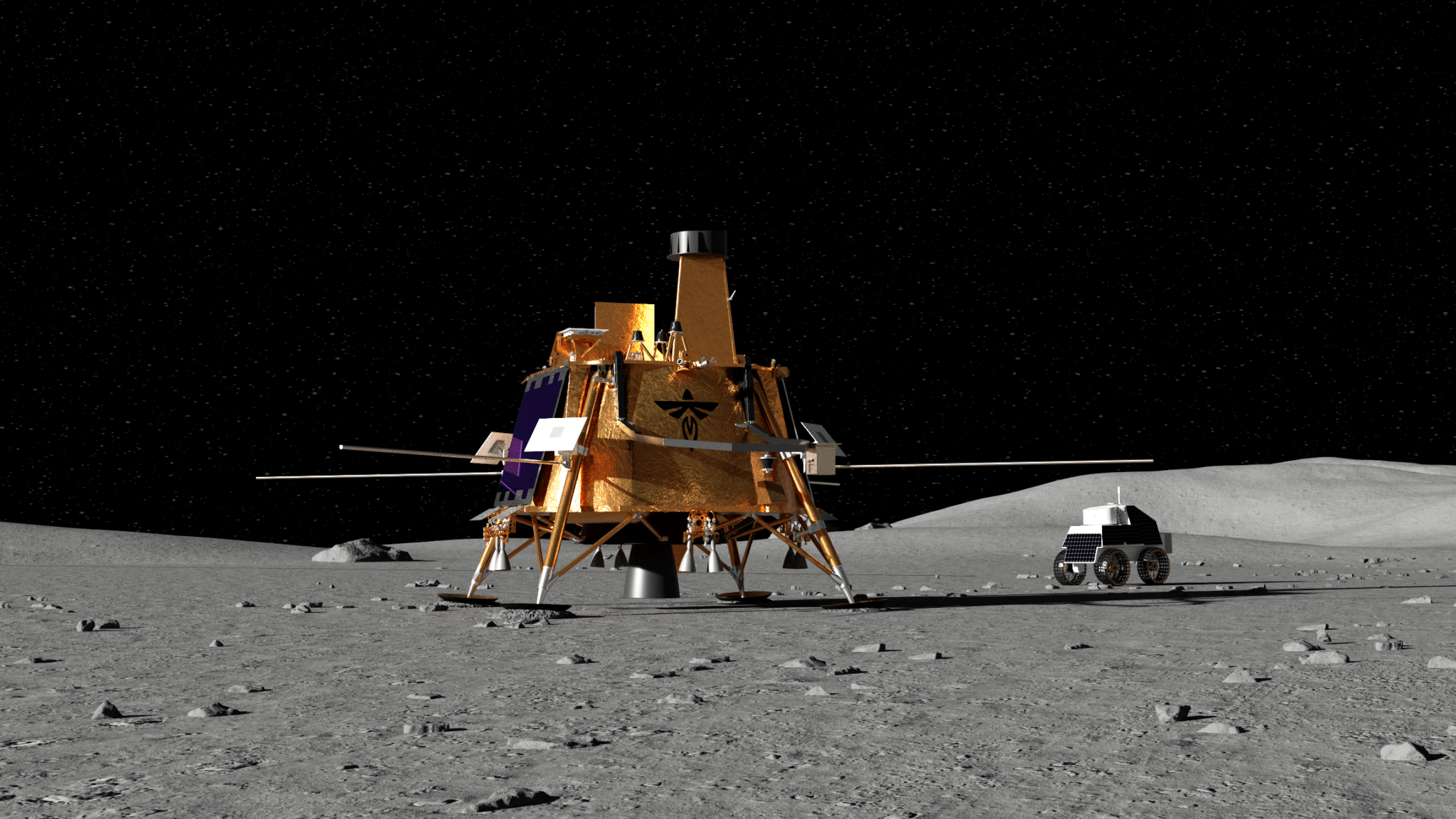
Blue Ghost Lunar Lander on its Way to the Moon

Image (Credit): Artist’s rendering of the Blue Ghost lunar lander on the Moon. (Firefly Aerospace)

Earlier today, a SpaceX rocket successfully launched Firefly Aerospace’s Blue Ghost mission. If it makes it to the lunar surface, it will be the second US mission to land on the Moon since the end of the Apollo program in the 1970s.

Firefly Aerospace issued a press release noting its the initial success of the mission:

Firefly’s Blue Ghost lunar lander launched on a SpaceX Falcon 9 rocket, successfully acquired signal, and completed on-orbit commissioning. With a target landing date of March 2, 2025, Firefly’s 60-day mission is now underway, including approximately 45 days on-orbit and 14 days of lunar surface operations with 10 instruments as part of NASA’s Commercial Lunar Payload Services (CLPS) initiative.

Blue Ghost Mission 1, named Ghost Riders in the Sky, launched from Launch Complex 39A at NASA’s Kennedy Space Center in Florida, at 1:11 a.m. EST on January 15, 2025. Blue Ghost separated from the SpaceX Falcon 9 rocket in a highly elliptical Earth orbit at 2:17 a.m. EST and established communications with Firefly’s Mission Operations Center in Cedar Park, Texas, at 2:26 a.m. EST. On-orbit spacecraft commissioning was then completed by 5:30 a.m. EST, which included verifying attitude determination and control capabilities, increasing the data transfer rate, establishing a power-positive attitude, and completing initial lander health checks.

This is a big step for Firefly Aerospace, which hopes to build on the success of this mission to launch other lunar missions in the next few years. But we need to take it one step at a time given the two US commercial lunar missions that failed earlier last year.

Note: The SpaceX launch also included a Japaneses private sector Moon mission – iSpace’s HAKUTO-R M2 “Resilience” lunar lander. This is the second Moon mission for iSpace. The first mission crashed into the Moon’s surface back in 2023.

iSpace has shown resilience after the previous attempt. A successful mission will be a good sign for the company and the private lunar industry as well.

You can read more about the mission particulars here.

Credit: iSpace

Space Stories: The Disappearance of Dark Skies in Chile, Subaru Telescope Gets New Eye, and Roman Telescope Previews

Image (Credit): The four large Unit Telescopes and the four smaller Auxiliary Telescopes that make up the European Southern Observatory’s (USO) Very Large Telescope. (USO)

Here are some recent stories related to astronomy telescopes.

Sky & TelescopeIndustrial Project Threatens Dark Chilean Skies

When a study in 2023 crowned Cerro Paranal the darkest observatory site in the world, astronomers must have felt reassured to have chosen the right spot. The 2,635-meter (8,645-foot) mountain in Chile’s Atacama Desert is home to the European Southern Observatory’s (ESO) Very Large Telescope, one of the most advanced and prolific astronomical facilities. But now, if a company named AES Andes (a subsidiary of the U.S. power company AES Corporation) gets its way, Paranal’s observational prowess might soon be history: Light pollution emitted by a proposed industrial “megaproject” could do away with the dark skies over this observatory.

National Astronomical Observatory of JapanPrime Focus Spectrograph on the Subaru Telescope to Begin Science Operations in February

Researchers have finished equipping the Subaru Telescope with a new special “compound eye,” culminating several years of effort. This new eye is an instrument featuring approximately 2,400 prisms scattered across the extremely wide field of view available at the Subaru Telescope’s primary focus, allowing for simultaneous spectroscopic observation of thousands of celestial objects. This unrivaled capability will help researchers precisely understand the formation and evolution of galaxies and the Universe. Among 8-meter-class telescopes, the Subaru Telescope is the most competitive with the largest survey capability in the world. This instrument, the Prime Focus Spectrograph (PFS), will be ready to begin scientific operations in February 2025.

NASASimulated Universe Previews Panoramas from NASA’s Roman Telescope

Astronomers have released a set of more than a million simulated images showcasing the cosmos as NASA’s upcoming Nancy Grace Roman Space Telescope will see it. This preview will help scientists explore Roman’s myriad science goals. “We used a supercomputer to create a synthetic universe and simulated billions of years of evolution, tracing every photon’s path all the way from each cosmic object to Roman’s detectors,” said Michael Troxel, an associate professor of physics at Duke University in Durham, North Carolina, who led the simulation campaign. “This is the largest, deepest, most realistic synthetic survey of a mock universe available today.”

Ice Delays New Glenn Rocket Launch and Firefly Heads to the Moon

Credit: Blue Origin

Blue Origin’s New Glenn rocket launch was pushed off again earlier today when ice was found building up on one of the lines related to the hydraulic systems.

At 3:09 a.m. EST, Blue Origin stated:

We’re standing down on today’s launch attempt to troubleshoot a vehicle subsystem issue that will take us beyond our launch window. We’re reviewing opportunities for our next launch attempt.

As a result, the new launch date is set for Thursday, January 16.

In the meantime, watch for the launch on Wednesday of Firefly Aerospace’s Blue Ghost Mission One as part of NASA’s Commercial Lunar Payload Services (CLPS) program. This mission will deliver 10 science and technology payloads to the Moon, including

  • testing regolith sample collection,
  • Global Navigation Satellite System abilities,
  • radiation tolerant computing, and
  • lunar dust mitigation. 

Firefly Aerospace notes:

Blue Ghost will spend approximately 45 days in transit to the Moon, allowing ample time to conduct health checks on each subsystem and begin payload science. Blue Ghost will then land in Mare Crisium and operate payloads for a complete lunar day (about 14 Earth days). Following payload operations, Blue Ghost will capture imagery of the lunar sunset and provide critical data on how lunar regolith reacts to solar influences during lunar dusk conditions. The lander will then operate for several hours into the lunar night.

Image (Credit): Blue Ghost Mission One schedule. (Firefly Aerospace)