
Is Musk Taking a Chainsaw to SpaceX?

Credit: Image by Mostafa Elturkey from Pixabay.

The press is all abuzz about Elon Musk’s latest statements regarding his establishment a new political party called the America Party. Some of the stories also relate to his continued inattention to his companies, particularly Tesla. Fortune magazine quoted one security tech analyst who stated:

Very simply Musk diving deeper into politics and now trying to take on the Beltway establishment is exactly the opposite direction that Tesla investors/shareholders want him to take during this crucial period for the Tesla story.

The same concerns exist with SpaceX, even it if is a private company. Elon Musk has been distracted by politics for too long as his companies take a back seat. His budget-cutting work for President Trump tanked Tesla sales around the world while his recent divorce with the White House caused President Trump to ask whether the government needed to cut off contracts to SpaceX. Throughout, it has been a roller coaster for his customers and investors.

Surprisingly, even Treasury Secretary Scott Bessent commented on the board of directors at Tesla and SpaceX during CNN’s State of the Union, noting:

I imagine that those boards of directors did not like this announcement yesterday (Saturday) and will be encouraging him to focus on his business activities, not his political activities.

AInvest also ssued this warning over the weekend:

Musk’s political pivot is a gamble with no clear playbook. While his companies’ technological prowess and market dominance provide a cushion, the interplay of regulatory risks, political spending, and third-party uncertainty demands vigilance.

It also doesn’t help that some of President Trump’s friends are now calling for the nationalization of SpaceX. For example, Trump advisor Steve Bannon has already suggested the White House should consider using the Defense Production Act to take control SpaceX. That would be an extremely serious step.

Mr. Musk does seem to have trouble keeping focus on his businesses, so maybe it makes sense for him to hand over more control to other managers while he goes off and plays with politics. He is a man who is no longer driven by Mars the planet but instead by Mars the god or war, in this case political wars.

His many distractions are not good for NASA, the space industry, or SpaceX investors.
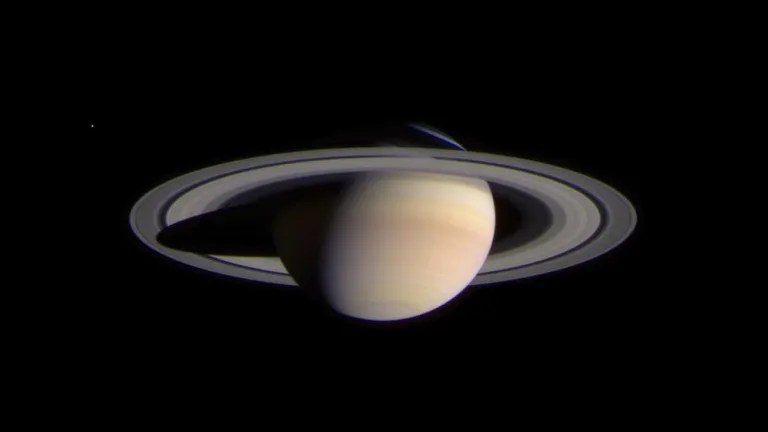
Space Stories: Mystery on Saturn, an Interstellar Visitor, and Hunting a Rogue Planet

Image (Credit): Saturn as captured by NASA’s Cassini spacecraft on February 9, 2004 (NASA/JPL/Space Science Institute)

Here are some recent space-related stories of interest.

—New Scientist: “Did Something Just Hit Saturn? Astronomers Are Racing to Find Out“

Something may have just hit Saturn – and, if so, an amateur astronomer could hold the key to confirming the event, which would be the first ever recorded on the gas giant. About seven asteroids or comets are estimated to impact Saturn every year, but no such event has ever been caught on camera. Now, NASA employee and amateur astronomer Mario Rana has recorded images that appear to show just that.

—Astronomy.com: “Astronomers Race to Learn More About Third Interstellar Visitor“

Astronomers have spotted an object from outside our solar system bolting toward the Sun at around 150,000 mph (240,000 km/h). The big, frozen ball of ice and dust presents a rare chance to study an object that formed around an alien solar system, and potentially much earlier in the Milky Way’s history. The object named 3I/ATLAS — “3I” because it’s the third interstellar object detected so far, and “ATLAS” in honor of the system of telescopes that revealed it, the Asteroid Terrestrial-impact Last Alert System. Because the object is also showing tentative signs of cometary activity, it has also been designated C/2025 N1 (ATLAS).

—Universe Today: “Old Hubble Space Telescope Photos Unlock the Secret of a Rogue Planet“

Astronomers have achieved a first in exoplanet hunting by using the Hubble Space Telescope images to investigate a mysterious event that could reveal the existence of a “rogue planet” drifting through space without a host star. The discovery centers on a brief astronomical phenomenon with the catchy name OGLE-2023-BLG-0524, detected in May 2023 by ground-based telescopes. The event lasted just eight hours and was caused by gravitational microlensing, an effect predicted by Einstein where a massive object acts like a magnifying glass in space, briefly brightening the light from a more distant object as it passes in front.

Study Findings: Carbonate Formation and Fluctuating Habitability on Mars

Image (Credit): Mars as captured by NASA Mars Global Surveyor MOC wide angle cameras. (NASA/JPL/MSSS)

Nature abstract of the study findings:

The cause of Mars’s loss of surface habitability is unclear, with isotopic data suggesting a ‘missing sink’ of carbonate. Past climates with surface and shallow-subsurface liquid water are recorded by Mars’s sedimentary rocks, including strata in the approximately 4-km-thick record at Gale Crater. Those waters were intermittent, spatially patchy and discontinuous, and continued remarkably late in Mars’s history—attributes that can be understood if, as on Earth, sedimentary-rock formation sequestered carbon dioxide as abundant carbonate (recently confirmed in situ at Gale). Here we show that a negative feedback among solar luminosity, liquid water and carbonate formation can explain the existence of intermittent Martian oases. In our model, increasing solar luminosity promoted the stability of liquid water, which in turn formed carbonate, reduced the partial pressure of atmospheric carbon dioxide and limited liquid water. Chaotic orbital forcing modulated wet–dry cycles. The negative feedback restricted liquid water to oases and Mars self-regulated as a desert planet. We model snowmelt as the water source, but the feedback can also work with groundwater as the water source. Model output suggests that Gale faithfully records the expected primary episodes of liquid water stability in the surface and near-surface environment. Eventually, atmospheric thickness approaches water’s triple point, curtailing the sustained stability of liquid water and thus habitability in the surface environment. We assume that the carbonate content found at Gale is representative, and as a result we present a testable idea rather than definitive evidence.

Citation: Kite, E.S., Tutolo, B.M., Turner, M.L. et al. Carbonate formation and fluctuating habitability on Mars. Nature 643, 60–66 (2025).

https://doi.org/10.1038/s41586-025-09161-1

Study-related stories:

University of Chicago – “Was Mars Doomed to be a Desert? Study Proposes New Explanation”

Science Alert – “NASA Discovery Could Explain Why We’ve Never Found Life on Mars”

The Register – “Mars Was Once a Desert with Intermittent Oases, Curiosity Data Suggests”

Russian Delivery Heading to ISS

Image (Credit): Launch of the Progress 92 cargo craft from the Baikonur Cosmodrome in Kazakhstan. (NASA)

Russia launched another cargo mission to the International Space Station ((SS) yesterday. A Soyuz rocket launched the Progress 92 spacecraft towards the space station at 3:32 pm ET from the Baikonur Cosmodrome in Kazakhstan. The spacecraft will dock with the ISS tomorrow afternoon, ensuring critical supplies are available to the crew member.

In the meantime, you can watch a Fourth of July message from NASA’s Expedition 73 Flight Engineers Anne McClain, Nichole Ayers, and Jonny Kim.

Happy Fourth of July to everyone.

Pic of the Week: Spiral Galaxy UGC 11397

Image (Credit): The spiral galaxy UGC 11397 as captured by the Hubble Space Telescope. (ESA/Hubble & NASA, M. J. Koss, A. J. Barth)

This week’s image is from the Hubble Space Telescope. It is an image of the spiral galaxy UGC 11397, which is located about 250 million years light-years away.

At the time the light we are now seeing left UGC 11397, the Earth was a very different place. It was dealing with the Permian–Triassic mass extinction, also called the Great Dying. During this period about 94 percent of marine species and 70 percent of terrestrial vertebrate families disappeared from the planet.

Anyway, getting back to the image itself, here is a little more information from NASA to explain what you are seeing:

What sets UGC 11397 apart from a typical spiral lies at its center, where a supermassive black hole containing 174 million times the mass of our Sun grows. As a black hole ensnares gas, dust, and even entire stars from its vicinity, this doomed matter heats up and puts on a fantastic cosmic light show.

Material trapped by the black hole emits light from gamma rays to radio waves, and can brighten and fade without warning. But in some galaxies, including UGC 11397, thick clouds of dust hide much of this energetic activity from view in optical light. Despite this, UGC 11397’s actively growing black hole was revealed through its bright X-ray emission — high-energy light that can pierce the surrounding dust. This led astronomers to classify it as a Type 2 Seyfert galaxy, a category used for active galaxies whose central regions are hidden from view in visible light by a donut-shaped cloud of dust and gas.