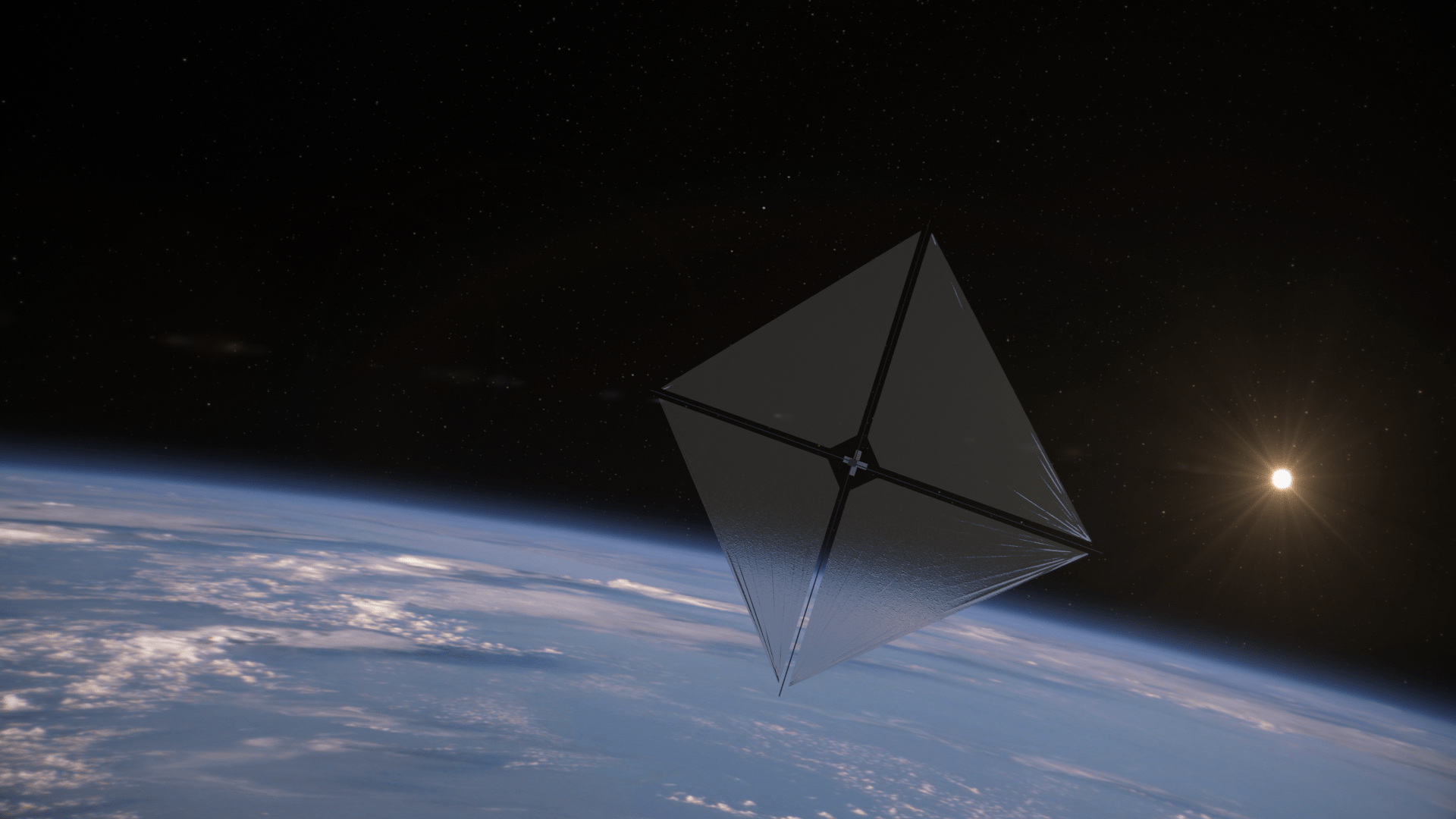
Like a sailboat turning to capture the wind, the solar sail can adjust its orbit by angling its sail. After evaluating the boom deployment, the mission will test a series of maneuvers to change the spacecraft’s orbit and gather data for potential future missions with even larger sails.
If all goes well, larger sails will be developed to potentially replace large rocket engines and accompanying fuel tanks for future trips to the Moon, Mars, other parts of the solar system, and even interstellar locations.
You might be able to see the solar sail in the night sky as it orbits the Earth, so keep looking up.
Ateam of researchers say they have found the “strongest statistical evidence yet that Planet 9 is really out there” in the solar system after studying a population of distant, unstable objects that cross Neptune’s orbit...In a new paper, the team looked at long-period objects that crossed the path of Neptune’s orbit, finding that their closest point of orbit to the sun was around 15-30 astronomical units (AU), with one AU being the distance between the sun and the Earth.
A huge heart-shaped feature on the surface of Pluto has intrigued astronomers since NASA’s New Horizons spacecraft captured it in a 2015 image. Now, researchers think they have solved the mystery of how the distinctive heart came to be — and it could reveal new clues about the dwarf planet’s origins…an international team of scientists has determined that a cataclysmic event created the heart. After an analysis involving numerical simulations, the researchers concluded a planetary body about 435 miles (700 kilometers) in diameter, or roughly twice the size of Switzerland from east to west, likely collided with Pluto early in the dwarf planet’s history.
The recent discovery of a potential new class of distant and mysterious “free-floating” planets has intrigued astronomers since stunning new images captured by the James Webb Space Telescope were shared late last year. These candidate planets, known as Jupiter-mass Binary Objects (JuMBOs), seem to orbit one another as they float freely in space unbound to any star—which counters prevailing theories of how planetary systems were thought to work. Now, a new study by a team of astrophysicists from UNLV and Stony Brook University, published April 19 in the journal Nature Astronomy, introduces a compelling model for how these JuMBOs may have formed.
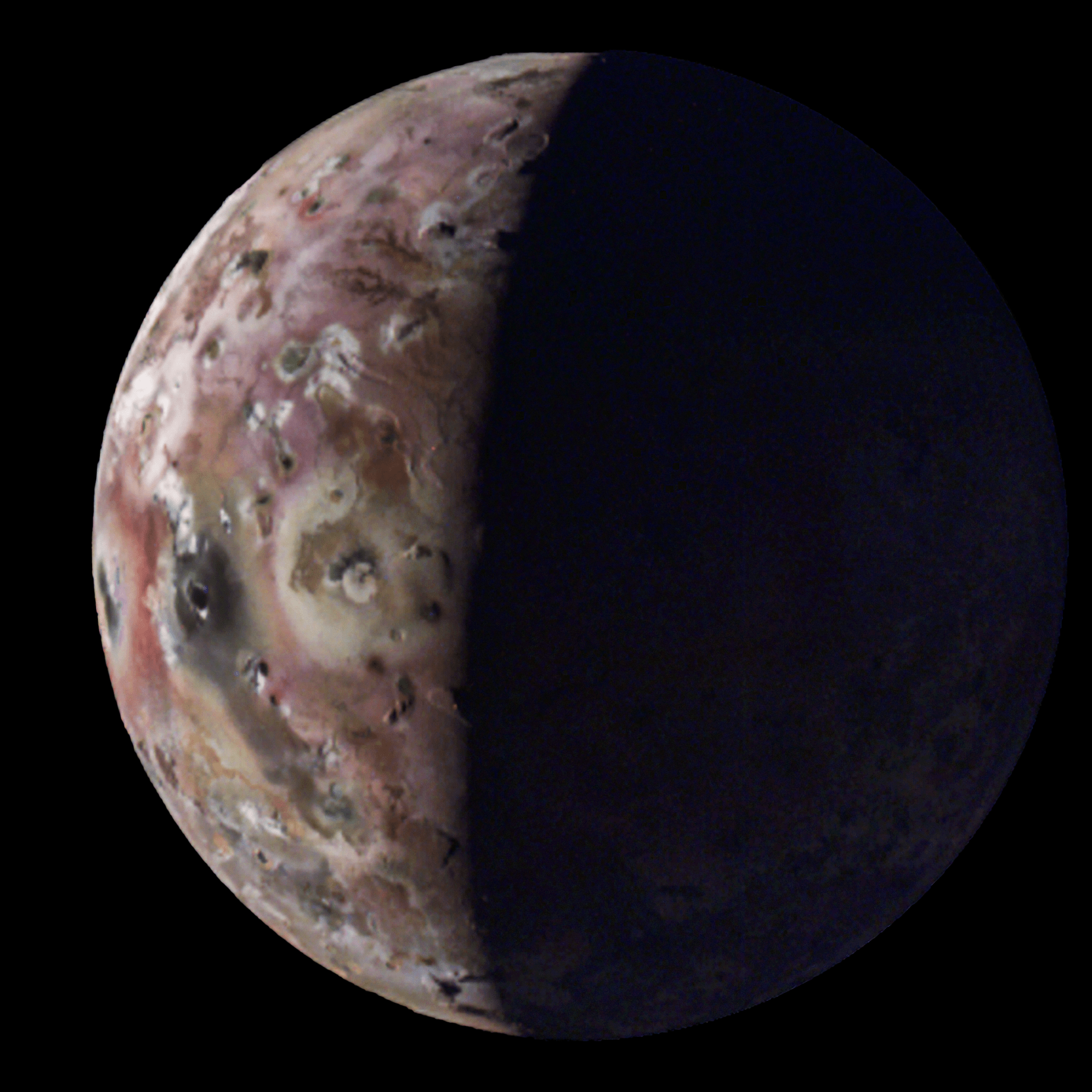
Image (Credit): View of Jupiter’s moon Io as seen by the Juno spacecraft on April 9. It was the first-ever image of the moon’s south polar region. (NASA/JPL-Caltech/SwRI/MSSS. Image processing: Gerald Eichstädt/Thomas Thomopoulos (CC BY))
The Juno spacecraft is still hard a work in the vicinity of Jupiter, with its latest mission being a flyby of the moon Io earlier this month (shown above).
Two recent flybys of the moon were also combined to create an image of a lake of cooling lava (shown below and via the video here). Juno’s principal investigator Scott Bolton explained the new image:
Io is simply littered with volcanoes, and we caught a few of them in action. We also got some great close-ups and other data on a 200-kilometer-long (127-mile-long) lava lake called Loki Patera. There is amazing detail showing these crazy islands embedded in the middle of a potentially magma lake rimmed with hot lava. The specular reflection our instruments recorded of the lake suggests parts of Io’s surface are as smooth as glass, reminiscent of volcanically created obsidian glass on Earth.
Juno has been zipping around Jupiter’s neighborhood since 2016. It’s main task is to study the origin and evolution of Jupiter, believed to be the first planet to have formed in our solar system. By doing so, NASA hopes to learn more about the solar system and the Earth as well.
Image (Credit): An artist’s rendering of Loki Patera, a lava lake on Jupiter’s moon Io, created using data from the JunoCam imager aboard NASA’s Juno spacecraft. (NASA/JPL-Caltech/SwRI/MSSS)
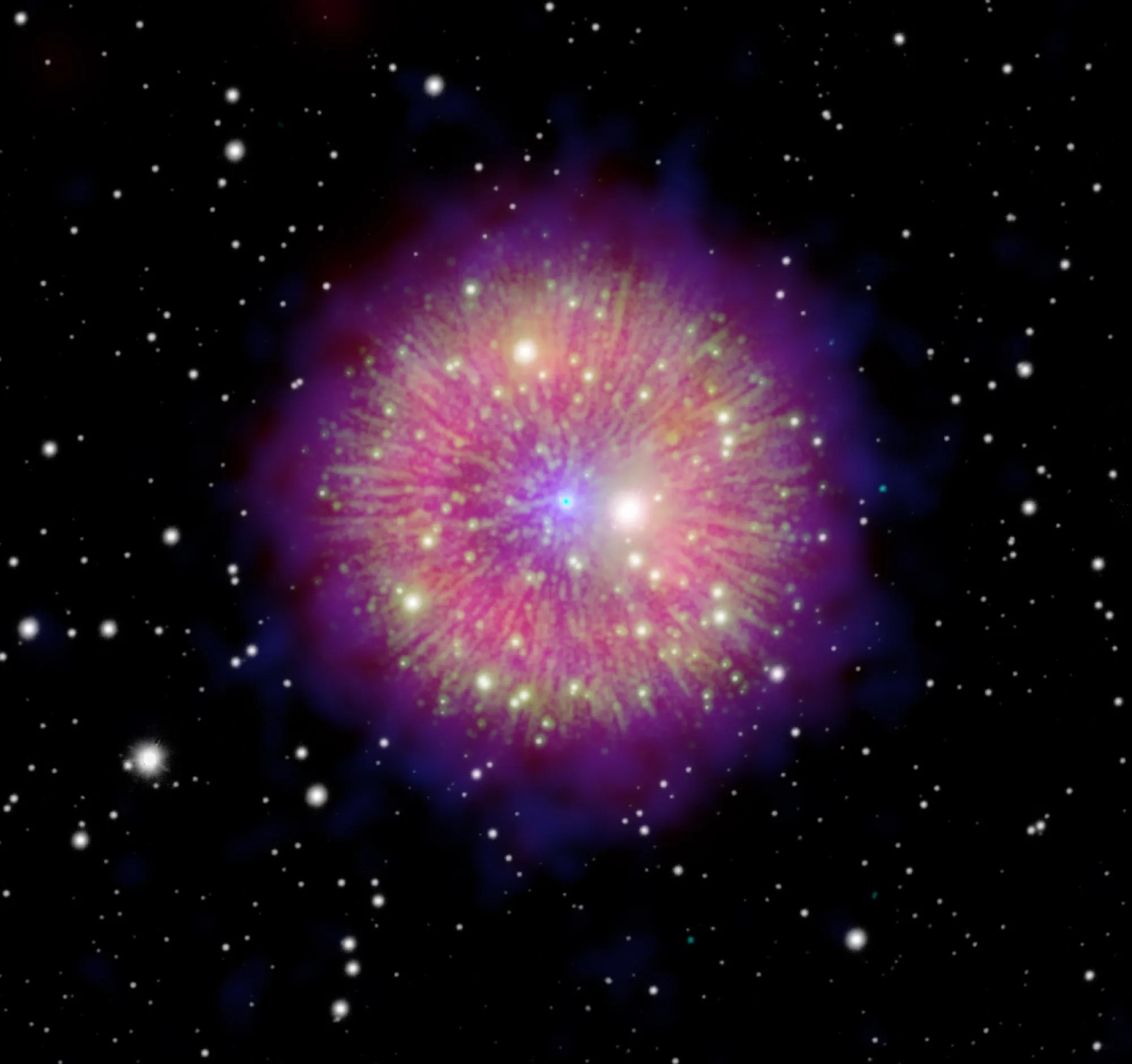
Image (Credit): Composite image of circular nebula Pa 30. (X-ray: (Chandra) NASA/CXC/U. Manitoba/C. Treyturik, (XMM-Newton) ESA/C. Treyturik; Optical: (Pan-STARRS) NOIRLab/MDM/Dartmouth/R. Fesen; Infrared: (WISE) NASA/JPL/Caltech/; Image Processing: Univ. of Manitoba/Gilles Ferrand and Jayanne English)
This week’s image is a circular nebula that first appears more than 800 years ago, shocking those observing it on Earth at the time and lasting for about 185 days. The circular nebula, called Pa 30, is shown above as a composite of multiple telescopes, including the Chandar X-ray Observatory, which is now facing a threat to its funding.
X-ray observations by ESA’s XMM-Newton (blue) show the full extent of the nebula and NASA’s Chandra X-ray Observatory (cyan) pinpoints its central source. The nebula is barely visible in optical light but shines bright in infrared light, collected by NASA’s Wide-field Infrared Space Explorer (red and pink). Interestingly, the radial structure in the image consists of heated sulfur that glows in visible light, observed with the ground-based Hiltner 2.4 m telescope at the MDM Observatory (green) in Arizona, USA, as do the stars in the background by Pan-STARRS (white) in Hawaii, USA.
Studies of the composition of the different parts of the remnant have led scientists to believe that it was formed in a thermonuclear explosion, and more precisely a special kind of supernova called a sub-luminous Type Iax event. During this event two white dwarf stars merged, and typically no remnant is expected for this kind of explosion. But incomplete explosions can leave a kind of ‘zombie’ star, such as the massive white dwarf star in this system. This very hot star, one of the hottest stars in the Milky Way (about 200 000 degrees Celsius), has a fast stellar wind with speeds up to 16,000 km/h. The combination of the star and the nebula makes it a unique opportunity for studying such rare explosions.
X-ray astronomers in the US have begun a campaign to save the Chandra X-ray Observatory from budget cuts that would effectively end the mission. They assert that the craft, which was launched in 1999, has plenty of life left in it. Cancelling support could, they say, damage scientific efforts to understand the universe and the careers of an emerging generation of X-ray astronomers.
“Mars Sample Return will be one of the most complex missions NASA has ever undertaken. The bottom line is, an $11 billion budget is too expensive, and a 2040 return date is too far away,” Nelson said. “Safely landing and collecting the samples, launching a rocket with the samples off another planet — which has never been done before — and safely transporting the samples more than 33 million miles (53 million kilometers) back to Earth is no small task. We need to look outside the box to find a way ahead that is both affordable and returns samples in a reasonable time frame.”
NASA’s TESS (Transiting Exoplanet Survey Satellite) entered into safe mode April 8, temporarily interrupting science observations. The team is investigating the root cause of the safe mode, which occurred during scheduled engineering activities. The satellite itself remains in good health. The team will continue investigating the issue and is in the process of returning TESS to science observations in the coming days.




 Our Awesome Universe