Space Stories: Questions About Orion, NASA’s Impact on Economy, and a New Crew for the Chinese Space Station

Image (Credit): Components of the Orion spacecraft. (NASA)

Here are some recent stories of interest.

—ARSTechnica: “For Some Reason, NASA is Treating Orion’s Heat Shield Problems as a Secret“

For those who follow NASA’s human spaceflight program, when the Orion spacecraft’s heat shield cracked and chipped away during atmospheric reentry on the unpiloted Artemis I test flight in late 2022, what caused it became a burning question. Multiple NASA officials said Monday they now know the answer, but they’re not telling. Instead, agency officials want to wait until more reviews are done to determine what this means for Artemis II, the Orion spacecraft’s first crew mission around the Moon, officially scheduled for launch in September 2025.

—NASA: “New Report Shows NASA’s $75.6 Billion Boost to US Economy“

In its third agencywide economic impact report, NASA highlighted how its Moon to Mars activities, climate change research and technology development, and other projects generated more than $75.6 billion in economic output across all 50 states and Washington, D.C., in fiscal year 2023…Combined, NASA’s missions supported 304,803 jobs nationwide, and generated an estimated $9.5 billion in federal, state, and local taxes throughout the United States.

—ABC News: “China Launches New Crew to its Space Station as it Seeks to Expand Exploration“

China declared a “complete success” after it launched a new three-person crew to its orbiting space station early Wednesday as the country seeks to expand its exploration of outer space with missions to the moon and beyond. The Shenzhou-19 spaceship carrying the trio blasted off from the Jiuquan Satellite Launch Center in northwest China at 4:27 a.m. local time atop a Long March-2F rocket, the backbone of China’s crewed space missions.
Troublesome Space Company News

Credit: Image by Gerd Altmann from Pixabay

It was not a good week for the US space industry. One major US space company is looking to exit the business while the head of another US space company is holding secret talks with Putin.

In the first case, Boeing’s bleak finances may be pushing it to consider the sale of its space business, which includes the troubled Starliner capsule most recently stuck at the International Space Station.

Fortune magazine highlighted comments by Boeing’s new CEO, Kelly Ortber, at his first earnings conference call on Wednesday, where he stated:

We’re better off doing less and doing it better than doing more and not doing it well…What do we want this company to look like five and 10 years from now? And do these things add value to the company or distract us?

This follows rumors that Boeing has been talking with Blue Origin about handing off some of its NASA-related portfolio.

It would appear that Boeing, which has been with NASA since the Apollo program, is having some second thoughts about its role in the space program as it deals with Starliner troubles, airplane manufacturing issues, and an ongoing worker strike.

And then we read about Elon Musk having help secret talks with Russia’s Vladimir Putin since at least 2022. You may remember Mr. Musk raised concerns in Washington when it was learned that he turned off his Starlink system when the Ukranians were planning an attack against invading Russian.

Some in Congress are already calling for an investigation into these discussions, given the role of SpaceX in critical Department of Defense contracts. Rep. Adam Smith (D-WA), the House Armed Services Committee’s top Democrat, stated:

We should investigate what Elon Musk is up to to make sure that it is not to the detriment of the national security of the United States.

NASA Administrator Bill Nelson also has some questions, stating:

I don’t know that that story is true. I think it should be investigated…If the story is true that there have been multiple conversations between Elon Musk and the president of Russia, then I think that would be concerning, particularly for NASA, for the Department of Defense, for some of the intelligence agencies.

It has become increasingly apparent that Mr. Musk’s excellence in creating companies will always be trumped by his bone-headed ego. He cannot help but be the center of attention rather than the competent engineer. He should really stay away from social media and social relationships until he can get his ego under control.

As I said, it was not a good week for the US space industry.

ISS Crew-8 Will be Back on Earth Friday

Image (Credit): SpaceX Dragon capsule docked to the ISS. (NASA)

The International Space Station’s (ISS) Crew-8 has departed the station.

NASA astronauts Matt Dominick, Mike Barratt, and Jeanette Epps, as well as Roscosmos cosmonaut Alexander Grebenkin, undocked from the station today at 5:05 PM ET.

They are now traveling towards Earth in a Dragon capsule and should be back on solid ground Friday morning.

Everyone is happy that the hurricanes are gone and NASA can return to normal operations – for now. Hurricane season officially ends November 30, so the weather folks will remain on the lookout.

In the meantime, we wish Crew-8 a safe landing on Friday.

We Have Moved from Exoplanet to Exomoon

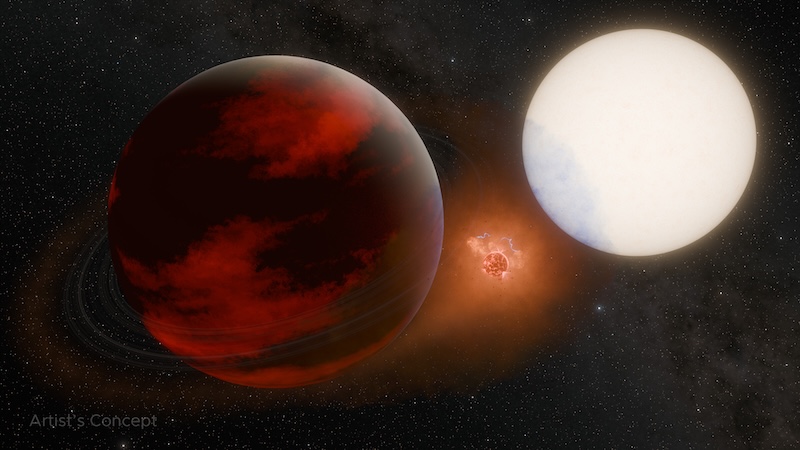
Image (Credit): An artist’s rendering of a volcanic moon orbiting WASP-49 b. (NASA/ JPL-Caltech)

The search for new exoplanets in our galaxy continues, but now it may include the first exomoon. This was something that was expected to occur at some point as the detection methods became better over time.

The exomoon in question is believed to be a volcanic moon orbiting a giant planet about 635 light-years away. Detected using the European Southern Observatory’s Very Large Telescope in Chile, the exomoon is discussed in a paper written by researchers with NASA’s Jet Propulsion Laboratory and Caltech in California. The clue was a cloud of sodium that did not appear to come from the host exoplanet.

The new discovery is being compared to Jupiter’s volcanic moon Io, which is the most volcanically active world in the solar system.

If you want to learn more about exomoons, I recommend a Cool Worlds video narrated by Assistant Professor of Astronomy David Kipping who provides five reasons that the study of exomoons is so important.

Space Stories: Starliner Not on the Schedule, More Questions About Artemis, and the Origin of Most Meteorites

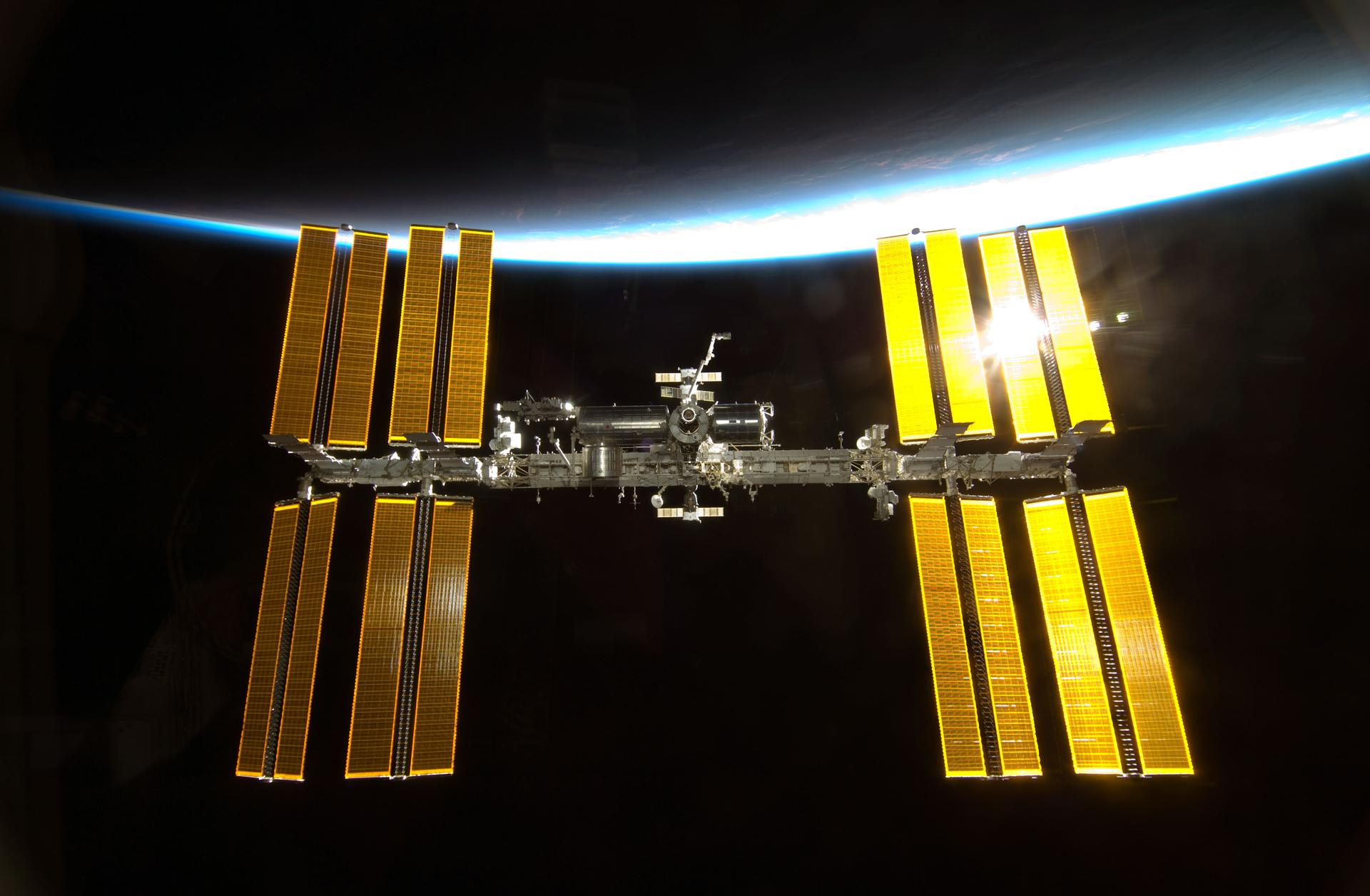
Image (Credit): The International Space Station. (NASA)

Here are some recent stories of interest.

—Space News: “NASA Further Delays First Operational Starliner Flight“

NASA will use SpaceX’s Crew Dragon for its two crew rotation missions to the International Space Station in 2025 as it continues to evaluate if it will require Boeing to perform another test flight of its Starliner spacecraft. In an Oct. 15 statement, NASA said it will use Crew Dragon for both the Crew-10 mission to the ISS, scheduled for no earlier than February 2025, and the Crew-11 mission scheduled for no earlier than July. Crew-10 will fly NASA astronauts Anne McClain and Nichole Ayers along with astronaut Takuya Onishi from the Japanese space agency JAXA and Roscosmos cosmonaut Kirill Peskov. NASA has not yet announced the crew for the Crew-11 mission.

—Bloomberg: “NASA’s $100 Billion Moon Mission Is Going Nowhere“

There are government boondoggles, and then there’s NASA’s Artemis program. More than a half century after Neil Armstrong’s giant leap for mankind, Artemis was intended to land astronauts back on the moon. It has so far spent nearly $100 billion without anyone getting off the ground, yet its complexity and outrageous waste are still spiraling upward. The next US president should rethink the program in its entirety.

—CNRS: “The Origin of Most Meteorites Finally Revealed“

An international team led by three researchers from the CNRS1 , the European Southern Observatory (ESO, Europe), and Charles University (Czech Republic) has successfully demonstrated that 70% of all known meteorite falls originate from just three young asteroid families. These families were produced by three recent collisions that occurred in the main asteroid belt 5.8, 7.5, and about 40 million years ago. The team also revealed the sources of other types of meteorites; with this research, the origin of more than 90% of meteorites has now been identified. This discovery is detailed in three papers, a first published on 13 September 2024 in the journal Astronomy and Astrophysics, and two new papers published on 16 October 2024 in Nature.