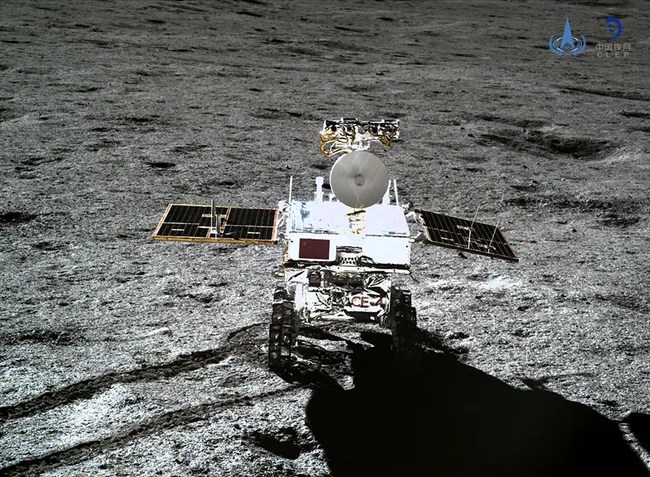
Image (Credit): China’s Yutu 2 rover, as seen by the Chang’e 4 lander, both of which landed on the lunar surface in January 2019. (CNSA)
“If the space agency holds to its notion of flying the Artemis II crew on a looping journey around the far side of the moon late next year, and landing the Artemis III crew in the south polar region in 2026 or 2027, the next boot prints on the moon will indeed be American. But don’t count on it.”
-Statement in a Time magazine article titled, “Why China Might Beat the U.S. Back to the Moon.” The article cites NASA’s delays and budget shortfall related to the Artemis mission. Interestingly, the article notes that the U.S. might have lacked the discipline to return to the Moon if China did not have similar plans. Finally, one key point to remember is that the U.S. beat the Chinese to the Moon by more than 50 years, so this is not really the same as the earlier space race with Russia. As a result, China is taking its time to do it right. We may need to keep that in mind as we face our own struggles.
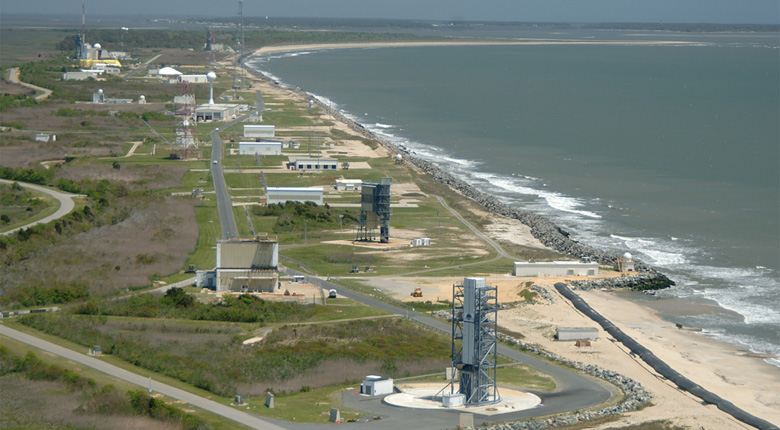
Image (Credit): NASA’s Wallops Flight Facility in Virginia. (Timmons Group)
While Virginia will not be in the direct path of the upcoming Total Solar Eclipse, it will be playing a role related to the eclipse that day.
NASA’s Wallops Flight Facility on the Virginia coast will be launch three rockets to study disturbances in the Earth’s ionosphere during the eclipse. The rockets will be launched 45 minutes before, during, and 45 minutes after the peak local eclipse.
These launches are part of NASA’s Atmospheric Perturbations around Eclipse Path (APEP) mission. Such launches during an eclipse are not unusual as NASA hopes to learn a few things from this study.
Aroh Barjatya, a professor of engineering physics at Florida’s Embry-Riddle Aeronautical University campus, stated:
Understanding the ionosphere and developing models to help us predict disturbances is crucial to making sure our increasingly communication-dependent world operates smoothly.
If you saw the recent film The Holdovers, you witnessed Paul Giamatti at the top of his game as a private school instructor (which earned him an Oscar nomination).
But if you would like to learn about another side of Mr. Giamatti, then you may want to check out his podcast with Stephen Asma called Chinwag. It is by no means a science or an astronomy podcast, yet it is a fun collection of conversations that often touch on related topics and guests, be it topics such as UFOs and the Drake Equation, or guests including astronaut Mike Massimino, writer Ted Chiang, and actor William Shatner.
Yes, there is plenty here about the occult and mind-numbing drugs, but I recommend you sift though some of this to find the gems. Below are a few of the episodes you may want to try, but don’t expect William Shatner to talk about Captain Kirk and space travel. He is too busy sharing stories about spiritualism, drugs, and his early acting career.
Paul and Stephen dig into our Chinwag mailbag for this SETI-inspired question (that’s Search for Extraterrestrial Intelligence to any novice listeners). The Drake Equation is explained and let’s just say there’s A LOT of math involved.
It’s been 60+ years since last estimates were made on the odds of finding intelligent life in the Milky Way, and Chinwag listener Rick B. wants to know, how long could a civilization broadcast its presence through technology, and what current factors might affect a civilization’s ability to remain detectable? Is there a ticking clock to our existence, and what’s Twinkie-lung got to do with all this?
In this Chinwag, Paul and Stephen are thrilled to be subject to fascinating thought experiments by award-winning fiction writer Ted Chiang. Up for the discussion?
The difference between fact and fiction when it comes to the existence of alien life, and whether Paul is indeed an assassin because he played one in an action film Ted once saw. Imaginations are running amok and people can’t differentiate between what’s real and what isn’t. Is social media to blame or was The National Enquirer the social media of yester-year? Online echo chambers and the dangerous speed of information may be a culprit for conspiracy theories. And is belief in aliens and monsters in pop culture a direct response to higher anxiety levels and an externalization of neuroses? Then, what is singularity and was it born with the invention of the wheel?
Paul and Stephen are happy to learn that Ted’s not afraid that AI will take over, but the natural desire to do less work may lead to more romances between humans and AI robots. So buckle up and plug in your lady-cyborg and get ready for an all new fascinating Chinwag!
Paul and Stephen are obsessed with UFOs and life beyond earth–so who better to add to the conversation than a guy who’s been to space twice?
This week, our intrepid Chinwaggers are joined by former NASA astronaut Mike Massimino, a man who decided that a fear of heights would be best overcome by a trip to space. In this week’s classified file: space toilets, robot arms, and why there should never be more than one comedian per space shuttle.
Stephen Asma and Paul Giamatti are giddy to speak with lifelong hero and Star Trek alum William Shatner on tequila tastings, space travel, bum drug trips, holding on to your inner child and that time he beat up an Australian Olympic swimmer on stage.
Scientists say Mars may have had more water and stayed wet for longer than they had previously estimated based on photos from NASA’s Curiosity rover. An international team of researchers led by Imperial College London recently found unusual formations in rock and sediment in unexpected places in the crater. The rocks allow scientists to compare the evolving geology of Mars with Earth.
Today, U.S. Senators Alex Padilla and Laphonza Butler (both D-Calif.) wrote to NASA Administrator Bill Nelson urging him to allocate the full $650 million necessary to fund the Mars Sample Return (MSR) mission in NASA’s FY24 spending plan. The Senators are issuing the letter following the passage of the FY 2024 appropriations package, which reiterated Congress’ strong commitment to the MSR mission.
A fresh, icy crust hides a deep, enigmatic ocean. Plumes of water burst through cracks in the ice, shooting into space. An intrepid lander collects samples and analyses them for hints of life. ESA has started to turn this scene into a reality, devising a mission to investigate an ocean world around either Jupiter or Saturn. But which moon should we choose? What should the mission do exactly? A team of expert scientists has delivered their findings...Aiming for transformational science, considering the characteristics of each moon and future planned missions to Jupiter and Saturn’s ocean worlds, the scientists identified Saturn’s moon Enceladus as the most compelling target, followed by Saturn’s moon Titan and then Jupiter’s moon Europa.
NASA’s Space Shuttle Columbia had its maiden flight on April 12, 1981 and continued to fly for another 22 years until its final disastrous flight in February 2003.
More than 20 years after this tragedy, CNN is retelling the story in a special four-episode program titled Space Shuttle Columbia: The Final Flight that premieres on April 7th and ends on April 14th.
In its publicity for the series, CNN states:
Across four episodes, the story of the ticking-clock of Columbia’s final mission is told in dramatic detail, beginning months before the troubled launch, unfolding across the sixteen days in orbit, and concluding with the investigation into the tragic loss of the seven astronauts’ lives. Weaving together intimate footage shot by the astronauts themselves inside the orbiter, exclusive first-hand testimony from family members of the Shuttle’s crew, key players at NASA – some of whom have never spoken before – and journalists who covered the story on the ground, the series paints an intimate portrait of the women and men onboard and uncovers in forensic detail the trail of events and missed opportunities that ultimately led to disaster.
We are certainly in another place as a nation these days, but the end of the shuttle program crippled our human spacefaring capabilities for years until SpaceX came along. We are back to reusable spacecraft again, but in a whole new format – less spaceplane and more Apollo capsule.
I look forward to the look back. I just hope we are done with “missed opportunities” and have a new mindset as we head back to the Moon.



 Our Awesome Universe