The ISS is Getting Pretty Crowded

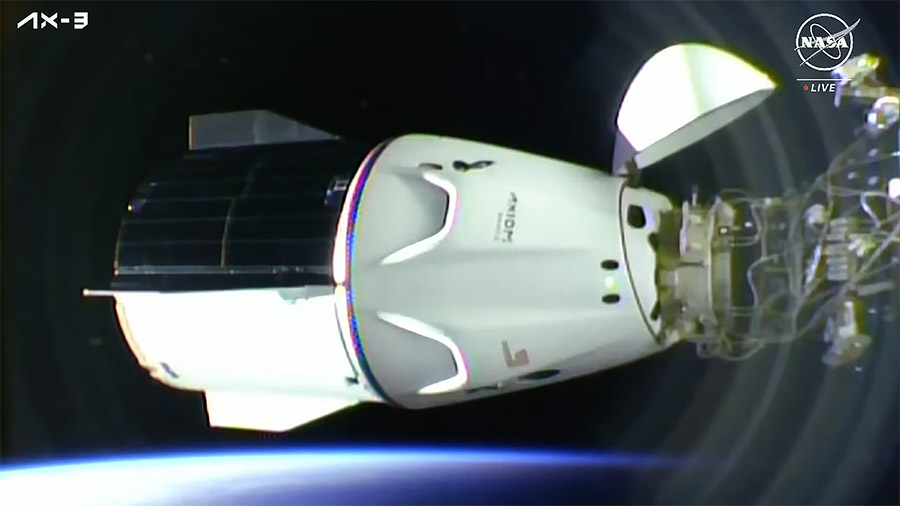
Image (Credit): The SpaceX Dragon Freedom spacecraft, which is carrying four Axiom Mission 3 crew members, docking to the space station shortly after an orbital sunrise. (NASA TV)

The seven real astronauts on the International Space Station (ISS) are now playing host to four visitors for the next two weeks after the Axiom Mission 3 crew came aboard the station earlier today.

Unlike the last two Axiom missions, all three paying members of the Axiom Mission crew are being supported by various European governments:

  • Marcus Wandt, member of the European Space Agency’s (ESA) astronaut reserve (ticket paid by ESA and the Swedish National Space Agency);
  • Walter Villadei, a member of the Italian air force (ticket paid by the Italian air force); and
  • Alper Gezeravcı, a fighter pilot with the Turkish air force (ticket paid by the Turkish government).

At the price of $55 million per seat, I am hoping the governments and space agencies feel they are getting their money’s worth versus being part of the normal 6-month astronaut rotation.

Supposedly, the extra hands will be working on 30 experiments that the normal crew did not have time for, though I would imagine they would be the less important experiments if they would otherwise not be performed at all.

If all of this is truly important work, then I expect such demand will justify the need for commercial space stations down the line to continue the work of the ISS. However, I expect a good chuck of future space interest will come from the tourist side.

In the meantime, I just hope the toilets on board the ISS can deal with the extra passengers.

Note: So as not to give all the attention to the visitors, the current Expedition 70 crew members aboard station are:

  • NASA astronauts Jasmin Moghbeli and Loral O’Hara;
  • ESA astronaut Andreas Mogensen;
  • JAXA (Japan Aerospace Exploration Agency) astronaut Furukawa Satoshi; and
  • Roscosmos cosmonauts Konstantin Borisov, Oleg Kononenko, and Nikolai Chub.

The End of Two Moon Missions?

Image (Credit): Artist’s rendering of Japan’s SLIM mission over the Moon. (JAXA)

Within a two day period, we saw one Moon lander become a burning wreck plummeting towards Earth and another land on the Moon with an immediate problem that threatened its mission. The Moon may be closer, but it is becoming a hazardous place for space missions, similar to Mars.

First, the NASA-contracted Astrobotic Peregrine lander mission ended yesterday as the spacecraft entered the Earth’s atmosphere and burned up. The $108 Moon mission burned up with its cargo, including NASA’s scientific instruments, various rovers, and the DNA remains of humans whose families hoped would be at rest on the Moon’s surface. I expect a few Native Americans may be saying “I told you so” to themselves.

It was almost comical reading a Scientific American article trying to put a good spin on the lost cargo:

In addition, all nine of the payloads that were designed to communicate with Peregrine successfully returned data to Earth. Iris, a rover built by Carnegie Mellon University, sent back a “Hello Earth!” message. COLMENA, a set of five small rovers built by the Mexican Space Agency, also succeeded in sending data back—making it the first Mexican scientific instrument to operate in the moon’s vicinity.

I expect “Hello Earth!” fell far below the ground crew’s expectations, but I guess you take what you can get. And Mexico will probably hold off on any celebrations for the moment.

The second set of bad news related to the latest Japanese Moon mission. The good news is that the Smart Lander for Investigation Moon (SLIM) spacecraft was a success in terms of a soft landing on the Moon. The problem is that the solar array is not getting sufficient solar power for the lander to remain operational for more than a few hours. It is possible that the situation may correct itself as the sunshine shifts over time, but this is not a good start to the mission.

Whatever happens, Japan can still claim to be the fifth nation to successfully land on the Moon. It is not perfect, but the Japanese have more reason to celebrate than the Mexicans at this point.

Pic of the Week: Surfboards in Space

Image (Credit): JWST image showing an array of odd shapes when the universe was only 600 million to 6 billion years old. The elongated shape in the left bottom part of the image is one of the most common identified shapes so far in Webb’s survey. (NASA, ESA, CSA, Steve Finkelstein (UT Austin), Micaela Bagley (UT Austin), Rebecca Larson (UT Austin))

This week’s image is one from the James Webb Space Telescope (JWST) showing galaxies from long ago. Many of these galaxies have an elongated shape similar to a surfboard. Again, JWST is opening our eyes everyday to the wonder and weirdness of the universe.

Here is more about the image from NASA:

Researchers analyzing images from NASA’s James Webb Space Telescope have found that galaxies in the early universe are often flat and elongated, like surfboards and pool noodles – and are rarely round, like volleyballs or frisbees. “Roughly 50 to 80% of the galaxies we studied appear to be flattened in two dimensions,” explained lead author Viraj Pandya, a NASA Hubble Fellow at Columbia University in New York. “Galaxies that look like pool noodles or surfboards seem to be very common in the early universe, which is surprising, since they are uncommon nearby.”

The team focused on a vast field of near-infrared images delivered by Webb, known as the Cosmic Evolution Early Release Science (CEERS) Survey, plucking out galaxies that are estimated to exist when the universe was 600 million to 6 billion years old.

Will China Beat Us to the Moon?

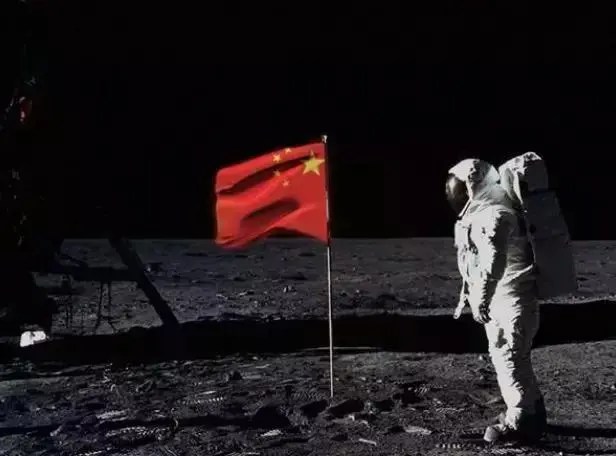
Image (Credit): A manufactured image, but it may be a reality soon enough. (Asia Times)

With the newly announced delays related to the Artemis lunar program, it is fair to ask whether the U.S. might fall behind the Chinese when it comes to a crewed lunar mission (of course, we won that battle 50 years ago, but you know that I mean).

All reports indicate that the Chinese wants to place humans on the Moon by 2030, but they are not expected to beat the Artemis timetable of a lunar landing in 2026. Of course, it is important that NASA stick to this timetable.

NASA Administrator Bill Nelson recently stated:

I do not have a concern that China is going to land before us…I think that China has a very aggressive plan. I think they would like to land before us, because that might give them some PR coup. But the fact is that I don’t think they will. I think it is true that their date that they announced keeps getting earlier. But specifically, with us landing in September of ’26, that will be the first landing.

Obstacles remain on what will prove to be a difficult mission even if it is a repeat. We already saw Russia’s failed attempt to simply land on the Moon last year, and the problems with last week’s NASA-funded commercial launch towards the Moon was worrying.

Nothing can be taken for granted in this new space race.

Space Quote: Another View of Elon and Drugs

“If we’re going to link performance to attitudes about drugs, maybe Musk should be setting the tone for NASA. Perhaps a microdosing schedule would get federal employees out of their ruts and set their creative juices flowing.”

-Statement by J.D. Tuccille in his Reason magazine article, “Let Elon Musk Enjoy Drugs.” The libertarian magazine has some strong views on drug laws and government operations, as the quote indicates. The article does note that Mr. Musk would be violating federal rules as the head of SpaceX if the reports of drug use are true, but also notes that only SpaceX can get Americans to the International Space Station. I guess Reason is all in favor of situational morality, something that seems to be gaining favor these days with those who deem themselves above the law.