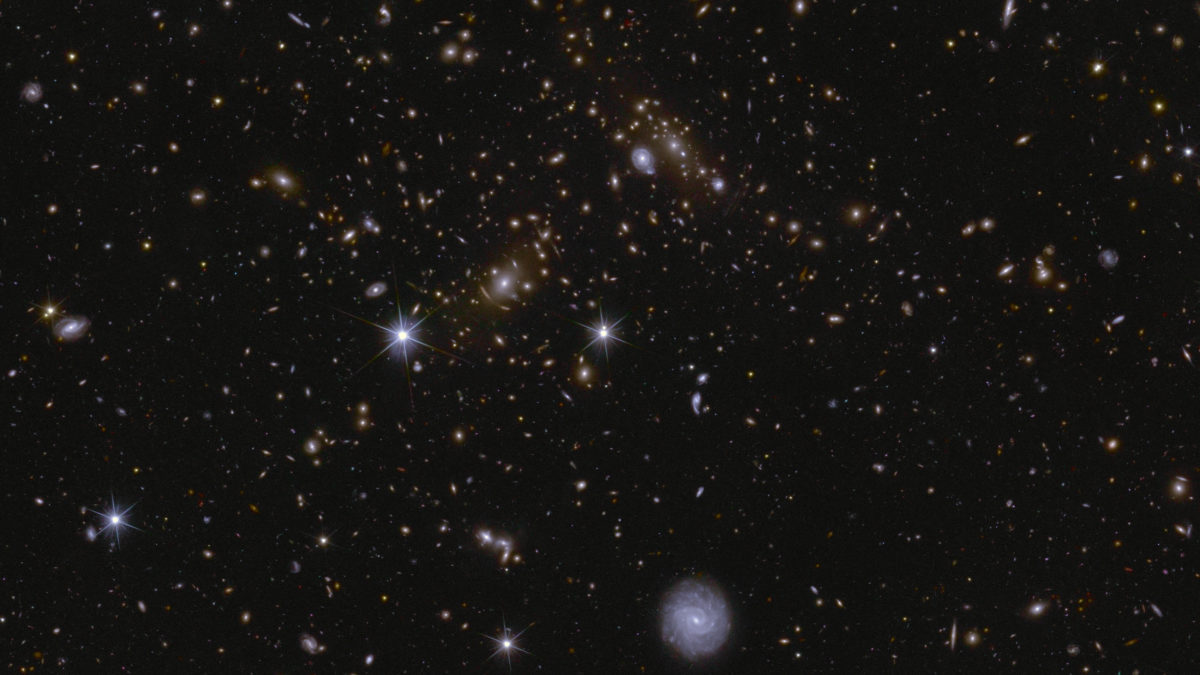
Image (Credit): The Deep Field South captured by the ESA’s Euclid space telescope. (ESA/Euclid/Euclid Consortium/NASA, image processing by J.-C. Cuillandre, E. Bertin, G. Anselmi/Handout via REUTERS)
Last week, the European Space Agency released images from the Euclid space telescope, which was launched on July 1, 2023. The goal of the space telescope’s mission is to catalog more than 1.5 billion galaxies over a six year period.
The image above shows a part of the sky called the Deep Field South. One of the galaxy clusters near the center of the image is located almost 6 billion light-years away. At the center bottom of the image you can also clearly see a beautiful spiral galaxy.
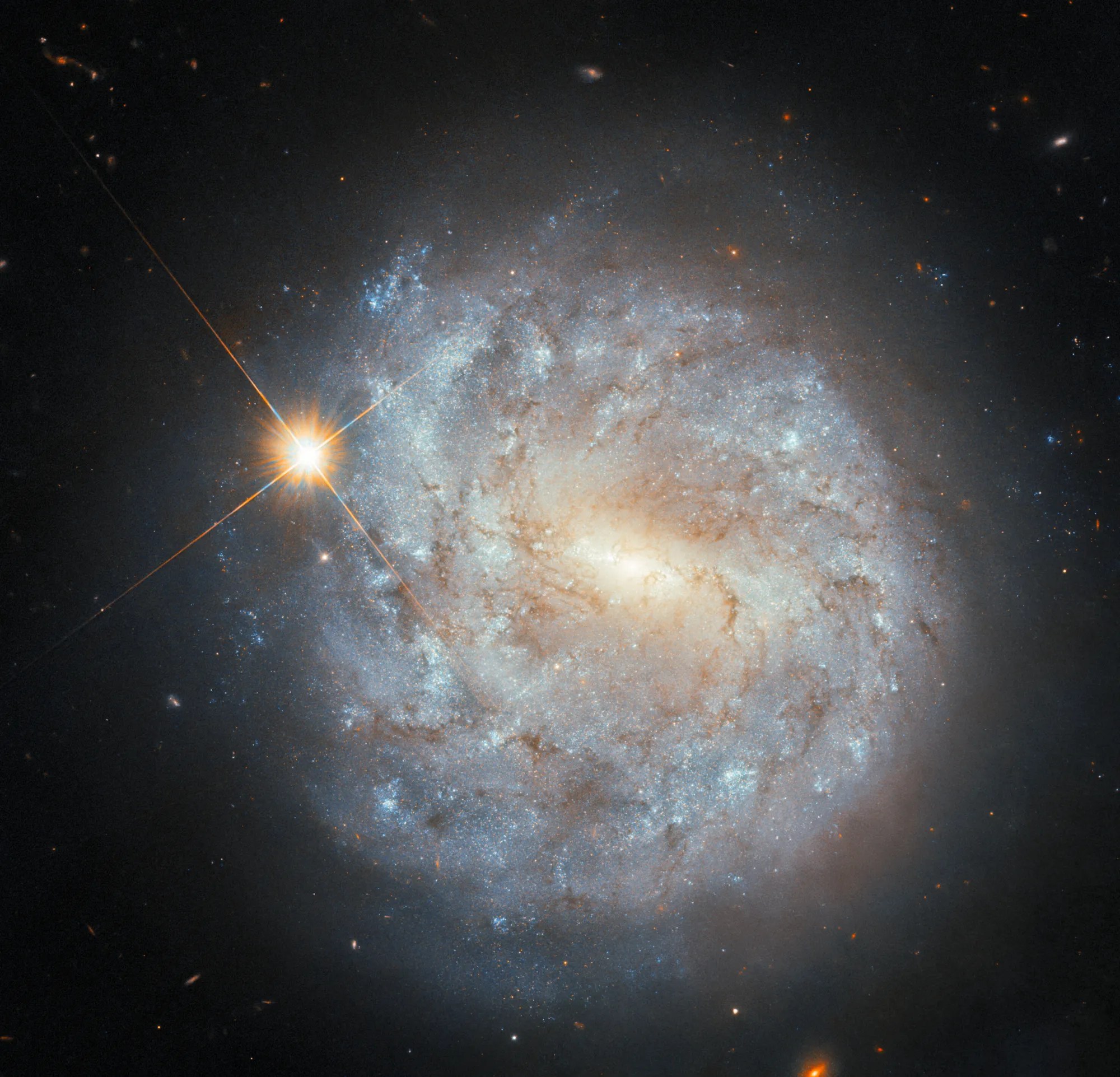
Image (Credit): Hubble Space Telescope image of a sparkling spiral galaxy paired with a prominent star, both in the constellation Virgo. (ESA/Hubble & NASA, S. J. Smartt, C. Kilpatrick)
This week’s image is from the NASA/ESA Hubble Space Telescope. It shows what appears to be two close neighbors – a star and a galaxy – but looks can be deceiving.
This NASA/ESA Hubble Space Telescope image features a sparkling spiral galaxy paired with a prominent star, both in the constellation Virgo. While the galaxy and the star appear to be close to one another, even overlapping, they’re actually a great distance apart. The star, marked with four long diffraction spikes, is in our own galaxy. It’s just 7,109 light-years away from Earth. The galaxy, named NGC 4900, lies about 45 million light-years from Earth.
This image combines data from two of Hubble’s instruments: the Advanced Camera for Surveys, installed in 2002 and still in operation today, and the older Wide Field and Planetary Camera 2, which was in use from 1993 to 2009. The data used here were taken more than 20 years apart for two different observing programs — a real testament to Hubble’s long scientific lifetime.
Image (Credit): Lynds 483 as captured by the JWST. (NASA, ESA, CSA, STScI)
This week’s image is from the James Webb Space Telescope. It shows two actively forming stars that are 650 light-years away. The formation is called Lynds 483, or L483, after American astronomer Beverly Turner Lynds, who studied nebulae in the early 1960s.
The two protostars responsible for this scene are at the center of the hourglass shape, in an opaque horizontal disk of cold gas and dust that fits within a single pixel. Much farther out, above and below the flattened disk where dust is thinner, the bright light from the stars shines through the gas and dust, forming large semi-transparent orange cones.
It’s equally important to notice where the stars’ light is blocked — look for the exceptionally dark, wide V-shapes offset by 90 degrees from the orange cones. These areas may look like there is no material, but it’s actually where the surrounding dust is the densest, and little starlight penetrates it. If you look carefully at these areas, Webb’s sensitive NIRCam (Near-Infrared Camera) has picked up distant stars as muted orange pinpoints behind this dust. Where the view is free of obscuring dust, stars shine brightly in white and blue.
Image (Credit): Athena approaching the Moon on March 6, 2025. (NASA)
This week’s image is from earlier today when Intuitive Machines’ Athena lunar lander was approaching the Moon’s South Pole. The good news is that the lander made it safely to the surface. However, the lunar lander may have landed in an odd way, creating solar generating issues similar to the company’s first attempt at landing this time last year.
NASA and Intuitive Machines are still trying to determine the status of the lander as well as its exact location. The lander’s goal was to land in Mons Mouton, a lunar plateau near the Moon’s South Pole. NASA’s Lunar Reconnaissance Orbiter should help to pinpoint the lander’s location and orientation in the next few days.
Hopefully, some if not all of the planned experiments are still possible. But for now it’s just a matter of waiting for more news on the mission.
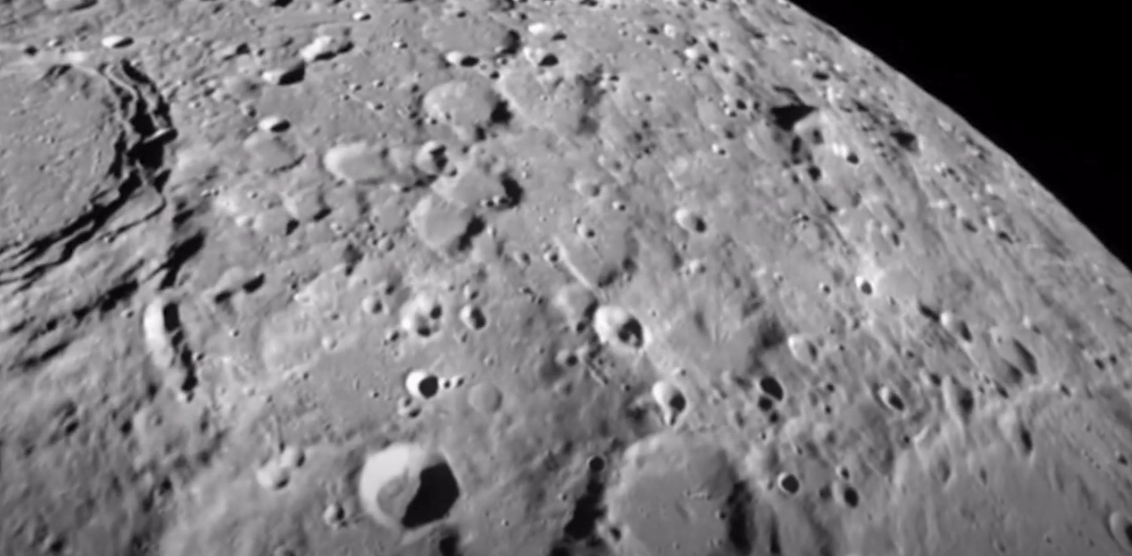
Image (Credit): The far side of the Moon captured by the Blue Ghost spacecraft. (Firefly Aerospace)
The image above is part of a video taken last week showing the far side of the Moon by Firefly Aerospace’s Blue Ghost spacecraft. The spacecraft is about 120 kilometers above the lunar surface. You can see the video here.
Regarding the video, the company noted:
In this orbit, the team will experience planned rolling comms blackouts as Blue Ghost goes around the far side of the Moon. When on the near side, the team will continue to downlink data and finalize the plan for our next maneuver that will get Blue Ghost even closer to the lunar surface and keep us right on track for landing on March 2.
You can learn more about the Blue Ghost’s mission here.



 Our Awesome Universe