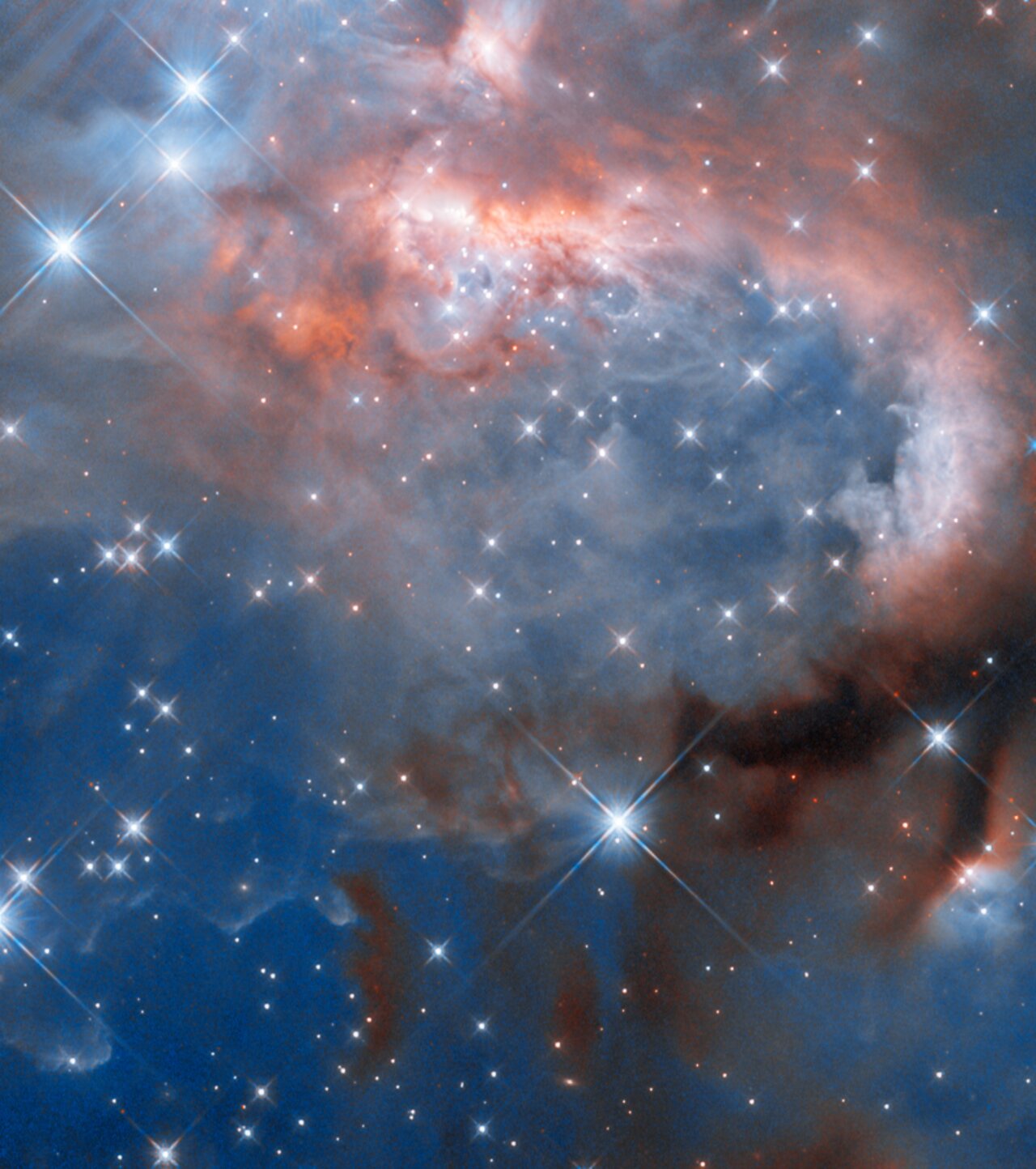
Pic of the Week: Nebula RCW 7

Image (Credit): RCW 7, a nebula located just over 5,300 light-years from Earth. (ESA/Hubble & NASA, J. Tan (Chalmers University & University of Virginia), R. Fedriani (Institute for Astrophysics of Andalusia))

This week’s image is from the NASA/European Space Agency’s (ESA) Hubble space telescope. It shows the nebula called RCW 7, which is located about 5,300 light-years away.

The ESA Hubble site describes the image in this way:

Clouds of gas and dust with many stars. The clouds form a flat blue background towards the bottom, and become more thick and smoky towards the top. They are lit on one side by stars in the nebula. A thick arc of gas and dust reaches around from the top, where it is brightly lit by many stars in and around it, to the bottom where it is dark and obscuring. Other large stars lie between the clouds and the viewer.

Pic of the Week: Frost on Olympus Mons

Image (Credit): Frosty summit of Mar’s Olympus Mons. (ESA/DLR/FU Berlin)

This week’s image is from the European Space Agency (ESA) and shows Olympus Mons on Mars, the tallest volcano in the solar system. Captured by ESA’s Mars Express, it shows water frost close to the planet’s equator, which was unexpected.

Colin Wilson, ESA project scientist for both ExoMars Trace Gas Orbiter and Mars Express, stated:

Finding water on the surface of Mars is always exciting, both for scientific interest and for its implications for human and robotic exploration…Even so, this discovery is particularly fascinating. Mars’s low atmospheric pressure creates an unfamiliar situation where the planet’s mountaintops aren’t usually colder than its plains – but it seems that moist air blowing up mountain slopes can still condense into frost, a decidedly Earth-like phenomenon.

Pic of the Week: Forth Starship Test is a Success

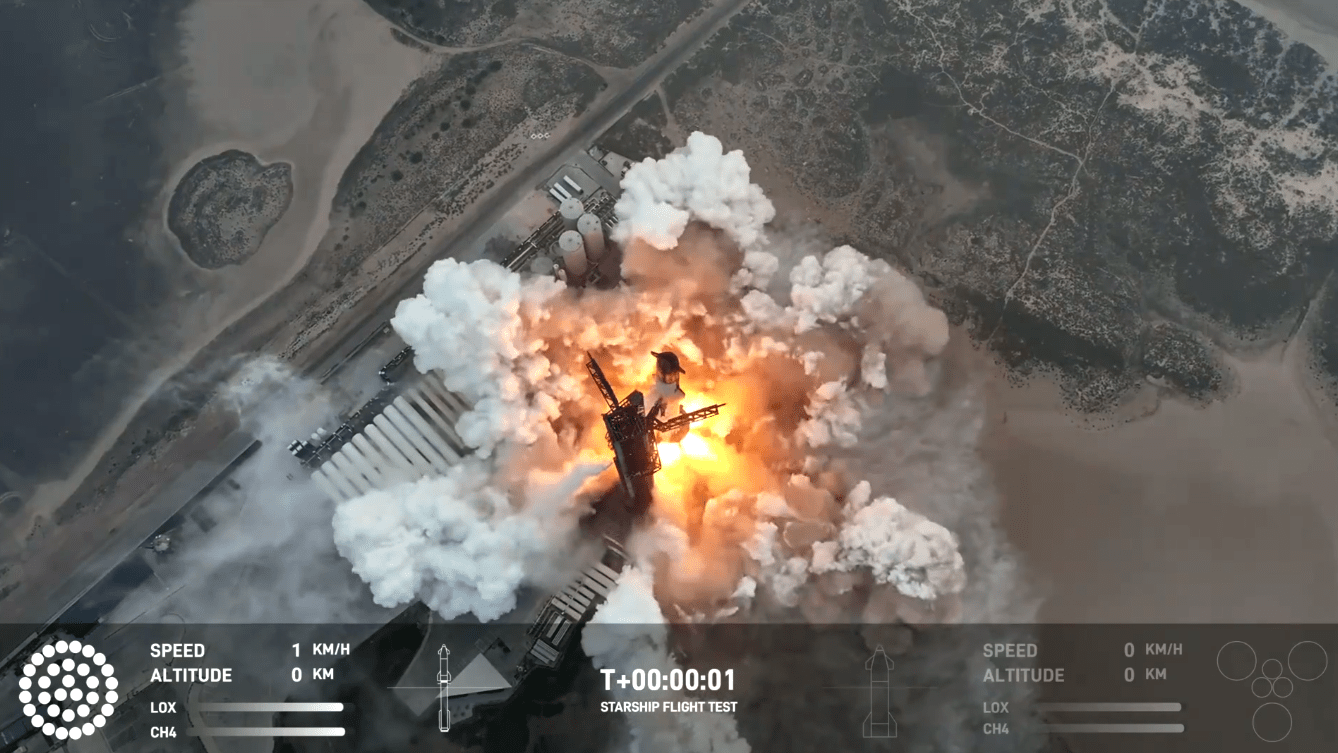
Image (Credit): The Starship rocket lifting off its launch pad in Texas earlier today. (SpaceX)

This week’s image shows the launch of the forth test of SpaceX’s Starship, which went further than any of the tests to date. In it’s summary of the flight, SpaceX noted:

Flight 4 ended with Starship igniting its three center Raptor engines and executing the first flip maneuver and landing burn since our suborbital campaign, followed by a soft splashdown of the ship in the Indian Ocean one hour and six minutes after launch.

You can see the full flight in this video.

As with yesterday’s successful launch of Boeing’s Starliner, today’s successful flight gave NASA greater assurance that the commercial sector is picking up the pace to assist the U.S. with both the International Space Station and Artemis program to the Moon (and eventually Mars).

Note: I like The Economist’s headline on the mission: “Elon Musk’s Starship Makes a Test Flight Without Exploding.”

Pic of the Week: The Dorado Group

Image (Credit): The Dorado group in the southern hemisphere. (ESA/Euclid/Euclid Consortium/NASA)

This week’s image was captured by the European Space Agency’s (ESA) Euclid space telescope. Launched last summer to create a 3D map of the universe, it has been pretty busy sending back some impressive images. This particular image shows the Dorado group of galaxies, one of the richest group of galaxies in the southern hemisphere. The grouping of approximately 70 galaxies is about 62 million light-years away.

Pic of the Week: A Triple-Star System

Image (Credit): Hubble image of a triple-star system. (NASA, ESA, G. Duchene (Universite de Grenoble I); Image Processing: Gladys Kober (NASA/Catholic University of America))

This week’s image is from the NASA/ESA Hubble Space Telescope. It shows a triple-star system that consists of the variable star HP Tau, HP Tau G2, and HP Tau G3.

NASA explains:

HP Tau is known as a T Tauri star, a type of young variable star that hasn’t begun nuclear fusion yet but is beginning to evolve into a hydrogen-fueled star similar to our Sun. T Tauri stars tend to be younger than 10 million years old ― in comparison, our Sun is around 4.6 billion years old ― and are often found still swaddled in the clouds of dust and gas from which they formed.