Pic of the Week: The Gediz Vallis Channel

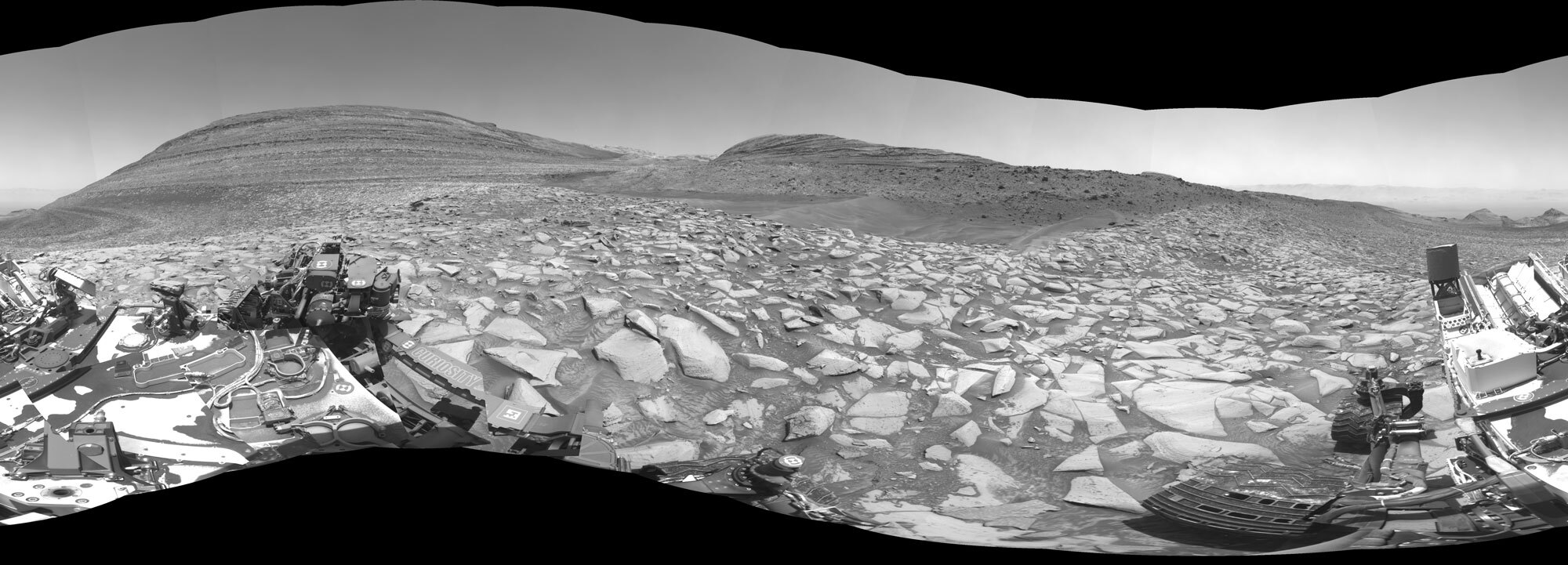
Image (Credit): Panoramic shot of Mar’s Gediz Vallis channel taken by the Curiosity rover. (NASA/JPL-Caltech)

This week’s image comes from NASA’s Curiosity rover in the Gediz Vallis channel. It is a 360-degree panorama shot from back on February 3. The rover has diligently continued its exploration of the Martian surface since it first landed in 2012.

In terms of this latest rover location, NASA stated:

NASA’s Curiosity rover has begun exploring a new region of Mars, one that could reveal more about when liquid water disappeared once and for all from the Red Planet’s surface. Billions of years ago, Mars was much wetter and probably warmer than it is today. Curiosity is getting a new look into that more Earth-like past as it drives along and eventually crosses the Gediz Vallis channel, a winding, snake-like feature that – from space, at least – appears to have been carved by an ancient river.

That possibility has scientists intrigued. The rover team is searching for evidence that would confirm how the channel was carved into the underlying bedrock. The formation’s sides are steep enough that the team doesn’t think the channel was made by wind. However, debris flows (rapid, wet landslides) or a river carrying rocks and sediment could have had enough energy to chisel into the bedrock. After the channel formed, it was filled with boulders and other debris. Scientists are also eager to learn whether this material was transported by debris flows or dry avalanches.

Pic of the Week: Preparing for the Total Solar Eclipse

Credit: New York Department of Economic Development

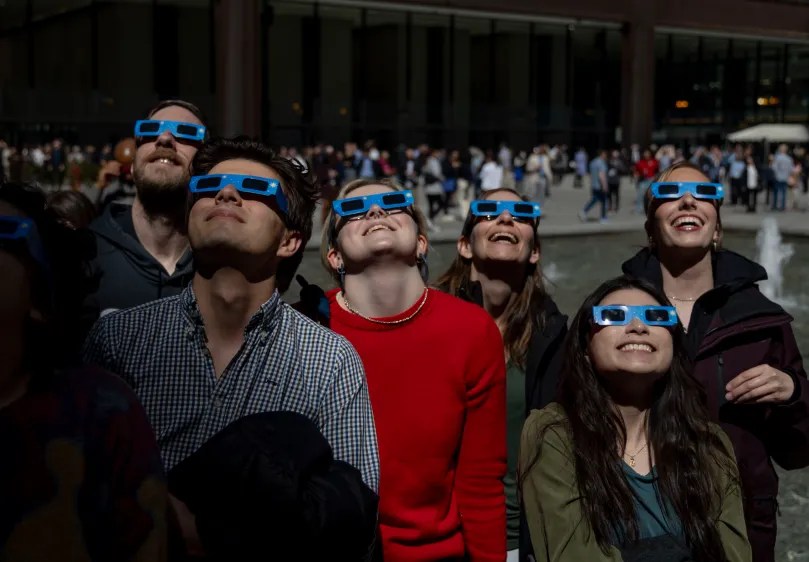
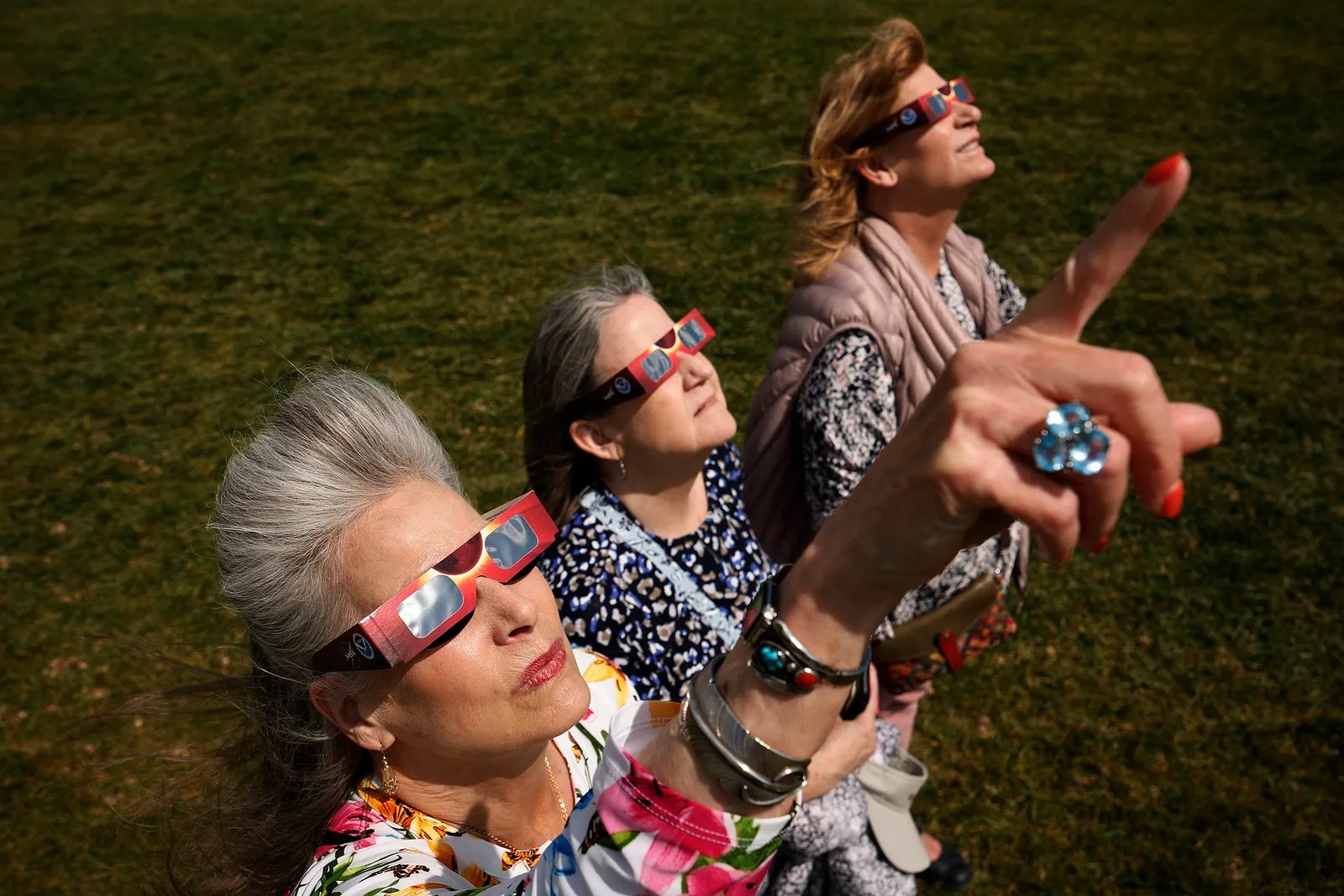
This week’s image comes from the great state of New York, which is advertising the upcoming Total Solar Eclipse on April 8.

New York is one of the state’s that will experience the eclipse, and the New York Department of Economic Development is not missing the chance to ensure everyone knows this.

A handy map also provides the timing of the eclipse in each city.

Credit: New York Department of Economic Development

Pic of the Week: Tightly Bound Herbig-Haro 46/47

Image (Credit): JWST view of actively forming stars known as Herbig-Haro 46/47. (NASA, ESA, CSA)

This week’s image, released last year, is from the James Webb Space Telescope (JWST). It shows two forming stars in what is called Herbig-Haro 46/47.

Here is a full explanation of what you are seeing from NASA:

NASA’s James Webb Space Telescope has captured a tightly bound pair of actively forming stars, known as Herbig-Haro 46/47, in high-resolution near-infrared light. Look for them at the center of the red diffraction spikes. The stars are buried deeply, appearing as an orange-white splotch. They are surrounded by a disk of gas and dust that continues to add to their mass.

Herbig-Haro 46/47 is an important object to study because it is relatively young – only a few thousand years old. Stars take millions of years to fully form. Targets like this also give researchers insight into how stars gather mass over time, potentially allowing them to model how our own Sun, a low-mass star, formed.

The two-sided orange lobes were created by earlier ejections from these stars. The stars’ more recent ejections appear in a thread-like blue, running along the angled diffraction spike that covers the orange lobes.

Actively forming stars ingest the gas and dust that immediately surrounds them in a disk (imagine an edge-on circle encasing them). When the stars “eat” too much material in too short a time, they respond by sending out two-sided jets along the opposite axis, settling down the star’s spin, and removing mass from the area. Over millennia, these ejections regulate how much mass the stars retain.

Don’t miss the delicate, semi-transparent blue cloud. This is a region of dense dust and gas, known as a nebula. Webb’s crisp near-infrared image lets us see through its gauzy layers, showing off a lot more of Herbig-Haro 46/47, while also revealing a deep range of stars and galaxies that lie far beyond it. The nebula’s edges transform into a soft orange outline, like a backward L along the right and bottom.

The blue nebula influences the shapes of the orange jets shot out by the central stars. As ejected material rams into the nebula on the lower left, it takes on wider shapes, because there is more opportunity for the jets to interact with molecules within the nebula. Its material also causes the stars’ ejections to light up.

Over millions of years, the stars in Herbig-Haro 46/47 will fully form – clearing the scene.

Pic of the Week: Third Launch of the Starship

Image (Credit): Starship launch from Boca Chica, Texas on March 14, 2024. (SpaceX)

This week’s pic is from this morning’s launch of the SpaceX Starship from the facility in Boca Chica, Texas. The flight went well until the point of reentry, when SpaceX lost contact and the rocket was lost. The plan had been for both a successful launch and return of the Starship. The Starship’s rocket booster also experienced a malfunction, causing it to crash in the Gulf of Mexico.

Each launch provides more information as it inches towards greater success. We can only hope the progress aligns with NASA’s goals for a return to the Moon.

Pic of the Week: Spiral galaxy NGC 1300

Image (Credit): JWST’s view of spiral galaxy NGC 1300. (NASA, ESA, CSA, STScI, Janice Lee (STScI), Thomas Williams (Oxford), and the PHANGS team)

This week’s image is from the James Webb Space Telescope (JWST). It shows a face-on view of spiral galaxy NGC 1300, which is 69 million light-years away.

Here is more about the image from NASA:

Webb’s image of NGC 1300 shows a face-on barred spiral galaxy anchored by its central region, which is circular and shows a bright white point at the center with a light yellow circle around it. The central core is tiny compared to the rest of the galaxy. The core extends into the galaxy’s prominent diagonal bar structure, which is filled with a blue haze of stars. Orange dust filaments cross the bar, extending diagonally to the top and bottom, connecting the yellow circle in the central core to the galaxy’s spiral arms. There are two distinct orange spiral arms made of stars, gas, and dust that start at the edges of the bar and rotate counterclockwise. Together, the arm and bars form a backward S shape. The spiral arms are largely orange, ranging from dark to bright orange. Scattered across the packed scene are very few bright blue pinpoints of light. There are vast areas between where the orange spiral arms wrap that appear black. The top left and bottom right edges are dark black and there are some larger red and blue points of light, some that appear like disks seen from the side.