Image (Credit): June 26, 2023 Starship engine test viewed from above. (SpaceX)
The image above shows the SpaceX Ship 25 rocket from above as it tested it engines on June 26, 2023. Presumably, Elon Musk was tweeting out this and other such shots, but given the restrictions placed on Twitter these days, you may not be able to acquire this on your own without an account.
As far as the next Starship launch, the exact date has yet to be shared. However, NASA is already talking about delaying the Artemis III lunar mission, which will use the Starship, from 2025 to 2026.
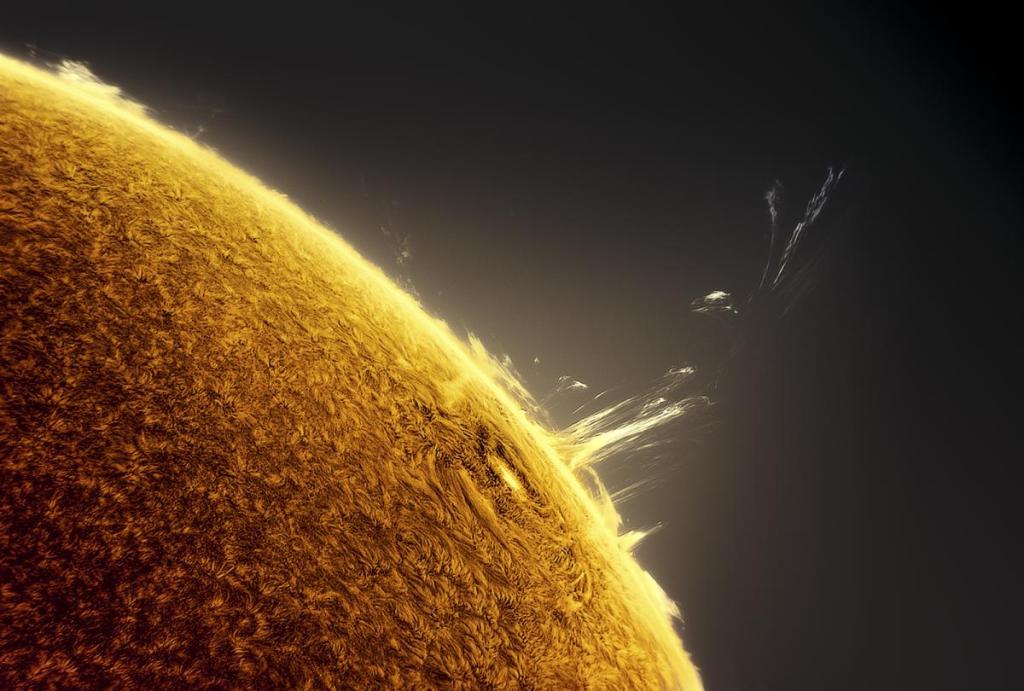
Image (Credit): Solar Flare X1 from AR2994 in ‘Motion.’ (Miguel Claro)
This week’s image is one of the finalist photos in the 2023 Astronomy Photographer of the Year shortlist held by the Royal Museums Greenwich. Check out the site for other fascinating finalist images.
Here is a little more about this solar flare image from photographer Miguel Claro taken in the Dark Sky Alqueva region, Évora district, Portugal:
“I was testing my new camera from Player One Apollo-M Max and photographing another region of the Sun, when I was notified by the SpaceWeatherLive app that an eruption was ongoing at 13.47 (UTC, Universal Time) with the release of an extraordinary X1-class solar flare [X class flares are the largest],” Miguel says.
“I had to immediately change my initial plans and pointed the telescope as quickly as possible to the limb where the flare departed from sunspot AR2994, already hidden behind the edge of the Sun. According to SpaceWeatherLive, ‘the explosion produced enough radiation for a strong shortwave radio blackout over the mid-Atlantic ocean and Europe’. Conditions were unstable, but I managed to make a short timelapse of about 27 minutes.”
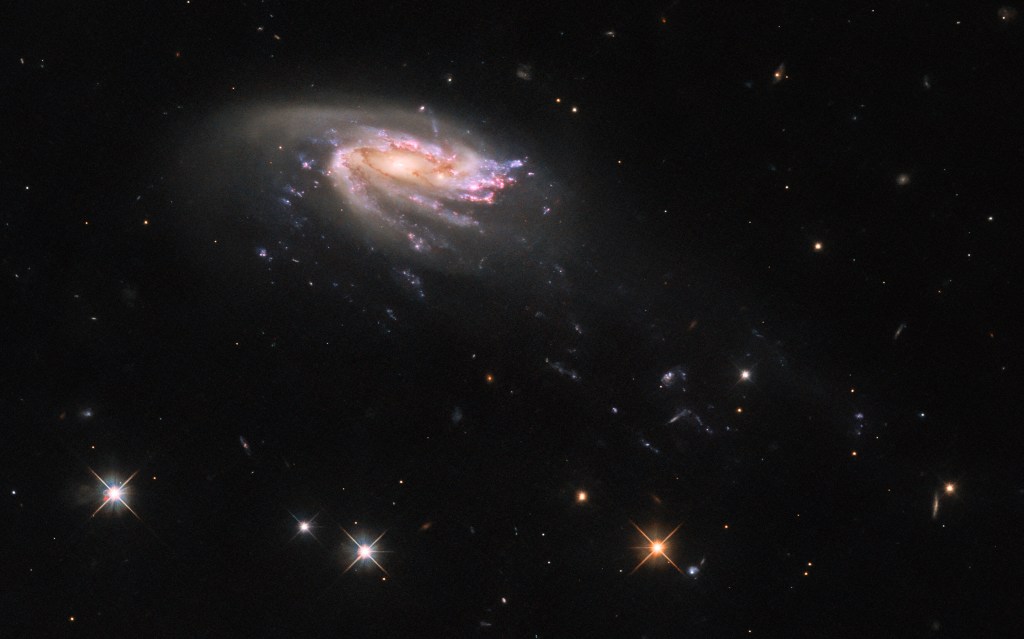
Image (Credit): The jellyfish galaxy JO206 trails across this image from the NASA/ESA Hubble Space Telescope. (ESA/Hubble & NASA, M. Gullieuszik and the GASP team)
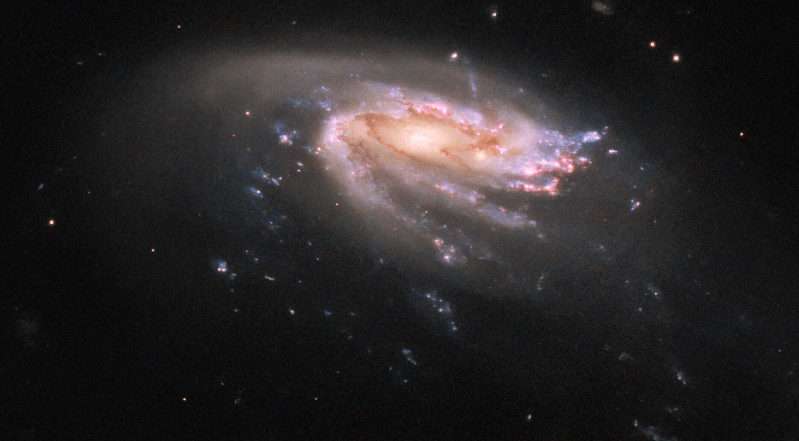
This week’s image is from the Hubble Space Telescope. It shows the jellyfish galaxy JO206, which is about 700 million light-years away. A close-up of the galaxy iteself is provided below.
[Galaxy JO206 is] showcasing a colorful star-forming disk surrounded by a pale, luminous cloud of dust. A handful of foreground bright stars with crisscross diffraction spikes stands out against an inky black backdrop at the bottom of the image…
Jellyfish galaxies are so-called because of their resemblance to their aquatic namesakes. In the bottom right of this image, long tendrils of bright star formation trail the disk of JO206, just as jellyfish trail tentacles behind them. The tendrils of jellyfish galaxies are formed by the interaction between galaxies and the intra-cluster medium, a tenuous superheated plasma that pervades galaxy clusters. As galaxies move through galaxy clusters, they ram into the intracluster medium, which strips gas from the galaxies and draws it into the long tendrils of star formation.
The tentacles of jellyfish galaxies give astronomers a unique opportunity to study star formation under extreme conditions, far from the influence of the galaxy’s main disk. Surprisingly, Hubble revealed that there are no striking differences between star formation in the disks of jellyfish galaxies and star formation in their tentacles, which suggests the environment of newly formed stars has only a minor influence on their formation.
Image (Credit): Close-up of the jellyfish galaxy JO206 from the NASA/ESA Hubble Space Telescope. (ESA/Hubble & NASA, M. Gullieuszik and the GASP team)
Image (Credit): The ISS before the Sun. (Thierry Legault)
This week’s image was taken by French astrophotographer Thierry Legault. It shows the International Space Station (ISS) transiting the Sun on June 9th. The other three dark objects are sun spots.
At the time this image was taken, two NASA astronauts, Stephen Bowen and Warren “Woody” Hoburg, were installing a new solar array on the station.
Image (Credit): NASA’s Perseverance Mars rover captured this mosaic of a hill nicknamed “Pinestand.” (NASA/JPL-Caltech/ASU/MSSS)
This week’s image comes from NASA’s Mars rover Perseverance as it explores the to Jezero Crater. The photo was posted last month. It has been a little while since we directly our attention at the Red Planet.
The image shows what may be the result of a fast-moving river some time in the past. In the NASA write-up accompanying the photo above, we read:
“Pinestand” is an isolated hill bearing sedimentary layers that curve skyward, some as high as 66 feet (20 meters). Scientists think these tall layers may also have been formed by a powerful river, although they’re exploring other explanations, as well.
“These layers are anomalously tall for rivers on Earth,” [postdoctoral researcher at NASA’s Jet Propulsion Laboratory in Southern California Libby] Ives said. “But at the same time, the most common way to create these kinds of landforms would be a river.”




 Our Awesome Universe