Image (Source): View of the Pacific from the ISS. More information provided below. (NASA)
This week’s image is from the International Space Station (ISS). It shows an October 1, 2022 photo of European Space Agency (ESA) astronaut Samantha Cristoforetti enjoying a view of the Pacific Ocean off the coast of Peru. She is sitting in the ISS’s so called “window to the world.” You can learn more about photo’s taken from this window via this short NASA video.
Image (Credit): Dust devils swirling across Jezero Crater, as viewed by NASA’s Perseverance Mars rover. (NASA/JPL-Caltech/SSI)
This week’s image is from earlier this year when NASA’s Perseverance Mars rover captured whirling dust on the Red Planet’s surface. Here is more on the dust devils from NASA:
During its first couple hundred days in Jezero Crater, NASA’s Perseverance Mars rover saw some of the most intense dust activity ever witnessed by a mission sent to the Red Planet’s surface. Not only did the rover detect hundreds of dust-bearing whirlwinds called dust devils, Perseverance captured the first video ever recorded of wind gusts lifting a massive Martian dust cloud.
A paper recently published in Science Advances chronicles the trove of weather phenomena observed in the first 216 Martian days, or sols. The new findings enable scientists to better understand dust processes on Mars and contribute to a body of knowledge that could one day help them predict the dust storms that Mars is famous for – and that pose a threat to future robotic and human explorers.
“Every time we land in a new place on Mars, it’s an opportunity to better understand the planet’s weather,” said the paper’s lead author, Claire Newman of Aeolis Research, a research company focused on planetary atmospheres. She added there may be more exciting weather on the way: “We had a regional dust storm right on top of us in January, but we’re still in the middle of dust season, so we’re very likely to see more dust storms.”
Image (Credit): JWST deep field view of the cosmos. (NASA, ESA, CSA, STScI)
This week we have another recent image from the James Webb Space Telescope (JWST) showing a thousands of galaxies, some of which have images distorted by the gravity of other galaxies. It is quite a collection of distant worlds.
Thousands of galaxies flood this near-infrared image of galaxy cluster SMACS 0723. High-resolution imaging from NASA’s James Webb Space Telescope combined with a natural effect known as gravitational lensing made this finely detailed image possible.
First, focus on the galaxies responsible for the lensing: the bright white elliptical galaxy at the center of the image and smaller white galaxies throughout the image. Bound together by gravity in a galaxy cluster, they are bending the light from galaxies that appear in the vast distances behind them. The combined mass of the galaxies and dark matter act as a cosmic telescope, creating magnified, contorted, and sometimes mirrored images of individual galaxies.
Clear examples of mirroring are found in the prominent orange arcs to the left and right of the brightest cluster galaxy. These are lensed galaxies – each individual galaxy is shown twice in one arc. Webb’s image has fully revealed their bright cores, which are filled with stars, along with orange star clusters along their edges.
Not all galaxies in this field are mirrored – some are stretched. Others appear scattered by interactions with other galaxies, leaving trails of stars behind them.
Image (Credit): JWSP’s view of The Pillars of Creation. (NASA, ESA, CSA, STScI; Joseph DePasquale (STScI), Anton M. Koekemoer (STScI), Alyssa Pagan (STScI))
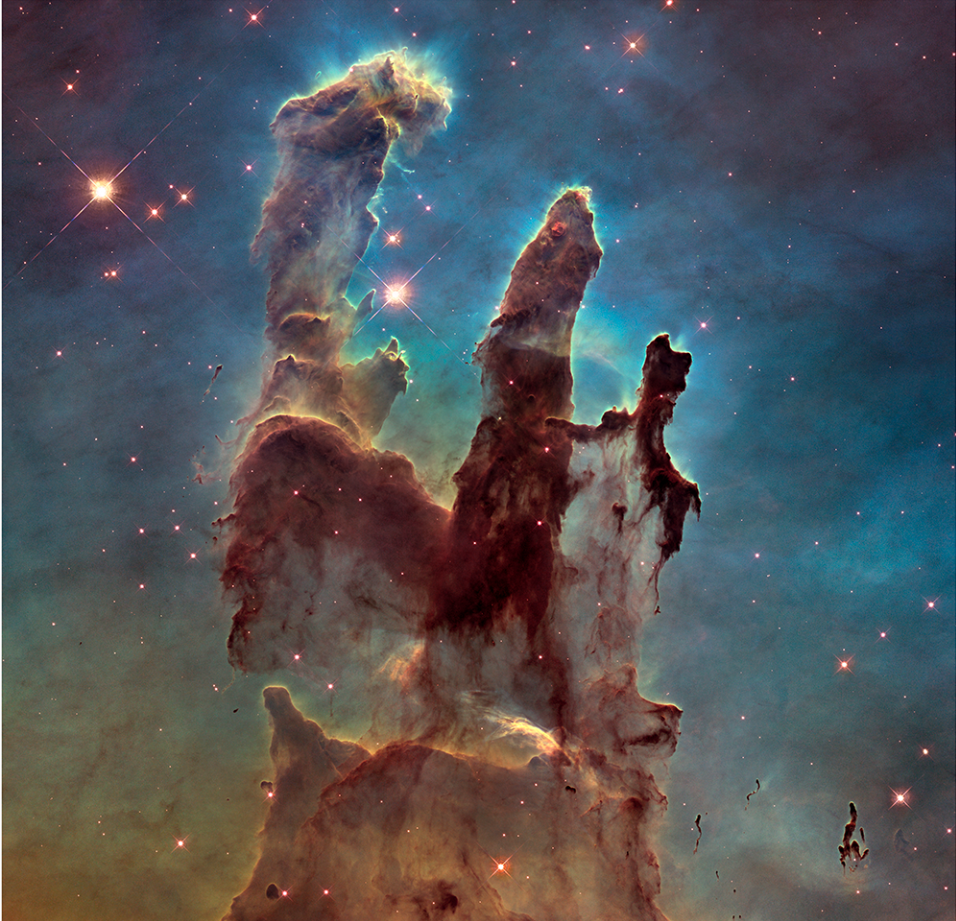
This week’s image is a redo of an earlier Hubble Space Telescope image (shown below), but this time we see the Pillars of Creation through the eyes of the James Webb Space Telescope (JWST). The pillars is part of the Eagle Nebula, which lies 6,500 light-years away.
Newly formed stars are the scene-stealers in this image from Webb’s Near-Infrared Camera (NIRCam). These are the bright red orbs that typically have diffraction spikes and lie outside one of the dusty pillars. When knots with sufficient mass form within the pillars of gas and dust, they begin to collapse under their own gravity, slowly heat up, and eventually form new stars.
What about those wavy lines that look like lava at the edges of some pillars? These are ejections from stars that are still forming within the gas and dust. Young stars periodically shoot out supersonic jets that collide with clouds of material, like these thick pillars. This sometimes also results in bow shocks, which can form wavy patterns like a boat does as it moves through water. The crimson glow comes from the energetic hydrogen molecules that result from jets and shocks. This is evident in the second and third pillars from the top – the NIRCam image is practically pulsing with their activity. These young stars are estimated to be only a few hundred thousand years old.
Although it may appear that near-infrared light has allowed Webb to “pierce through” the clouds to reveal great cosmic distances beyond the pillars, there are no galaxies in this view. Instead, a mix of translucent gas and dust known as the interstellar medium in the densest part of our Milky Way galaxy’s disk blocks our view of the deeper universe.
Image (Credit): Hubble Space Telescope’s view of The Pillars of Creation in 2014. (NASA, ESA, and the Hubble Heritage Team)
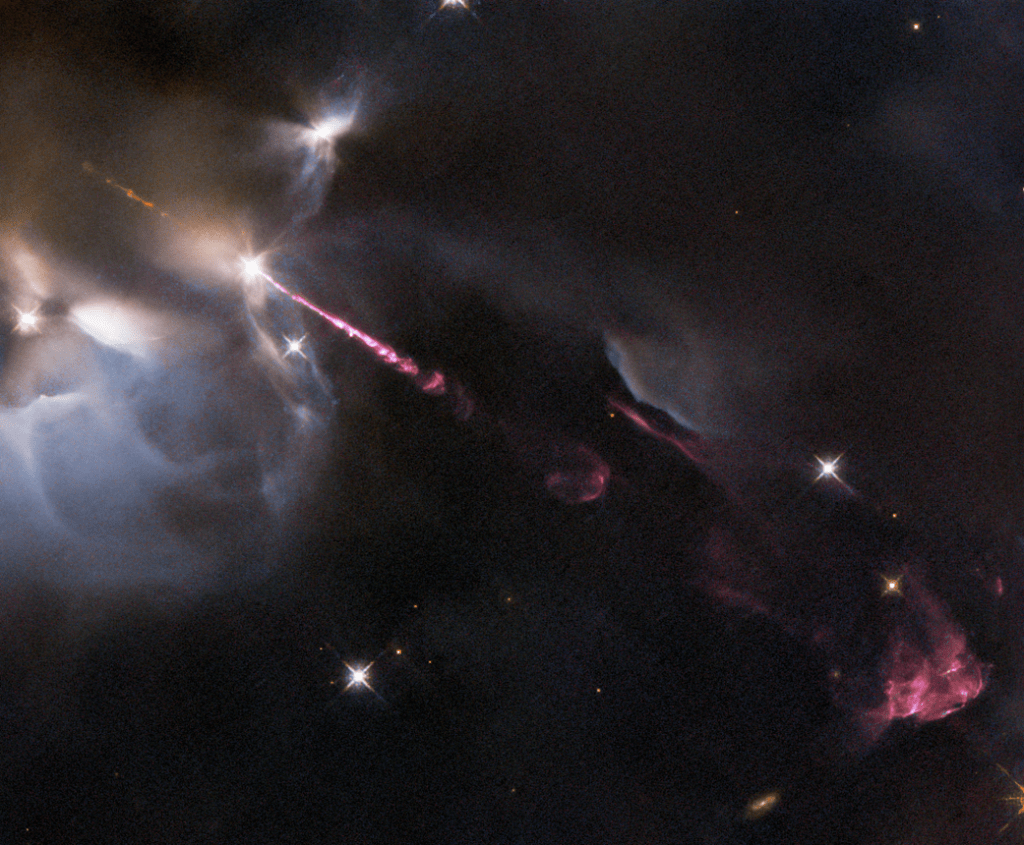
Image (Credit): Hubble image of an outburst from an infant star. (ESA/Hubble & NASA, B. Nisini)
This week’s image is from the NASA/ESA Hubble Space Telescope. While it may look like an enormous interstellar stingray, it actually shows gas streaming from a newly-formed star. Here is the story from the European Space Agency (ESA):
An energetic outburst from an infant star streaks across this image from the NASA/ESA Hubble Space Telescope. This stellar tantrum – produced by an extremely young star in the earliest phase of formation – consists of an incandescent jet of gas travelling at supersonic speeds. As the jet collides with material surrounding the still-forming star, the shock heats this material and causes it to glow. The result is the colorfully wispy structures, which astronomers refer to as Herbig–Haro objects, billowing across the lower right of this image.
Herbig–Haro objects are seen to evolve and change significantly over just a few years. This particular object, called HH34, was previously captured by Hubble between 1994 and 2007, and again in glorious detail in 2015. HH34 resides approximately 1,250 light-years from Earth in the Orion Nebula, a large region of star formation visible to the unaided eye. The Orion Nebula is one of the closest sites of widespread star formation to Earth, and as such has been pored over by astronomers in search of insights into how stars and planetary systems are born.