Image (Credit): Jupiter’s moon Europa. (NASA/JPL-Caltech/SwRI/MSSS/Björn Jónsson CC BY-NC-SA 2.0)
This week’s image is from NASA’s Juno spacecraft orbiting Jupiter and its moons. It is a beautiful image of Europa from the spacecraft’s Junocam. Europa is one of 80 known moons orbiting its host planet.
JunoCam took its closest image at an altitude of 945 miles (1,521 kilometers) over a region of the moon called Annwn Regio. In the image, terrain beside the day-night boundary is revealed to be rugged, with pits and troughs. Numerous bright and dark ridges and bands stretch across a fractured surface, revealing the tectonic stresses that the moon has endured over millennia. The circular dark feature in the lower right is Callanish Crater.
Such JunoCam images help fill in gaps in the maps from images obtained by NASA’s Voyager and Galileo missions. Citizen scientist Björn Jónsson processed the image to enhance the color and contrast. The resolution is about 0.6 miles (1 kilometer) per pixel.
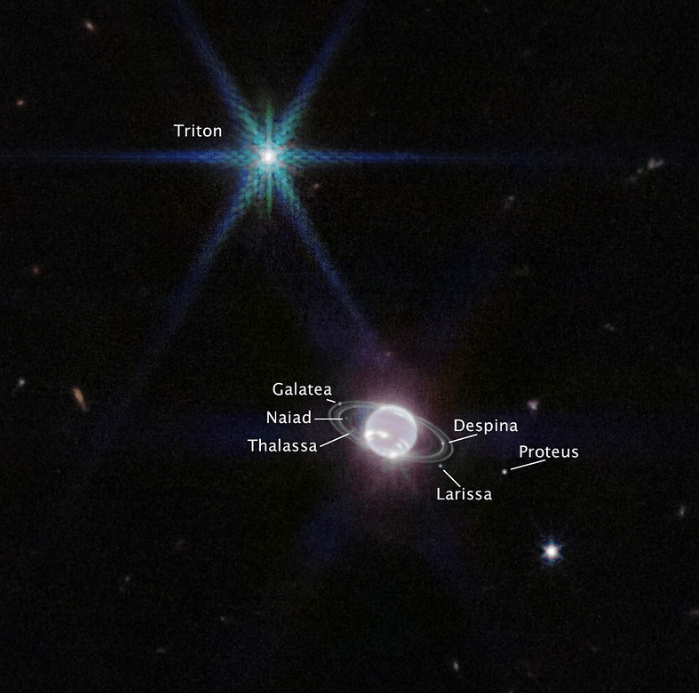
Image (Credit): JWST image of Nepture showing its rings and moons. (NASA, ESA, CSA, STScI)
This week’s image is from the James Webb Space Telescope (JWST). It clearly shows the rings of Neptune as well as a number of its moons (the image below is a broader shot labeling those moons). It is an impressive shot by the JWST within our solar system, similar to the space telescope’s recent image of Jupiter.
In this Webb image, Neptune resembles a pearl with rings that look like ethereal concentric ovals around it. There are 2 thinner, crisper rings and 2 broader, fainter rings. A few extremely bright patches on the lower half of Neptune represent methane ice clouds. Six tiny white dots, which are six of Neptune’s 14 moons, are scattered among the rings. The background of the image is black.
The Neptune image was uploaded to the NASA website on September 21, just a few days shy of the actual date in the calendar when Neptune was observed for the first time ever – September 23. The year was 1846 and the observer was German astronomer Johann Galle.
Image (Credit): JWST labeled image of Nepture showing its rings and moons. (NASA, ESA, CSA, STScI)
Image (Credit): Hubble image of colliding galaxies – NGC 169 (bottom) and IC 1559 (top).(ESA/Hubble & NASA, J. Dalcanton, Dark Energy Survey, DOE, FNAL/DECam, CTIO/NOIRLab/NSF/AURA, SDSS)
This week’s image comes again from the Hubble Space Telescope, which is keeping us entertained as the James Webb Space Telescope cycles through its required observations and spins off images from time to time.
While an earlier image appeared to show colliding galaxies, though it was believed to be an optical illusion, the collision above is real. Below is more on the image from the European Space Agency’s (ESA) Hubble site:
Galaxies can merge, collide, or brush past one another — each of which has a significant impact on their shapes and structures. As common as these interactions are thought to be in the Universe, it is rare to capture an image of two galaxies interacting in such a visibly dynamic way. This image, from the NASA/ESA Hubble Space Telescope, feels incredibly three-dimensional for a piece of deep-space imagery.
The subject of this image is named Arp 282, an interacting galaxy pair that is composed of the Seyfert galaxy NGC 169 (bottom) and the galaxy IC 1559 (top). If you’re interested in learning more about Seyfert galaxies, you can read about the Seyfert galaxy NGC 5728 here.Interestingly, both of the galaxies comprising Arp 282 have monumentally energetic cores, known as active galactic nuclei (AGN), although it is difficult to tell that from this image. This is actually rather fortunate, because if the full emission of two AGNs was visible in this image, then it would probably obscure the beautifully detailed tidal interactions occurring between NGC 169 and IC 1559. Tidal forces occur when an object’s gravity causes another object to distort or stretch. The direction of the tidal forces will be away from the lower-mass object and towards the higher mass object. When two galaxies interact, gas, dust and even entire solar systems will be drawn away from one galaxy towards the other by these tidal forces. This process can actually be seen in action in this image — delicate streams of matter have formed, visibly linking the two galaxies.
Image (Credit): (NASA/JPL-Caltech/University of Arizona)
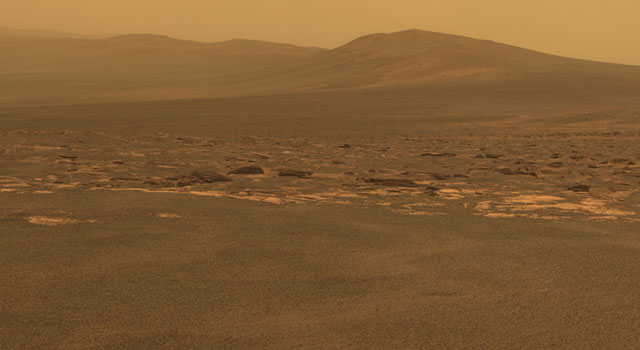
This week’s image is from NASA’s Mars Reconnaissance Observer. The Martian surface looks magical as we see the effects of water and ice. We tend to see Mars in one way – the view from a lander or rover showing a plain desert-like horizon (shown below) – but from above we can see it is so much more.
Both water and dry ice have a major role in sculpting Mars’ surface at high latitudes. Water ice frozen in the soil splits the ground into polygons. Erosion of the channels forming the boundaries of the polygons by dry ice sublimating in the spring adds plenty of twists and turns to them.
Spring activity is visible as the layer of translucent dry ice coating the surface develops vents that allow gas to escape. The gas carries along fine particles of material from the surface further eroding the channels. The particles drop to the surface in dark fan-shaped deposits. Sometimes the dark particles sink into the dry ice, leaving bright marks where the fans were originally deposited. Often the vent closes, then opens again, so we see two or more fans originating from the same spot but oriented in different directions as the wind changes.
Image (Credit): The view from NASA’s Mars Exploration Rover Opportunity showing a portion of the west rim of Endeavour crater. (NASA/JPL-Caltech/Cornell/ASU)
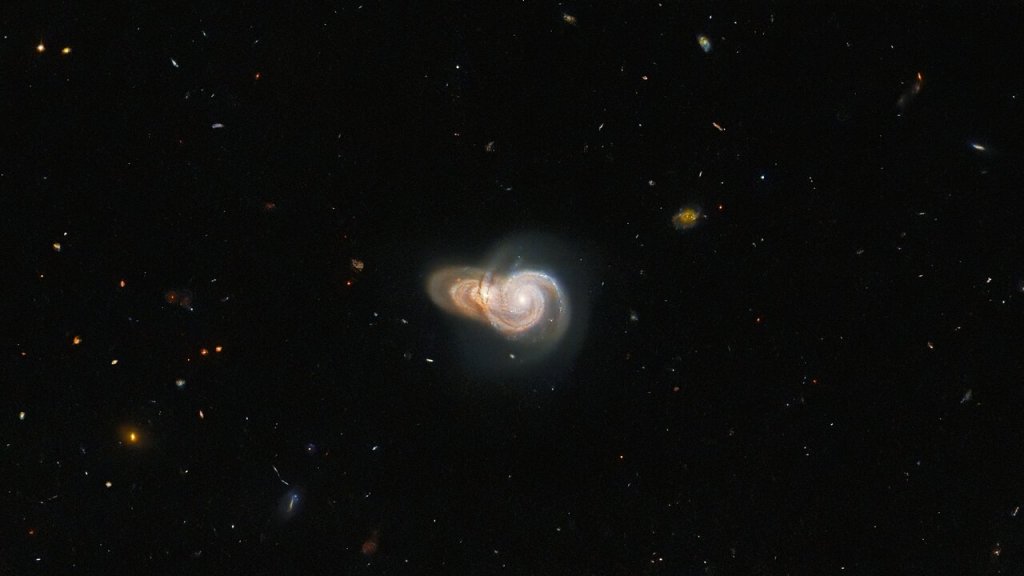
Image (Credit): Two spiral galaxies about 1 billion light-years away captured by the Hubble. (European Space Agency)
This week’s fascinating image from the NASA/ESA Hubble Space Telescope shows what appears to be two colliding spiral galaxies. A cropped version is shown below to highlight the colors. Here is more from ESA:
The two galaxies, which have the uninspiring names SDSS J115331 and LEDA 2073461, lie more than a billion light-years from Earth. Despite appearing to collide in this image, the alignment of the two galaxies is likely just by chance — the two are not actually interacting. While these two galaxies might simply be ships that pass in the night, Hubble has captured a dazzling array of interacting galaxies in the past.