Image (Credit): Multiple galaxies captured by the NASA/ESA Space Telescope – noted below. (ESA/Hubble & NASA, W. Keel)
With all the excitement about the James Webb Space Telescope, let’s not forget about the ongoing great work being performed by the Hubble Space Telescope. This recently released Hubble image shows multiple galaxies as well as multiple types of galaxies.
This luminescent image features multiple galaxies, perhaps most noticeably LEDA 58109, the lone galaxy in the upper right. LEDA 58109 is flanked by two further galactic objects to its lower left — an active galactic nucleus (AGN) called SDSS J162558.14+435746.4 that partially obscures the galaxy SDSS J162557.25+435743.5, which appears to poke out to the right behind the AGN.
Galaxy classification is sometimes presented as something of a dichotomy: spiral and elliptical. However, the diversity of galaxies in this image alone highlights the complex web of galaxy classifications that exist, including galaxies that house extremely luminous AGNs at their cores, and galaxies whose shapes defy the classification of either spiral or elliptical.
Image (Credit): Jupiter as captured by the JWST. (NASA, ESA, CSA, Jupiter ERS Team; image processing by Ricardo Hueso (UPV/EHU) and Judy Schmidt)
This week’s image once again comes from the new James Webb Space Telescope (JWST), but instead of peering outside of our solar system, it is looking around closer to home. The image above of Jupiter is an amazing shot that shows the planet in all its glory – violent storms, glowing auroras, delicate rings, and orbiting moons. The particulars are labeled in the same image below.
The image came from the JWST’s Near-Infrared Camera (NIRCam), which NASA notes has:
…three specialized infrared filters that showcase details of the planet. Since infrared light is invisible to the human eye, the light has been mapped onto the visible spectrum. Generally, the longest wavelengths appear redder and the shortest wavelengths are shown as more blue. Scientists collaborated with citizen scientist Judy Schmidt to translate the Webb data into images.
This is a whole new way to see our neighborhood worlds as well as the worlds many light years away.
Image (Credit): Jupiter as captured by the JWST with all of the key areas labeled. (NASA, ESA, CSA, Jupiter ERS Team; image processing by Ricardo Hueso (UPV/EHU) and Judy Schmidt)
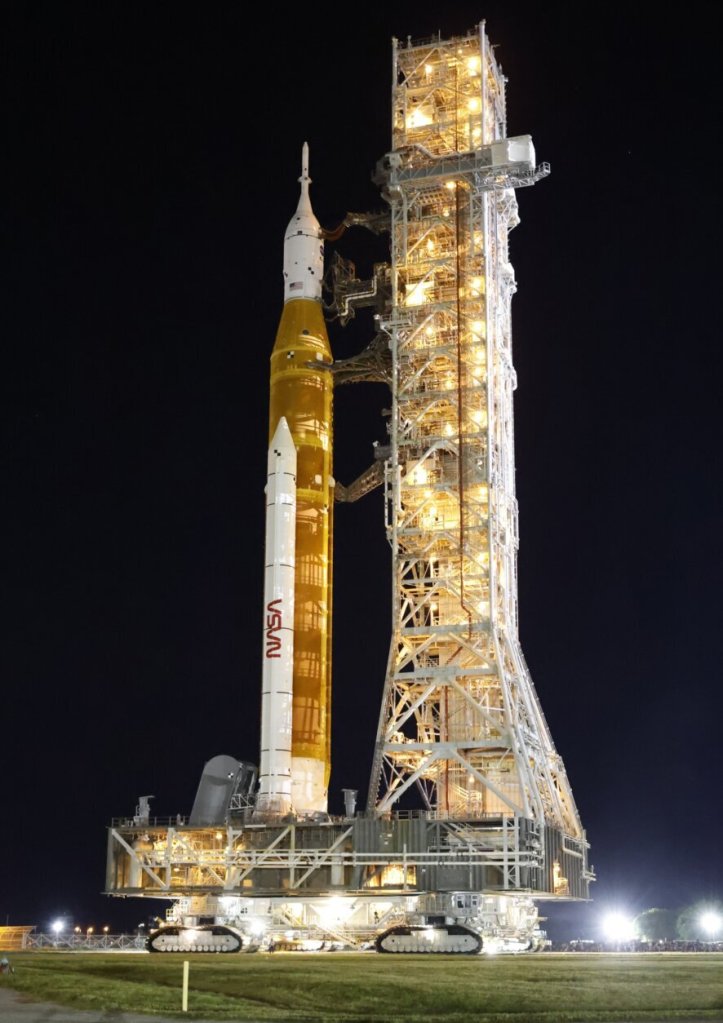
Image (Credit): NASA’s Space Launch System moving from the Vehicle Assembly Building to the launch pad at Cape Canaveral, Florida, on August 16, 2022. (NASA)
This week’s image highlights NASA’s actions to launch the first phase of the Artemis Mission. The image shows the Space Launch System and Orion capsule moving towards launch pad 39B at the Kennedy Space Center. The launch of the six-week unmanned mission around the Moon is planned for August 29th. The full mission for this first phase, or Artemis I, is shown below.
Image (Credit): The Cartwheel Galaxy, located about 500 million light-years away, as captured by the JWST. (NASA, ESA, CSA, STScI)
This week’s picture is one of the latest images from the James Webb Space Telescope (JWST). It shows the Cartwheel Galaxy, which is about 500 million light-years away. The Hubble’s view of this same galaxy is provided below.
NASA’s James Webb Space Telescope has peered into the chaos of the Cartwheel Galaxy, revealing new details about star formation and the galaxy’s central black hole. Webb’s powerful infrared gaze produced this detailed image of the Cartwheel and two smaller companion galaxies against a backdrop of many other galaxies. This image provides a new view of how the Cartwheel Galaxy has changed over billions of years.
The Cartwheel Galaxy, located about 500 million light-years away in the Sculptor constellation, is a rare sight. Its appearance, much like that of the wheel of a wagon, is the result of an intense event – a high-speed collision between a large spiral galaxy and a smaller galaxy not visible in this image. Collisions of galactic proportions cause a cascade of different, smaller events between the galaxies involved; the Cartwheel is no exception.
The collision most notably affected the galaxy’s shape and structure. The Cartwheel Galaxy sports two rings — a bright inner ring and a surrounding, colorful ring. These two rings expand outwards from the center of the collision, like ripples in a pond after a stone is tossed into it. Because of these distinctive features, astronomers call this a “ring galaxy,” a structure less common than spiral galaxies like our Milky Way.
The bright core contains a tremendous amount of hot dust with the brightest areas being the home to gigantic young star clusters. On the other hand, the outer ring, which has expanded for about 440 million years, is dominated by star formation and supernovas. As this ring expands, it plows into surrounding gas and triggers star formation.
Image (Credit): An image of the Cartwheel Galaxy taken with the NASA/ESA Hubble Space Telescope. (ESA/Hubble & NASA)
Image (Credit): Martian crater. (NASA/JPL-Caltech/University of Arizona)
This week’s image may appear to be a mining pit in Arizona, but in fact it is a crater in Mar’s southern hemisphere. The blue dust near the top of the crater’s rim is frozen carbon dioxide. The image was taken from NASA’s Mars Reconnaissance Orbiter using its High Resolution Imaging Science Experiment.
Every winter, a layer of carbon dioxide frost (dry ice) forms on the surface of Mars. At its greatest extent in mid-winter, this frost reaches from the poles down to the middle latitudes, until it is too warm and sunny to persist. In most places this is around 50 degrees latitude, similar to the latitude of southern Canada on Earth.
However, small patches of dry ice are found closer to the equator on pole-facing slopes, which are colder because they receive less sunlight. This image was taken in the middle of winter in Mars’ Southern Hemisphere, and shows a crater near 37 degrees south latitude. The south-facing slope has patchy bright frost, blue in enhanced color. This frost occurs in and around the many gullies on the slope, and in other images, has caused flows in the gullies.