Space Stories: Astronomical Damage in Ukraine, An Awakened Black Hole, and Understanding Jupiter’s Giant Red Spot

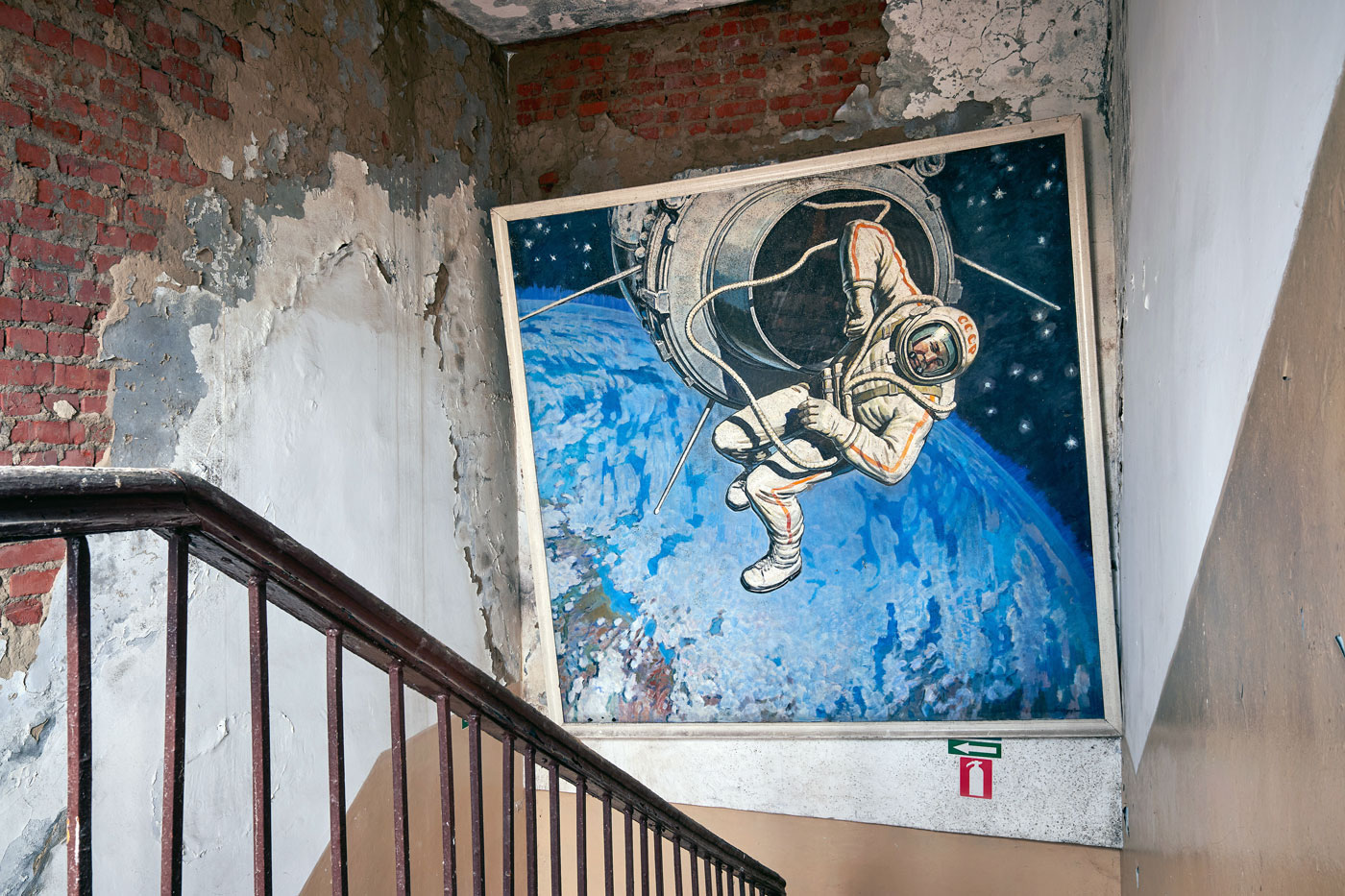
Image (Credit): Stairwell of the Braude observatory’s main building with a painting of Alexei Leonov, the Soviet cosmonaut who performed the first spacewalk in 1965. (Science.org/Eric Lusito)

Here are some recent stories of interest.

Science.org: A Shattered Window to the Radio Sky

In November 2023, photographer Eric Lusito made a rare visit to the Braude Radio Astronomy Observatory near Kharkiv, Ukraine, once one of the nation’s flagship scientific facilities. Since his visit, the Kharkiv region, which was partly occupied by Russian forces in 2022 but liberated later that year, has again faced a renewed Russian assault. As of this writing, military specialists say that effort has stalled. Here is Lusito’s account of his visit.

The Guardian: Astronomers Detect Sudden Awakening of Black Hole 1m Times Mass of Sun

The mysterious brightening of a galaxy far, far away has been traced to the heart of the star system and the sudden awakening of a giant black hole 1m times more massive than the sun. Decades of observations found nothing remarkable about the distant galaxy in the constellation of Virgo, but that changed at the end of 2019 when astronomers noticed a dramatic surge in its luminosity that persists to this day. Researchers now believe they are witnessing changes that have never been seen before, with the black hole at the galaxy’s core putting on an extreme cosmic light show as vast amounts of material fall into it.

University of the Basque Country: Establishing Age and Origin of Jupiter’s Great Red Spot

As a popular icon among objects in the Solar System, Jupiter’s Great Red Spot (GRS) is probably the best-known atmospheric structure. Its large size (right now its diameter is that of the Earth) and the contrast of its reddish colour against the planet’s pale clouds make it an object that can be easily seen even with small telescopes…Speculation about the origin of the GRS dates back to the first telescopic observations made by the astronomer Giovanni Domenico Cassini, who in 1665 discovered a dark oval at the same latitude as the GRS and named it the ‘Permanent Spot’ (PS), since it was observed by him and other astronomers until 1713. Track of it was subsequently lost for 118 years and it was not until 1831 and later years that S. Schwabe again observed a clear structure, roughly oval in shape and at the same latitude as the GRS; that can be regarded as the first observation of the current GRS, perhaps of a nascent GRS.

Recent Book: The Wrong Stuff

Credit: PublicAffairs

Here is a book released this month that may be worth taking to the beach.

The Wrong Stuff: How the Soviet Space Program Crashed and Burned is a tale about a space program that wowed the world in the 1950s and 1960s until the U.S. stole the show with the first man on the Moon. However, the Soviet space program may have had problems long before the U.S. leapfrogged it. If you are interested in the space race, then this is the book for you.

This is a summary from the book:

In the wake of World War II, with America ascendant and the Soviet Union devastated by the conflict, the Space Race should have been over before it started. But the underdog Soviets scored a series of victories–starting with the 1957 launch of Sputnik and continuing in the years following–that seemed to achieve the impossible. It was proof, it seemed, that the USSR had manpower and collective will that went beyond America’s material advantages. They had asserted themselves as a world power.

But in The Wrong Stuff, John Strausbaugh tells a different story. These achievements were amazing, yes, but they were also PR victories as much as scientific ones. The world saw a Potemkin spaceport; the internal facts were much sloppier, less impressive, more dysfunctional. The Soviet supply chain was a disaster, and many of its machines barely worked. The cosmonauts aboard its iconic launch of the Vostok 1 rocket had to go on a special diet, and take off their space suits, just to fit inside without causing a failure. Soviet scientists, under intense government pressure, had essentially made their rocket out of spit and band aids, and hurried to hide their work as soon as their worldwide demonstration was complete.

As we watch the Russian military struggle in Ukraine, we are reminded that the Russians and others (North Korea?) have been good at putting on a show, but the truth can be very different.

None of this takes away from the bravery of the Soviet cosmonauts who thrived and died in that space program. As always, the rot was in the system, which could only stand for so long.

Maybe Putin should put this on his beach reading list as he continues to rattle his saber. It may do him and the world some good.

Progress 88 Resupply Mission Approaches ISS

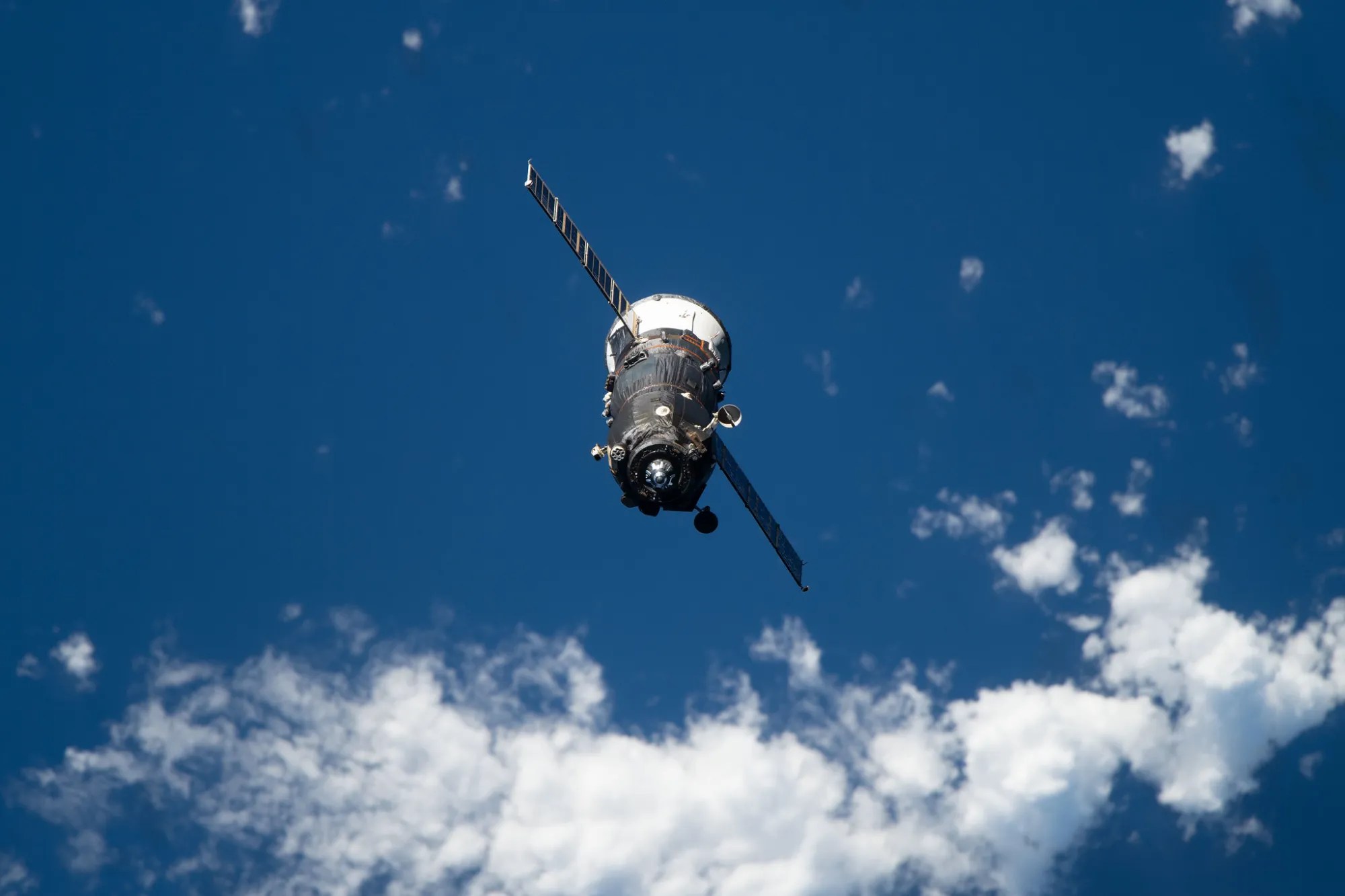
Image (Credit): The Progress 85 cargo craft after undocking from International Space Station on Feb. 12. (NASA)

Yesterday saw another successful resupply launch towards the International Space Station (ISS). The Russian Progress 88 uncrewed spacecraft attached to a Soyuz rocket left Kazakhstan early Thursday morning. It will dock with the ISS Saturday morning (which you can watch on NASA TV).

These missions have become so routine that you generally see few if any stories about such missions. That is a sign of an efficient system. The residents on the ISS like boring efficiency as long as it gets them the supplies they need.

Stay tuned for a little more drama when the Boeing Starliner heads to the ISS tomorrow.

Space Stories: Robot Trains on the Moon, Commercial Space Stations, and Russian Lunar Reactors

Image (Credit): Artist’s rendering of the Flexible Levitation on a Track system on the lunar surface with planet Earth on the horizon. (NASA/Ethan Schaler)

Here are some recent stories of interest.

NDTV: NASA Announces Plans To Build First Railway System On Moon

As the National Aeronautics and Space Administration (NASA) readies to return astronauts to the moon, it has announced its plans to build a levitating robot train on the lunar surface. In a blog post, the American space agency provided details about the project called “Flexible Levitation on a Track (FLOAT)”, which aims to provide a “robotic transport system” to support future lunar activities of astronauts visiting the moon. The transport system will be critical to the daily operation of a sustainable lunar base in the 2030s, NASA said in a statement. 

IEEE Spectrum: Commercial Space Stations Approach Launch Phase

A changing of the guard in space stations is on the horizon as private companies work toward providing new opportunities for science, commerce, and tourism in outer space. Blue Origin is one of a number of private-sector actors aiming to harbor commercial activities in low Earth orbit (LEO) as the creaking and leaking International Space Station (ISS) approaches its drawdown. Partners in Blue Origin’s Orbital Reef program, including firms Redwire, Sierra Space, and Boeing, are each reporting progress in their respective components of the program. The collaboration itself may not be on such strong ground. Such endeavors may also end up slowed and controlled by regulation so far absent from many new, commercial areas of space.

Newsweek: Russia Reveals New China Nuclear Moon Base Details

Details about joint plans between Moscow and Beijing to put a lunar nuclear reactor within the next decade have been revealed by the head of Russia’s space agency. In March, Roscosmos announced plans to work with China to build an automated nuclear reactor to power a proposed lunar base that the two countries would operate together within the next decade. To construct the site, Roscosmos director general Yury Borisov said two months ago it was looking at using nuclear-powered rockets to transfer cargo to the moon, but had not yet figured out how to build these spacecraft safely. In an article published Wednesday by state news outlet RIA Novosti, Borisov said that development of the plant was underway and the countries were working on creating experimental and research facilities as part of the project.

China Returns to the Far Side of the Moon

Image (Credit): China’s Chang’e 6 lunar probe at the Wenchang Space Launch Site in Hainan province prior to the launch on Friday. (CNSA)

Last Friday, China launched the Chang’e-6 lunar probe towards the moon with the goal of returning the first lunar soil sample from the far side of the Moon. An earlier mission in 2020, Chang’e-5, successfully returned lunar soil samples from the near side of the Moon for the first time in 44 years. Before that, in 2019, China place a rover on the far side of the Moon via the Chang’e-4 mission.

China is making some bold strides in space with, it might be added, some help from the Europeans. While the US bans any cooperation with the Chinese, France, Italy and Sweden have contributed to the Chang’e-6 mission. For example, Sweden added the Negative Ions at the Lunar Surface (NILS) instrument to the lunar probe.

Maybe one day we can join the Chinese on some of these missions, but that day seems to be far away. That said, we were able to find a way with the Russians, which allowed for the ongoing success of the International Space Station.