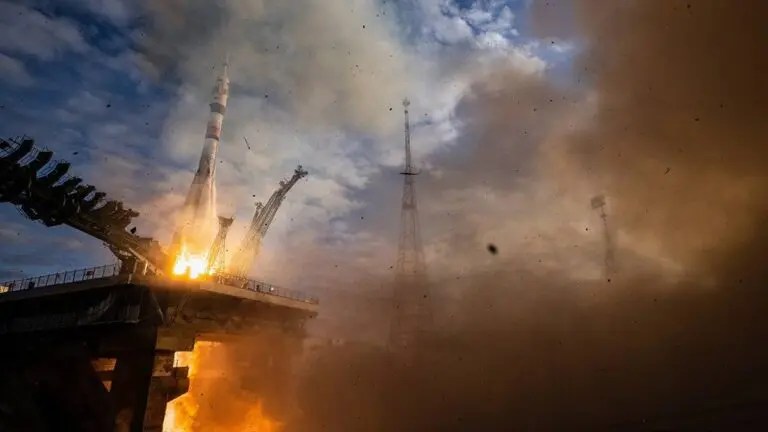
Image (Credit): The launch earlier today of the Progress MS-28 cargo spacecraft to the ISS. (TASS Russian News Agency)
This week’s image is from earlier today when the Russian’s successfully launched its Progress MS-28 cargo spacecraft via a Soyuz rocket to the International Space Station (ISS). The resupply mission was launched from the Baikonur Cosmodrome located in Kazakhstan. The spacecraft will rendezvous with the ISS on Saturday.
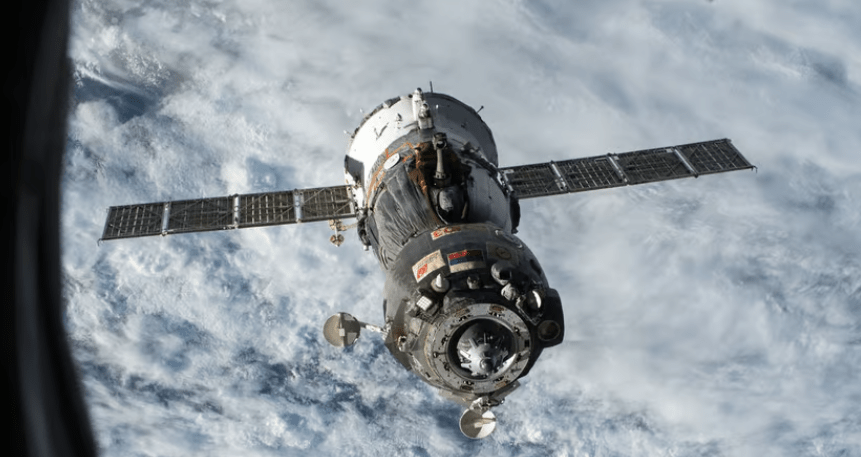
Image (Credit): A Russian Soyuz spacecraft outside the ISS. (NASA)
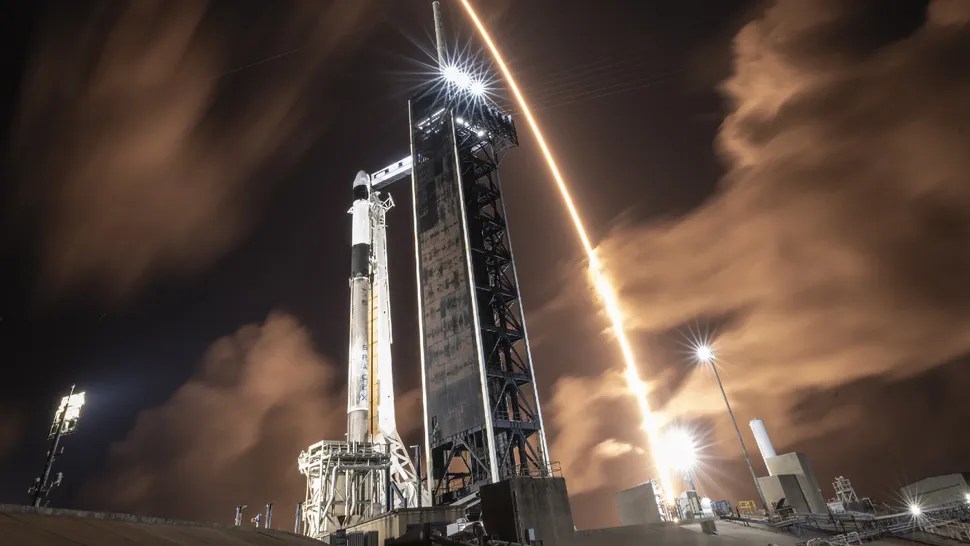
Well, the U.S. now has one space company with its manned spacecraft stranded at the International Space Station (ISS) while a second space company responsible for manned flights to the ISS has been grounded following a rocket mishap.
So where does this leave the ISS? Dependent on the Russians for manned flights to the ISS until the SpaceX problem can be investigated. Of course, SpaceX was also one solution for returning the Boeing crew to Earth if the Starliner problem could not be timely resolved. So much for that at the moment.
Both the Boeing and SpaceX issues could be resolved in the next few weeks, but this shows how quickly the situation can change on the ground and in space. While the Russians have certainly had their own issues with the Soyuz spacecraft as well, at least the men and women on the station have one option available to them.
Let’s hope Boeing gets its act together and the SpaceX mishap can be resolved quickly.
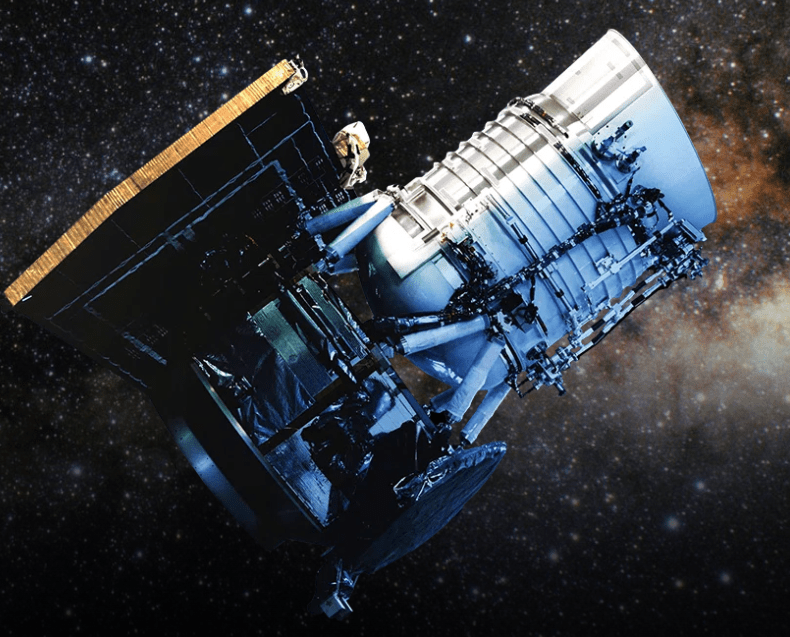
A NASA space telescope designed to “hunt” asteroids and comets that could pose a threat to life on Earth and orbiting spacecraft will soon burn up in orbit. In late 2024 or early 2025, the agency’s Near-Earth Object (NEO) Wide-field Infrared Survey Explorer—or NEOWISE—is expected to come home in pieces following the conclusion of its second mission later this month…However, NASA has a replacement lined up: the Near Earth Object Surveyor (NEO Surveyor), set for a 2027 launch. The infrared space telescope is the first to be designed specifically for hunting large numbers of NEOs in and around Earth orbit. It has a baseline development cost of $1.2 billion to which NASA committed in 2022.
Four volunteers who spent more than a year living in a 1,700-square-foot space created by NASA to simulate the environment on Mars have emerged. The members of the Crew Health and Performance Exploration Analog mission — or CHAPEA — walked through the door of their habitat at NASA’s Johnson Space Center in Houston on Saturday to a round of applause…Haston and the other three crew members — Anca Selariu, Ross Brockwell and Nathan Jones — entered the 3D-printed Mars replica on June 25, 2023, as part of a NASA experiment to observe how humans would fare living on the Red Planet.
Russia is aiming to create the four-module core of its planned new orbital space station by 2030, its Roscosmos space agency said on Tuesday. The head of Roscosmos, Yuri Borisov, signed off on the timetable with the directors of 19 enterprises involved in creating the new station. The agency confirmed plans to launch an initial scientific and energy module in 2027. It said three more modules would be added by 2030 and a further two between 2031 and 2033.
Image (Credit): A current map showing the location of the Tunguska Event in Russia. (Wikipedia)
It was on this day in 1908 that about 800 square miles of forest in Siberia were decimated in what was later attributed to an meteor exploding 3 to 6 miles above the Tunguska River area. As a result of the aerial explosion, no impact crater was created from what was called the Tunguska Event.
The meteor that hit Russia has been estimated top be 160–200 feet wide. The asteroid that passed by the Earth yesterday, 2024 MK, has been estimated to be 400 and 850 feet wide. We are lucky that we did not need to go through this again more than 100 years later.
The Tunguska Event is the largest impact event in recorded history. It was this event that later inspired what we celebrate today – Asteroid Day.
Image (Credit): Stairwell of the Braude observatory’s main building with a painting of Alexei Leonov, the Soviet cosmonaut who performed the first spacewalk in 1965. (Science.org/Eric Lusito)
In November 2023, photographer Eric Lusito made a rare visit to the Braude Radio Astronomy Observatory near Kharkiv, Ukraine, once one of the nation’s flagship scientific facilities. Since his visit, the Kharkiv region, which was partly occupied by Russian forces in 2022 but liberated later that year, has again faced a renewed Russian assault. As of this writing, military specialists say that effort has stalled. Here is Lusito’s account of his visit.
The mysterious brightening of a galaxy far, far away has been traced to the heart of the star system and the sudden awakening of a giant black hole 1m times more massive than the sun. Decades of observations found nothing remarkable about the distant galaxy in the constellation of Virgo, but that changed at the end of 2019 when astronomers noticed a dramatic surge in its luminosity that persists to this day. Researchers now believe they are witnessing changes that have never been seen before, with the black hole at the galaxy’s core putting on an extreme cosmic light show as vast amounts of material fall into it.
As a popular icon among objects in the Solar System, Jupiter’s Great Red Spot (GRS) is probably the best-known atmospheric structure. Its large size (right now its diameter is that of the Earth) and the contrast of its reddish colour against the planet’s pale clouds make it an object that can be easily seen even with small telescopes…Speculation about the origin of the GRS dates back to the first telescopic observations made by the astronomer Giovanni Domenico Cassini, who in 1665 discovered a dark oval at the same latitude as the GRS and named it the ‘Permanent Spot’ (PS), since it was observed by him and other astronomers until 1713. Track of it was subsequently lost for 118 years and it was not until 1831 and later years that S. Schwabe again observed a clear structure, roughly oval in shape and at the same latitude as the GRS; that can be regarded as the first observation of the current GRS, perhaps of a nascent GRS.