The Moon Has One More Crater

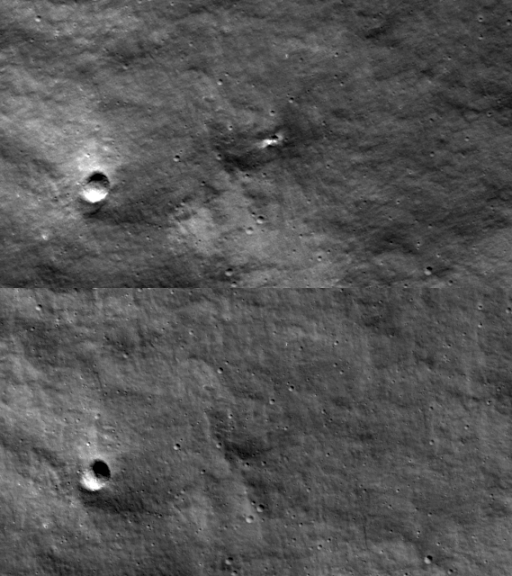
Image (Credit): Contrast between two views of the lunar surface from June 27, 2020, and Aug. 24, 2023, which is before and after the crash of Russia’s Luna-25 spacecraft. (NASA’s Goddard Space Flight Center/Arizona State University)

If President Putin wanted to leave a mark, he has done so on the Moon. NASA’s Lunar Reconnaissance Orbiter (LRO) has apparently located the spot where the Luna-25 spacecraft crashed, as shown in the before and after shot above.

Given that craters can last for billions of years on the Moon’s surface, we can rest assured that the Russians have made an indelible mark on a distant land.

Russia, let’s call it a win and recall those troops from Ukraine.

By the way, maybe we should call the new crater Putin’s Sunset.

Space Quote: The Changing Competition in Space and Elsewhere

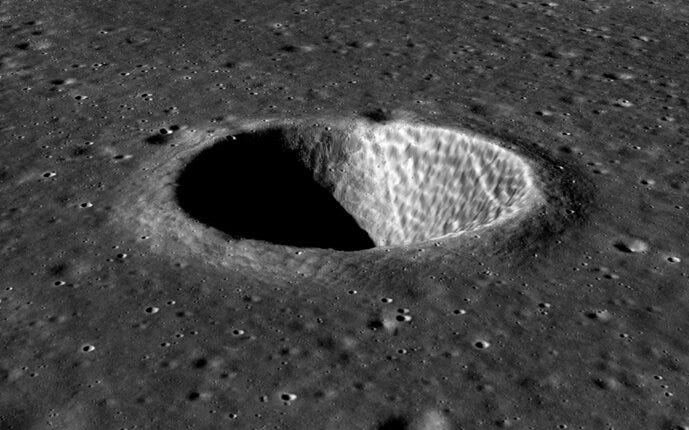
Image (Credit): 3D view of a crater on the Moon generated from images captured by Chandrayaan 2 orbiter’s Terrain Mapping Camera in 2019. (ISRO)

“…a comparison with India is illuminating: India’s economy was about half the size of Russia’s when the Berlin Wall came down in 1989. Today, India’s economy is 50 percent bigger than Russia’s. Forget about keeping pace with the United States: Russia can’t keep up with India.”

-Editorial in The Washington Post by David Von Drehle titled “India’s Brilliant Moon Landing Illuminates Russia’s Drastic Decline.” India’s steady progress on space missions, including Chandrayaan 2 back in 2019 (shown above), has occurred during Russia’s slow decline and current situation. This cannot be lost on Russia as its cosmonaut traveled to the International Space Station this weekend aboard an American rocket. Around the world, space programs are moving on without Russia, which was the leading nation at the start of the Space Age.

A New Crew Departs for the ISS

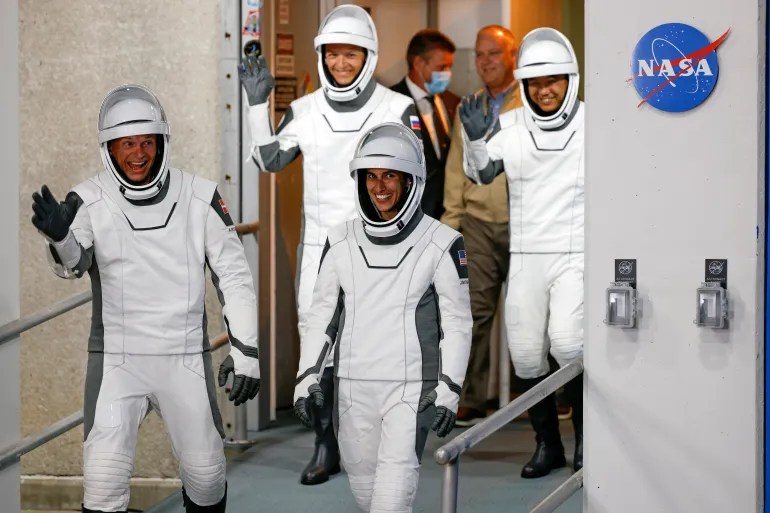
Image (Credit): ISS crew preparing for August 26, 2023 launch. (Terry Renna/AP Photo)

A new crew departed Earth for the International Space Station (ISS) at 3:27am ET today from NASA’s Kennedy Space Center in Florida via a SpaceX Falcon 9 rocket. The crew includes:

  • NASA astronaut Jasmin Moghbeli,
  • ESA (European Space Agency) astronaut Andreas Mogensen,
  • JAXA (Japan Aerospace Exploration Agency) astronaut Satoshi Furukawa, and
  • Roscosmos cosmonaut Konstantin Borisov.

The new crew should be onboard the ISS tomorrow morning, bringing the number of occupants at the station to 11 until 4 crew members return to Earth in a few days.

Russia is probably happy to have attention back on the ISS rather than the Moon for the moment. It has not been a good week for the Russian space program.

You can read more about the new crew members at this NASA site.

We Await the Indian Moon Landing

Image (Credit): Images of the Moon from India’s Chandrayaan-3 spacecraft after it entered lunar orbit more than two weeks ago. (Indian Space Research Organisation)

We are down to one spacecraft approaching the Moon’s south pole – India’s Chandrayaan-3 mission, which is expected to land as early as tomorrow. This is India’s second try for a Moon landing after the loss of Chandrayaan-2, so fingers crossed. Chandrayaan-1 also sent a probe that impacted the Moon, but that was the plan.

We shall see if Indian patience beats Russian bravado.

India Prime Minister Modi put a possible spin on the past missions. Regarding Chandrayaan-1, he said:

Chandrayaan-1 is considered to be a path-breaker among global lunar missions as it confirmed the presence of water molecules on the moon. It featured in over 200 scientific publications around the world.

Even the failed second mission has its successes:

Chandrayaan-2 was equally pathbreaking because data from the Orbiter associated with it detected the presence of chromium, manganese and sodium for the first time through remote sensing. This will also provide more insights into the moon’s magmatic evolution. The key scientific outcomes from Chandrayaan 2 include the first ever global map for lunar sodium, enhancing knowledge on crater size distribution, unambiguous detection of lunar surface water ice with IIRS instrument and more. This Mission has featured in almost 50 publications.

I like the positive attitude.

Luna-25 Fails to Land (Properly) on the Moon

Image (Credit): Our Moon in all its glory. (NASA/JPL/USGS)

The message from Roscosmos was pretty bland:

During the operation, an abnormal situation occurred on board the automatic station, which did not allow the maneuver to be performed with the specified parameters.

Translated into normal speech, we learned that Luna-25 crashed during its attempted landing on the lunar surface.

This is a blow for Russia and Putin as well. The Soviet Union could threaten the world and run a terrific space program. The Russians are bogged down in Ukraine and unable to pick up a lunar program ceased about 50 years ago. It is sad to watch.

Roscosmos Director General Yury Borisov blamed the crash on Russia’s long absence from the Moon, stating,

The negative experience of interrupting the lunar program for almost 50 years is the main reason for the failures.

He may want to add corruption, economic sanctions, and horrible leadership to that list of reasons.

At least the Russian mission was able to share a few photos from orbit before it all ended.

The Moon’s south pole is still available for anyone who wants it. The Indian space program will give it a try this week. We can only wish them well as they fly over the Russian rubble.