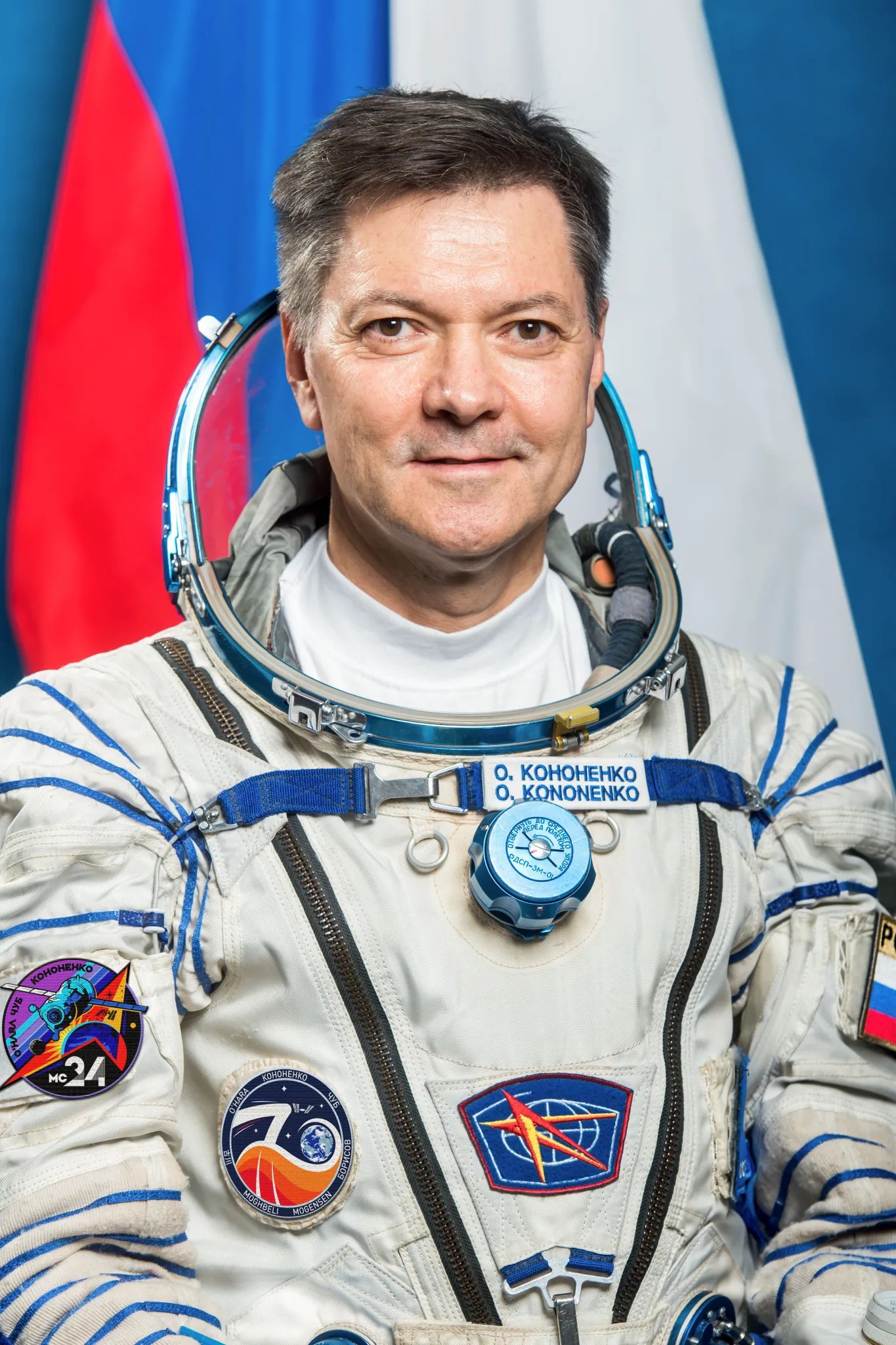
Just yesterday, Russian cosmonaut Oleg Kononenko surpassed an earlier record for the amount of time a human has spent in space. He has now been in orbit more than 878 days, this being his fifth rotation on the International Space Station. The earlier record was set in 2015 by cosmonaut Gennady Padalka.
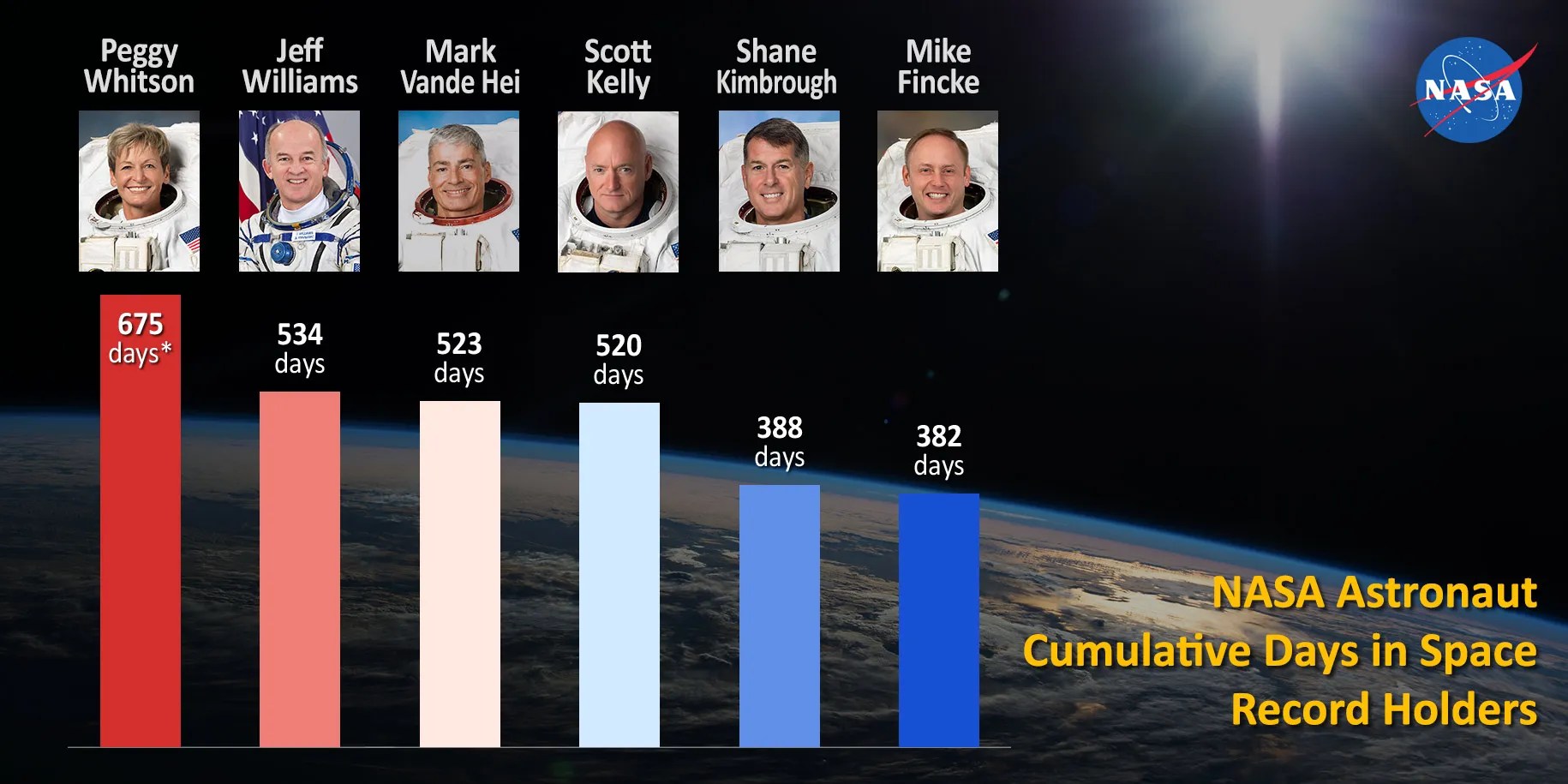
American astronauts have a ways to go before approaching this record. To date, the record for cumulative days in space is held by a NASA astronaut Peggy Whitson at 675 days.
*Peggy Whitson extended her record cumulative time in space by nine days as an Axiom Space astronaut during Axiom Mission-2 from May 21 through May 30, 2023. Credit: NASA
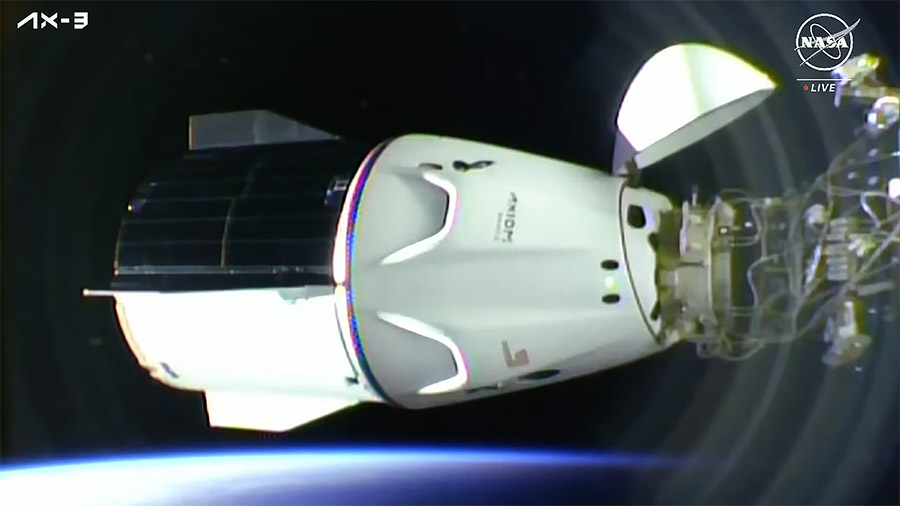
Image(Credit): The SpaceX Dragon Freedom spacecraft, which is carrying four Axiom Mission 3 crew members, docking to the space station shortly after an orbital sunrise. (NASA TV)
The seven real astronauts on the International Space Station (ISS) are now playing host to four visitors for the next two weeks after the Axiom Mission 3 crew came aboard the station earlier today.
Unlike the last two Axiom missions, all three paying members of the Axiom Mission crew are being supported by various European governments:
Marcus Wandt, member of the European Space Agency’s (ESA) astronaut reserve (ticket paid by ESA and the Swedish National Space Agency);
Walter Villadei, a member of the Italian air force (ticket paid by the Italian air force); and
Alper Gezeravcı, a fighter pilot with the Turkish air force (ticket paid by the Turkish government).
At the price of $55 million per seat, I am hoping the governments and space agencies feel they are getting their money’s worth versus being part of the normal 6-month astronaut rotation.
Supposedly, the extra hands will be working on 30 experiments that the normal crew did not have time for, though I would imagine they would be the less important experiments if they would otherwise not be performed at all.
If all of this is truly important work, then I expect such demand will justify the need for commercial space stations down the line to continue the work of the ISS. However, I expect a good chuck of future space interest will come from the tourist side.
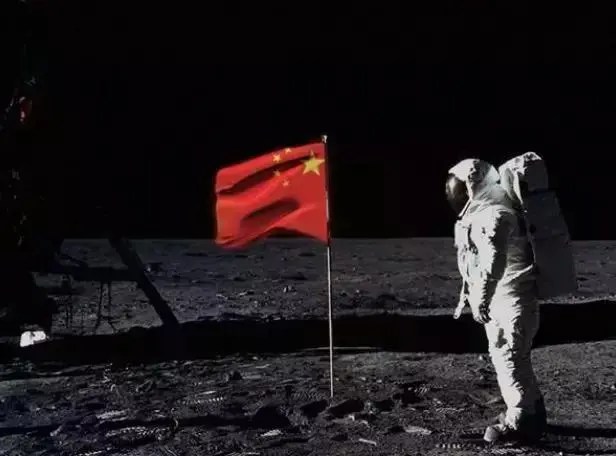
Image (Credit): A manufactured image, but it may be a reality soon enough. (Asia Times)
With the newly announced delays related to the Artemis lunar program, it is fair to ask whether the U.S. might fall behind the Chinese when it comes to a crewed lunar mission (of course, we won that battle 50 years ago, but you know that I mean).
All reports indicate that the Chinese wants to place humans on the Moon by 2030, but they are not expected to beat the Artemis timetable of a lunar landing in 2026. Of course, it is important that NASA stick to this timetable.
I do not have a concern that China is going to land before us…I think that China has a very aggressive plan. I think they would like to land before us, because that might give them some PR coup. But the fact is that I don’t think they will. I think it is true that their date that they announced keeps getting earlier. But specifically, with us landing in September of ’26, that will be the first landing.
Obstacles remain on what will prove to be a difficult mission even if it is a repeat. We already saw Russia’s failed attempt to simply land on the Moon last year, and the problems with last week’s NASA-funded commercial launch towards the Moon was worrying.
Nothing can be taken for granted in this new space race.
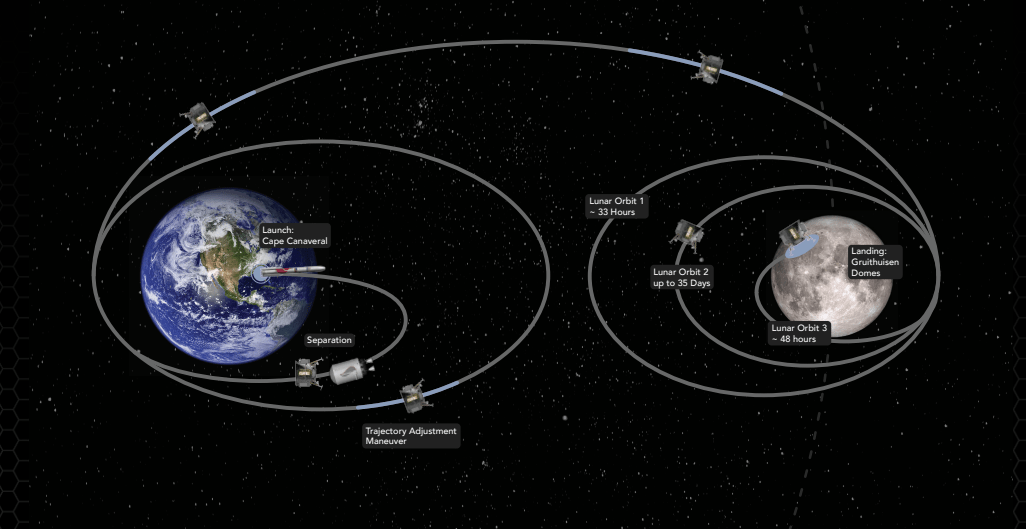
Image (Credit): Planned flight of the Peregrine lunar lander. (Astrobotic)
We started with high hopes, yet a problem has already threatened the success of Astrobotic’s mission to the Moon. Shortly after a successful lift off earlier this morning, the Peregrine lunar lander started reporting issues with its propulsion system, which impacted its ability to charge its batteries. Fortunately, the charging issue was resolved, yet the propulsion issue is still outstanding.
Astrobotic is already talking about a modified mission. Noting the loss of propellant, the company stated:
The team is working to try and stabilize this loss, but given the situation, we have prioritized maximizing the science and data we can capture. We are currently assessing what alternative mission profiles may be feasible at this time.
That sounds pretty ominous at this point when the final goal is the Moon. The US mission is starting to look like two other lunar missions that failed last year – one Japanese and one Russian – yet those happened on the Moon’s surface. If the Peregrine can stay in the Moon’s orbit then maybe it can get a few things accomplished.
If there is any good news, it is that the United Launch Alliance (ULA) Vulcan rocket appeared to operate as expected. That means the folks at ULA and Blue Origin can sleep a little better tonight.
I do not expect the Astrobotic people will have a good night’s sleep for some time.
Image (Credit): Chart showing the planned travel of the JUICE spacecraft. (ESA, work performed by ATG under contract to ESA)
I wanted to start out the new year by first remembering all of the great missions from 2023. I also decided to group this work rather than focus on single missions.
NASA Asteroid Missions: Asteroids were the big news this year, with Lucy encountering a surprise pair of asteroids, OSIRIS-REx bringing back a sample from the asteroid Bennu, and NASA launching the Psyche mission.
JWST Discoveries: This year we celebrated the anniversary of the James Webb Space Telescope (JWST), which has been better than ever imaged. It is helping to change our understanding of the origin of the universe while poking and prodding at exoplanets to review their secrets.
ESA Missions: The European Space Agency (ESA) has also been very busy in 2023. For instance, the launch of the Euclid mission to study dark matter and dark energy, as well as the JUICE mission to study Jupiter and its moons, will assist with our understanding of the big picture as well as our own neighborhood.
That’s an impressive record, and I look forward to even more great news in 2024.