In an earlier posting, I noted that the people at Cool Worlds Lab were planning to create a podcast to further share the Lab’s research. Well, that day has come and you can now listen to the first episode with Professor David Kipping interviewing Rebecca Charbonneau, who is a Janksy Fellow at the National Radio Astronomy Observatory (NRAO). She is a historian of astronomy who is writing a book on the history of the Search for Extraterrestrial Intelligence (SETI).
The conversation covers a number of SETI topics, including a young Carl Sagan’s collaboration with Soviet astronomer I.S. Shklovsky on an English translation of Shklovsky’s book Universe, Life, Intelligence. It was a chance to escape Soviet censors and bring new light to SETI ideas.
It’s a great start to a new series. I look forward to many more podcast episodes in addition to all of the other great media shared by Cool Worlds Labs.
“With geopolitical tensions between Washington and Beijing extending into space, it is only to be expected that policymakers are looking back to the Cold War for helpful lessons. Unfortunately, it is far too easy to learn the wrong lessons from space cooperation during and immediately after the Cold War. Certainly, space cooperation was not a silver bullet to superpower problems on Earth and in space. The pattern of space cooperation between the United States and Russia is an important reminder that space cooperation has generally been the product of improving relations rather than the catalyst for change.”
-Statement by Aaron Bateman in his Bulletin of the Atomic Scientists’ article, “The Prospects for United States–China Space Cooperation are Limited.” The article suggests some ways that the two space-faring nations can find common ground even if they are not working on the same space missions as the American and Russians did in the past and still do today.
Elon Musk got his way. The US Department of Defense (DOD) will be paying an undisclosed amount for the Starlink services being used in Ukraine. This is good news for the Ukrainians had they feared interruption of this vital link with the rest of the world, yet I imagine this will also put SpaceX’s Starlink system at greater risk given that it now is a clearly a subcontractor to the US defense initiatives.
As the media has pointed out, Musk started to cut back on Starlink services to make a point about it being used as part of the war, with one Senator noting:
I was personally disappointed to see discontinuation of full services at such a critical time for Ukraine self-defense…Do you feel there’s a connection between the availability of this capability to our partners in Ukraine in this conflict, and relationships we have with companies like SpaceX?
It appears the relationship has improved now that DOD has opened its checkbook. I guess the next move will be taken by the Russians. And if the past is any guide, things may get ugly.
As the International Space Station nears the end of its life, SpaceX and Los Angeles-based startup Vast have unveiled a plan to launch the first commercial space station. SpaceX will use a Falcon 9 rocket to send the station’s main module, Haven-1, into low-Earth orbit as early as August 2025.
The second orbital mission of China’s robotic space plane has come to a close. The mysterious reusable vehicle touched down Monday (May 8) at the Jiuquan Satellite Launch Center in northwest China, wrapping up a 276-day mission to Earth orbit, according to China’s state-run Xinhua news agency.
Dmitry Rogozin was fired as director general of Russia’s main space corporation, Roscosmos, nearly a year ago. He has spent much of the time since near the front lines of Russia’s invasion of Ukraine, sharing various hateful, threatening, and nationalistic sentiments on his Telegram account. Occasionally, however, the pugnacious politician still opines about space on his “Rogozin at the Front” social media account. He did so this weekend, calling into question whether the United States really did land astronauts on the Moon.
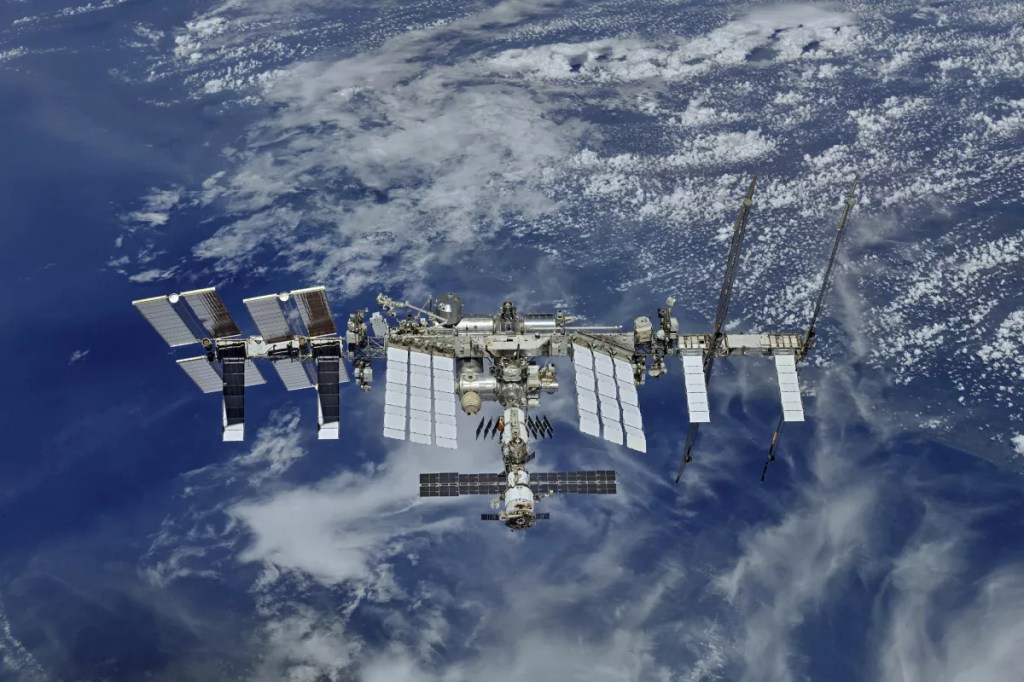
Russia said Wednesday it planned to use the International Space Station until 2028, an apparent reversal of an earlier announcement to quit the orbiting laboratory after 2024. On Wednesday, the head of Russian space agency Roscosmos, Yuri Borisov, said Moscow’s participation in the international space project had been extended. “By the decision of the government, the operation of the International Space Station has been extended until 2028,” Borisov told President Vladimir Putin during a televised meeting, referring to the Russian segment.
The Czech Republic became the 24th country to sign the Artemis Accords May 3, growing Europe’s presence in the U.S.-led agreement. In a brief ceremony at NASA Headquarters, Jan Lipavský, minister of foreign affairs for the Czech Republic, formally signed the accords in the presence of officials from NASA and the U.S. State Department. Representatives of several other countries who previously signed the Artemis Accords also attended…Neither U.S. nor Czech officials announced specific plans to cooperate on the Artemis lunar exploration campaign as a result of signing the accords, but suggested the signing opened the door for future discussions.
China will attempt to collect the first samples from the far side of the moon next year with its Chang’e 6 mission. The complex, four-spacecraft mission will launch on a Long March 5 rocket from Wenchang in May 2024, according to Wu Yanhua, chief designer of China’s Deep Space Exploration Major Project, speaking at a deep-space exploration conference on April 25 in the Chinese city of Hefei.





 Our Awesome Universe