ESA’s Euclid Space Telescope Safely Launched

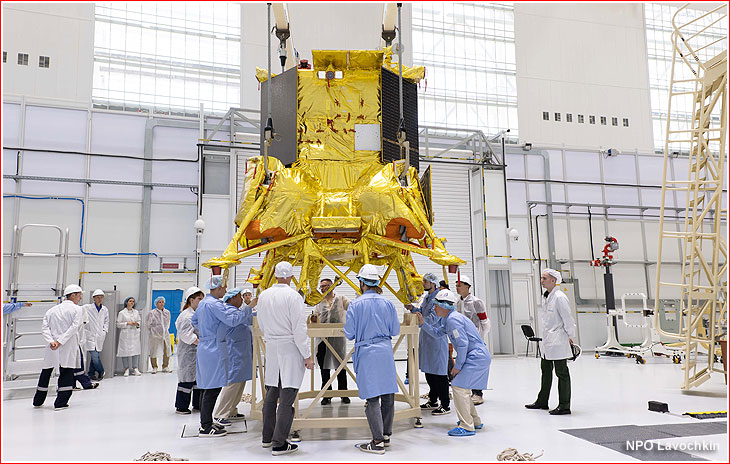
Credit: ESA

Earier today, the European Space Agency’s (ESA) Euclid Space Telescope was safely launched from Cape Canaveral on a Space X Falcon 9 rocket (though the original plan was to use a Russian Soyuz rocket until the invasion nixed that idea). The space telescope is destined for the Sun-Earth Lagrange point 2 (L2), which is an average distance of 1 million miles beyond Earth’s orbit. It will join the James Webb Space Telescope.

In addition to the 1.2 meter diameter telescope, the mission includes two scientific instruments: a visible-wavelength camera (the VISible instrument, VIS) and a near-infrared camera/spectrometer (the Near-Infrared Spectrometer and Photometer, NISP). 

The focus of the new space telescope will be to create a 3D map of the universe to better understand dark matter and dark energy. As noted on the ESA’s website, Euclid hopes to answer these questions:

  • What is the structure and history of the cosmic web?
  • What is the nature of dark matter?
  • How has the expansion of the Universe changed over time?
  • What is the nature of dark energy?
  • Is our understanding of gravity complete?

It is a tall order for this new telescope. Astronomer Isobel Hook from the UK’s Lancaster University put it this way to BBC News:

It will be like setting off on a ship before people knew where land was in different directions. We’ll be mapping out the Universe to try to understand where we fit into it and how we’ve got here – how the whole Universe got from the point of the Big Bang to the beautiful galaxies we see around us, the Solar System and to life.

A Day in Astronomy: Sally Ride and Valentina Tereshkova

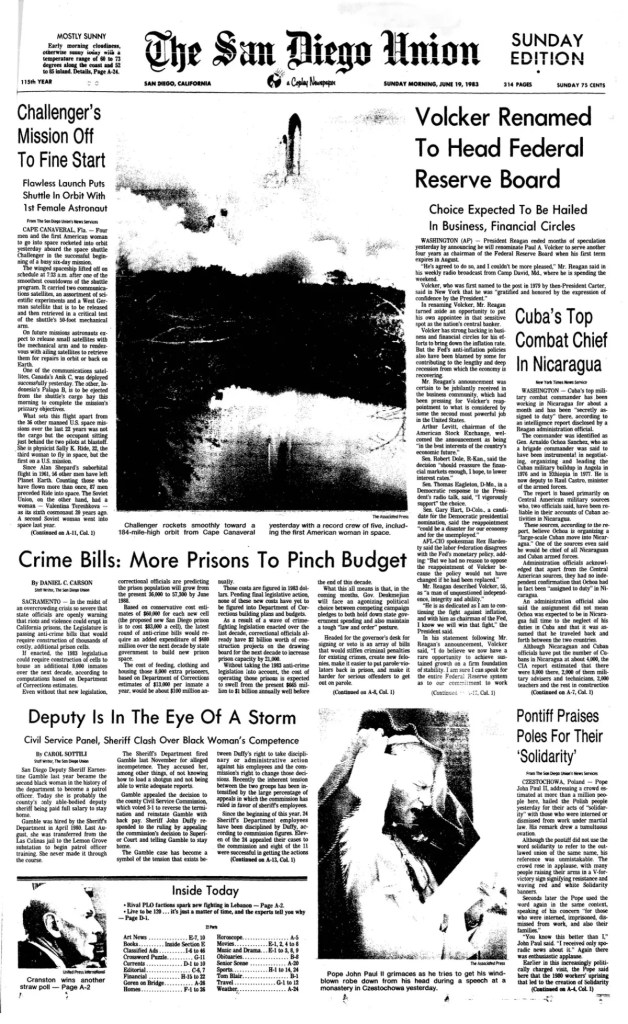
Credit: The San Diego Union

On this day in 1983, astronaut Sally Ride became the first American woman in space, traveling aboard the shuttle Challenger. And 20 years earlier on the same date, Russian cosmonaut Valentina Tereshkova, the first Russian female in space, returned to Earth aboard Vostok 6, after orbiting the planet 48 times. She still remains the only woman to travel into space on a solo mission.

Image (Credit): Cosmonaut Valentina Tereshkova (New Mexico Museum of Space History)

Podcast: Cool Worlds Labs Has Started a Podcast

In an earlier posting, I noted that the people at Cool Worlds Lab were planning to create a podcast to further share the Lab’s research. Well, that day has come and you can now listen to the first episode with Professor David Kipping interviewing Rebecca Charbonneau, who is a Janksy Fellow at the National Radio Astronomy Observatory (NRAO). She is a historian of astronomy who is writing a book on the history of the Search for Extraterrestrial Intelligence (SETI).

The conversation covers a number of SETI topics, including a young Carl Sagan’s collaboration with Soviet astronomer I.S. Shklovsky on an English translation of Shklovsky’s book Universe, Life, Intelligence. It was a chance to escape Soviet censors and bring new light to SETI ideas.

It’s a great start to a new series. I look forward to many more podcast episodes in addition to all of the other great media shared by Cool Worlds Labs.

Credit: Emerson-Adams Press

Space Quote: A Space Detente with China?

“With geopolitical tensions between Washington and Beijing extending into space, it is only to be expected that policymakers are looking back to the Cold War for helpful lessons. Unfortunately, it is far too easy to learn the wrong lessons from space cooperation during and immediately after the Cold War. Certainly, space cooperation was not a silver bullet to superpower problems on Earth and in space. The pattern of space cooperation between the United States and Russia is an important reminder that space cooperation has generally been the product of improving relations rather than the catalyst for change.”

-Statement by Aaron Bateman in his Bulletin of the Atomic Scientists’ article, “The Prospects for United States–China Space Cooperation are Limited.” The article suggests some ways that the two space-faring nations can find common ground even if they are not working on the same space missions as the American and Russians did in the past and still do today.

Starlink: DOD Pays for Ukrainian Service

Image (Credit): Map of Ukraine. (BBC News)

Elon Musk got his way. The US Department of Defense (DOD) will be paying an undisclosed amount for the Starlink services being used in Ukraine. This is good news for the Ukrainians had they feared interruption of this vital link with the rest of the world, yet I imagine this will also put SpaceX’s Starlink system at greater risk given that it now is a clearly a subcontractor to the US defense initiatives.

As the media has pointed out, Musk started to cut back on Starlink services to make a point about it being used as part of the war, with one Senator noting:

I was personally disappointed to see discontinuation of full services at such a critical time for Ukraine self-defense…Do you feel there’s a connection between the availability of this capability to our partners in Ukraine in this conflict, and relationships we have with companies like SpaceX?

It appears the relationship has improved now that DOD has opened its checkbook. I guess the next move will be taken by the Russians. And if the past is any guide, things may get ugly.