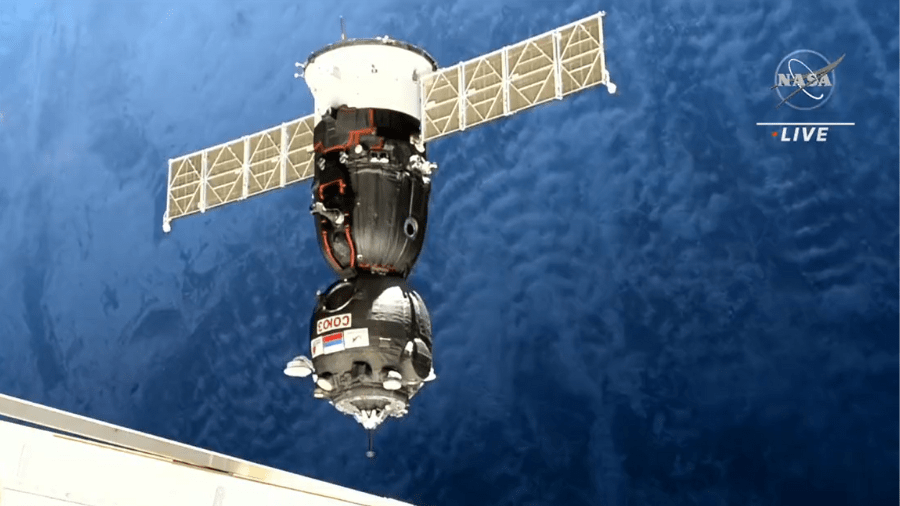
Image (Credit): Soyuz M-23 capsule approaching the ISS. (NASA)
Yesterday, Russia’s M-23 capsule has safely arrived at the International Space Station (ISS). It was carrying supplies but no crew. Now the M-22 crew has a safe way to return to Earth when the are ready.
SpaceX and NASA are targeting no earlier than Monday, February 27 for Falcon 9’s launch of Dragon’s sixth operational human spaceflight mission (Crew-6) to the International Space Station from Launch Complex 39A (LC-39A) at NASA’s Kennedy Space Center in Florida. The instantaneous launch window is at 1:45 a.m. ET (6:45 UTC), with a backup opportunity available on Tuesday, February 28 at 1:22 a.m. ET (6:22 UTC).
Things are starting to return to normal up there. Boring is welcome at this point.
Image (Credit): SpaceX Crew 6 mission on the launchpad. (SpaceX)
Image (Credit): Launch of Russia’s Soyuz M-23 mission to the ISS. (NASA)
Yesterday, Russia launched the uncrewed Soyuz M-23 mission from the Baikonur Cosmodrome in Kazakhstan (it was actually “today” in Russian time). The spacecraft will replace the damaged M-22 capsule attached to the International Space Station (ISS). As a result, the earlier M-22 crew of Russian cosmonauts Sergey Prokopyev and Dmitri Petelin, and NASA astronaut Frank Rubio, will return in this replacement capsule.
NASA noted that the M-22 capsule will be studied by the Russian upon its return in March:
The damaged Soyuz MS-22 is scheduled to undock from the station in late March and return to Earth for an uncrewed parachute-assisted landing in Kazakhstan, and post-flight analysis by Roscosmos.
Given recent leaks on two Russian spacecraft, let’s hope the M-23 mission goes without a hitch. Fingers crossed.
SpaceX will also be shipping a new crew up to the ISS next week, so the space traffic continues even with these hiccups.
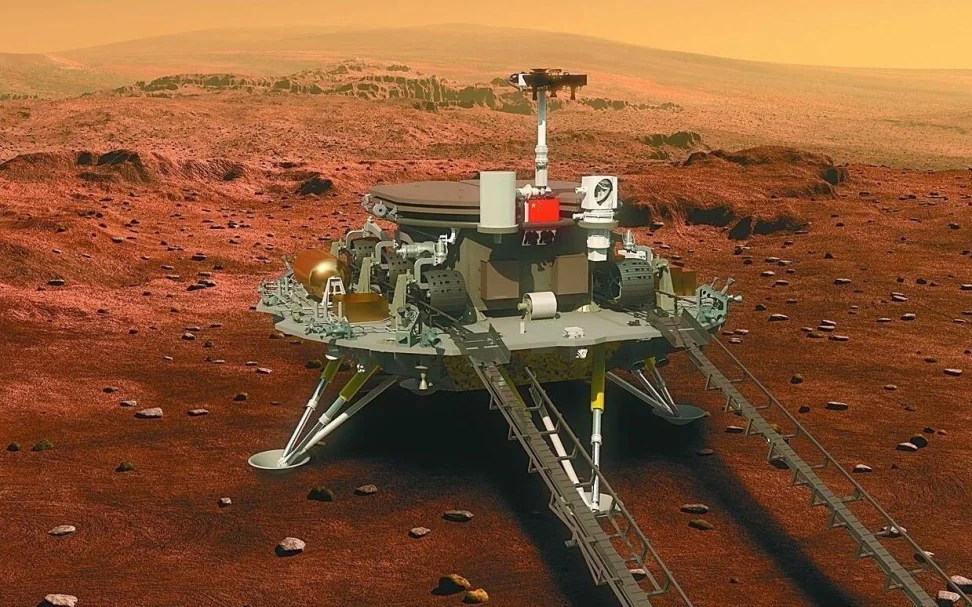
Images from NASA’s Mars Reconnaissance Orbiter reveal that China’s Zhurong rover remains stationary on the Red Planet as China remains silent on the status of its spacecraft. The High Resolution Imaging Science Experiment (HiRISE) camera aboard the Mars Reconnaissance Orbiter (MRO) captured images of the rover on March 11, 2022, a second on Sept. 8, 2022 and finally Feb. 7, 2023. The images were published Feb. 21 by the HiRISE Operations Center.
Astronomers have discovered what appear to be massive galaxies dating back to within 600 million years of the big bang, suggesting the early universe may have had a stellar fast-track that produced these “monsters.” While the new James Webb Space Telescope has spotted even older galaxies, dating to within a mere 300 million years of the beginning of the universe, it’s the size and maturity of these six apparent mega-galaxies that stunned scientists. They reported their findings Wednesday in the journal Nature.
A decades-old Soviet era piece of space junk has crashed back to Earth after over 40 years in orbit, improbably crash landing back in its home country, Russia. The abandoned Soviet Vostok-2M Blok E rocket stage, weighing more than 3,000 pounds, “made an uncontrolled reentry over Novaya Zemlya at 1016 UTC Feb 20 after 42.7 years in orbit,” tweeted Jonathan McDowell, an astrophysicist and group leader at the Chandra X-ray Center Science Data Systems.
Image (Credit): The Progress 82 cargo craft approaches the ISS on October 27, 2022. (NASA)
It appears that we now have two problematic capsules attached to the International Space Station (ISS). Late last year, we learned about a liquid coolant lead in the Russian Soyuz Crew Return Vehicle (Soyuz MS-22 crew ship), and now we have a leak in the second Russian capsule as well (Progress 82 cargo capsule). This is not a good sign for the seven ISS crew members, some of whom were already scheduled to go home.
After inspecting the Progress 82 spacecraft, it was set loose on Friday to burn up over the Pacific Ocean, as noted by NASA:
Loaded with trash, Progress 82 undocked from the space station’s Poisk module at 9:26 p.m. EST Friday, Feb. 17. The Progress deorbit was delayed about 24-hours while Roscosmos engineers analyzed imagery acquired after undocking of the radiator area of the spacecraft, which is the suspected region where a coolant leak occurred on Feb. 11.
As a result of this second incident, the Russian launch of a replacement capsule (Soyuz MS-23), scheduled for this week, may need to be delayed until the issues with both spacecraft are fully discussed and understood. In a discussion about the two leaks, an NPR commentator noted:
Analysts say Russia’s supply chain has been stretched thin due to the war in Ukraine.
This is not good news for anyone. If we cannot rely on the Russian missions, the SpaceX and Northrop Grumman will be doing double duty.
Image (Credit): White House briefing podium. (TVNewsCheck)
With a third unidentified object (aka UFO) shot down from the northern skies, the White House thought it was necessary to set the record straight earlier today. According to Politico, White House press secretary Karine Jean-Pierre made the administration’s position very clear:
I know there have been questions and concerns about this, but there is no — again no indication — of aliens or extraterrestrial activity with these recent takedowns…I wanted to make sure that the American people knew that, all of you knew that and it was important for us to say that from here because we’ve been hearing a lot about it.
It seems Gen. Glen VanHerck, commander of the North American Aerospace Defense Command and U.S. Northern Command, was not as quick denying an extraterrestrial origin during a Sunday interview, stating:
I’ll let the intel community and the counterintelligence community figure that out. I haven’t ruled out anything.
We have enough problems with the Russians and Chinese without some pesky aliens getting in the way. Talk about timing!
Rest assured that the White House is on top of it.
Update: I just hope that we are not shooting down our own space objects. In a February 14th article, The New York Times reported that the National Weather Service alone launches about 60,000 high-flying balloons annually. When you add NASA balloons and others from U.S. departments, you can only hope that the left hand knows what the right hand is doing. Internationally, we may need the World Meteorological Organization and other international bodies to help sort out the clutter in the lower atmosphere.





 Our Awesome Universe
