Another Russian Casualty: Mars

Source/Credit: The Exomars rover from the ESA.

Yesterday, the European Space Agency (ESA) announced that another space program has been impacted by the Russia’s invasion of Ukraine:

Regarding the ExoMars programme continuation, the sanctions and the wider context make a launch in 2022 very unlikely. ESA’s Director General will analyse all the options and prepare a formal decision on the way forward by ESA Member States.

The ESA website on the Exomars program notes that it is a two part mission searching for life on Mars: the Trace Gas Orbiter launched in 2016 and the Exomars rover and surface platform planned for launch in 2022. NASA also contributed to this latest mission:

NASA’s participation in the 2022 ExoMars Rover mission includes providing critical elements to the premier astrobiology instrument on the rover, the Mars Organic Molecule Analyzer (MOMA). By studying organic molecules, the chemical building blocks of life, MOMA is designed to help answer questions about whether life ever existed on Mars, along with its potential origin, evolution and distribution on the Red Planet.

The list of impacted space missions will only grow.

Ukraine and Starlink

Source/Credit: Starlink terminals posted in a Ukrainian tweet.

Three cheers for SpaceX’s assistance to Ukraine during this difficult time. After Ukrainian Vice Prime Minister Mykhailo Fedorov made a plea to SpaceX for assistance with its Internet, Mr. Must approved the shipment of Starlink terminals to Ukraine to allow the country to use the company’s satellites for its communications.

Vice Prime Minister Fedorov had tweeted:

@elonmusk, while you try to colonize Mars — Russia try to occupy Ukraine! While your rockets successfully land from space — Russian rockets attack Ukrainian civil people! We ask you to provide Ukraine with Starlink stations and to address sane Russians to stand.

We can haggle about the number of Starlink satellites in orbit another time. Fortunately, such satellites are there when the beleaguered Ukrainians need them.

You can read more about it via The Verge.

Russia Interrupts Space Missions

Source/Credit: Guiana Space Center launch pads from the ESA.

Be prepared. With the ongoing Russian invasion of Ukraine and the related U.S. and European sanctions, we can expect some delays and cancellations in upcoming space missions. The latest news story is Russia’s pull out of the Guiana Space Center in Kourou, French Guiana, leading to the delayed launch of two European Space Agency (ESA) Galileo navigation satellites that were to be sent into orbit on Soyuz rockets.

Director General of Russia’s Roscosmos tweeted:

In response to EU sanctions against our enterprises, Roscosmos is suspending cooperation with European partners in organizing space launches from the Kourou cosmodrome and withdrawing its technical personnel, including the consolidated launch crew, from French Guiana.

Luckily, the world is becoming less and less reliant on Russian rockets. Nonetheless, it would be better for Russia to focus on scientific missions again rather than military missions. Rockets should be aimed at the stars instead of the Ukrainian people.

Space Quote: Sanctions and the ISS

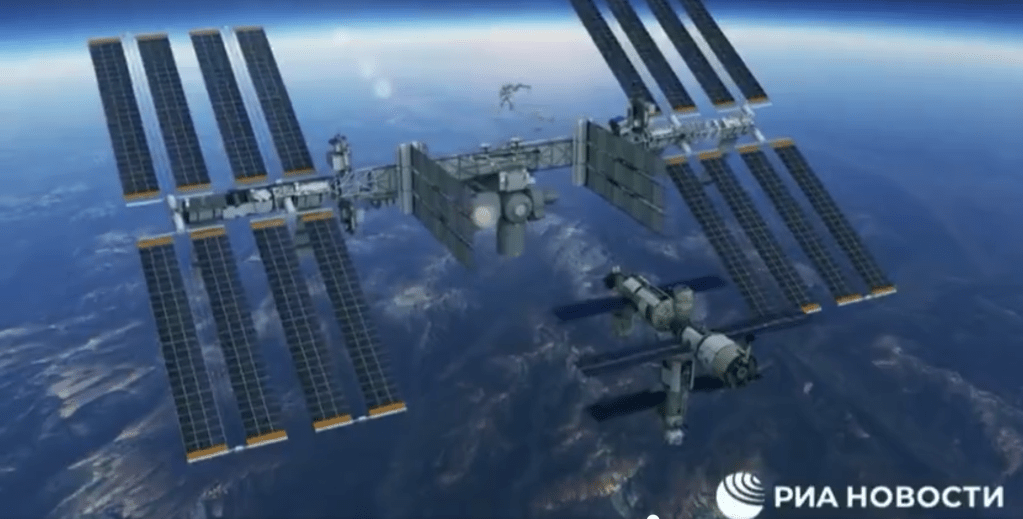
Source/Credit: International Space Station (ISS) from NASA.

“If you block cooperation with us, who will save the ISS from uncontrolled deorbiting and falling on US or European territory?”

–Dmitry Olegovich Rogozin, Director General of Roscosmos, commenting on US sanctions against Russia’s aerospace industry resulting from that country’s invasion of Ukraine this week. The ISS is expected to stay aloft until 2031, assuming everyone cooperates.

Is the U.S. Falling Behind in the Space Race?

Source/Credit: Yutu 2 rover on the dark side of the moon from the China National Space Administration.

As much as we talk about cooperation in space, it is always nice to be the first nation to pass a milestone, be it the first man on the Moon or the first probe of Pluto. The U.S. has plenty of great stories about space travel, as do the Russians, and now the Chinese are creating their own stories. For instance, China’s Yutu 2 rover was the first rover to explore the dark side of the Moon.

Now Politico magazine is worried about China taking the lead in some areas, as well as militarizing space. A recent article, “‘We’re falling behind’: 2022 seen as a pivotal lap in the space race with China,” discussed the race for the moon as well as delays in the U.S. spacecraft to get us there:

A linchpin of the NASA moon effort is the Space Launch System, the Boeing-built mega-rocket that has been beset by years of delay and cost overruns that is finally set to make its maiden test flight in 2022.

The U.S., Russia, and China all have designs on the moon:

The U.S. moon program has been enlisting international partners in the form of the Artemis Accords, which now includes more than a dozen countries. But Russia and China, which are pursuing a lunar research station, are also seeking partners.

We already know that the U.S. hopes to have astronauts on the Moon in 2024, so what are the Russian and Chinese schedules for their projects? It appears the two nations are working on a joint lunar research base scheduled for the 2030s. However, not everyone is convinced this will happen. A Foreign Policy article, “A Chinese-Russian Moon Base? Not So Fast,”voiced skepticism that the two nations can generate sufficient funding, technological know-how, and political unity to pull off such a mission, citing earlier joint attempts, including a Martian mission:

In 2007, China and Russia signed an agreement for “joint Chinese-Russian exploration of Mars,” culminating in a 2011 launch of a Mars orbiter and landing craft. However, the Russian rocket malfunctioned, causing Russian and Chinese spacecraft to come crashing back down to Earth, an embarrassing conclusion to both countries’ first attempt to reach the red planet.

The two nations seems to be even more unified against the U.S. since this Foreign Policy article was published, so anything is possible. However, the U.S. did pretty well in the 1960s and 1970s after initially trailing the Russians, so my money is still on the U.S. in this latest race.